
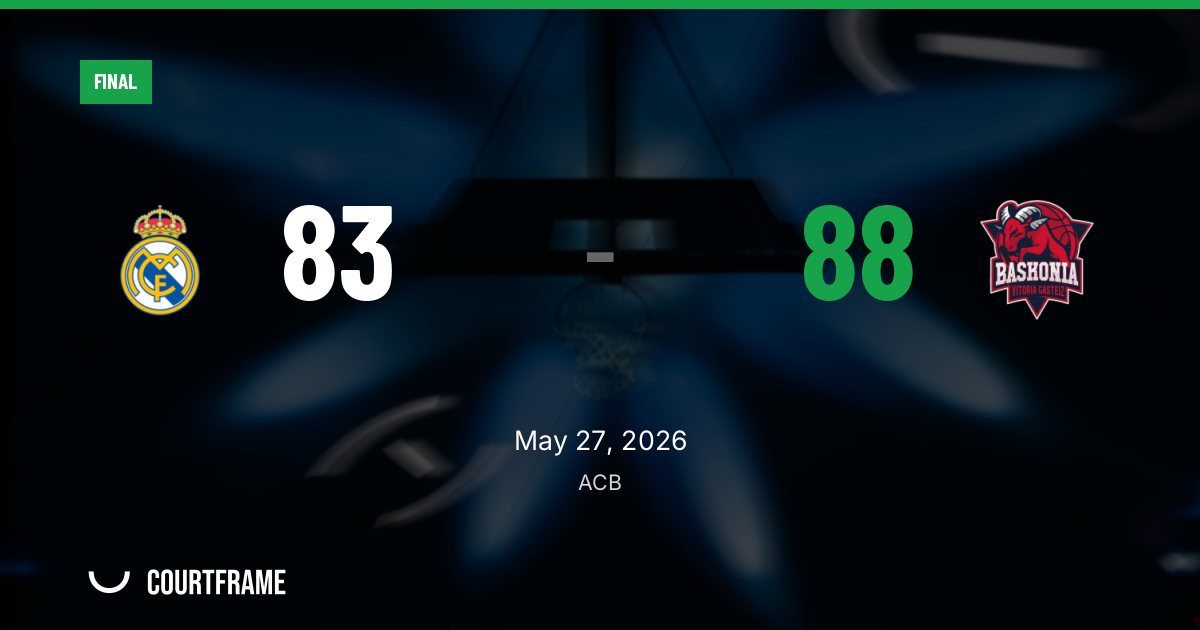
Baskonia arrived in Madrid as the hotter team and left with control of the series.
Behind a cleaner, sharper fourth quarter, Baskonia beat Real Madrid 88-83 on May 27 at Movistar Arena, taking a 2-0 lead in the best-of-seven ACB playoff matchup. Real Madrid had the home court, the deeper playoff résumé and the market’s slight backing. Baskonia had the better recent profile — and it traveled.
The final margin reflected the matchup’s defining split: Madrid generated enough offense to stay close, but Baskonia forced the game into possessions where execution mattered most. The visitors committed 12 turnovers to Madrid’s 17, finished with 10 steals and used a 24-17 fourth quarter to flip the game late.
Baskonia’s Form Carries Into Madrid
This result did not come from nowhere. Baskonia entered on a five-game winning streak, with the No. 1 CPI profile in the matchup at 100.00. Real Madrid, by contrast, came in with a 60.58 CPI, ranked eighth, and had lost four of its last five.
The market still leaned slightly toward Madrid, with an implied probability of 57.1 percent for the home side across 12 bookmakers. But the underlying indicators favored Baskonia’s efficiency. Over the previous 10-game sample, Baskonia had posted a 123.9 offensive rating and a 12.8 net rating, while Madrid carried a minus-1.7 net rating with a 120.6 defensive rating.
Those numbers showed up in the game’s pressure points. Madrid led 29-26 after the first quarter and 46-42 at halftime, but Baskonia never let the game separate. The visitors answered with a 22-20 third quarter, then controlled the fourth.
The Turnover Gap Decided the Game
Madrid’s biggest problem was not shot-making. It was possession control.
Real Madrid finished with 17 turnovers, continuing a trend that had been visible before tipoff. Its recent turnover rate sat at 20.7, and against Baskonia’s active hands, that became a decisive issue. Baskonia had 10 steals, two more than Madrid, and protected the ball well enough to keep its half-court rhythm intact.
The contrast was clear: Baskonia had 18 assists against 12 turnovers; Madrid had 16 assists against 17 turnovers. In a five-point playoff game, that gap was the difference between surviving on the road and wasting a winnable position at home.
Madrid did win the rebounding battle 33-29 and had more blocks, 4-3. But the extra work on the glass could not fully offset the empty possessions.
Shot Profile Kept Baskonia in Range
Baskonia’s offensive identity also held firm. The visitors entered with a 37.5 percent 3-point rate over the last 10-game sample and one of the strongest efficiency profiles in the matchup, including a 77.3 true shooting percentage and 72.2 effective field goal percentage.
Against Madrid, Baskonia made 11 3-pointers on 30 attempts and went 17-for-20 at the free-throw line. That combination gave the visitors enough scoring stability even when Madrid had stretches of control.
Real Madrid made 10 3-pointers on 27 attempts and shot 9-for-12 at the line. The home side was efficient enough to stay attached, but Baskonia’s additional free-throw volume and better ball security gave it the cleaner scoring base.
Madrid’s Experience Wasn’t Enough
Real Madrid entered with 14 games of playoff experience compared to Baskonia’s eight, and with no significant injuries reported on either side, this was a clean matchup between two of the ACB’s top regular-season teams. Madrid came in 26-7, Baskonia 24-9.
But experience did not solve Madrid’s late-game execution issues. The home team’s recent defensive concerns remained visible: Madrid’s last 10-game defensive rating was 120.6, and Baskonia found enough structure late to produce 24 fourth-quarter points.
For Baskonia, this was another confirmation of a team peaking at the right time. Its 66.7 percent away split and five-game winning streak translated into a composed road playoff performance. For Madrid, the concerns are sharper now: a fourth straight recent loss entering the matchup has become a 2-0 series hole.
What It Means
Baskonia now leads the series 2-0 and has taken both the momentum and the tactical edge. The visitors have been the cleaner team, the more efficient team and the better late-game team through the opening stretch of the series.
Madrid is not facing elimination yet, but the pressure has shifted dramatically. The next response must start with possession discipline. Against a Baskonia team forcing mistakes and converting enough from the perimeter and line, Madrid cannot afford another turnover-heavy performance.