
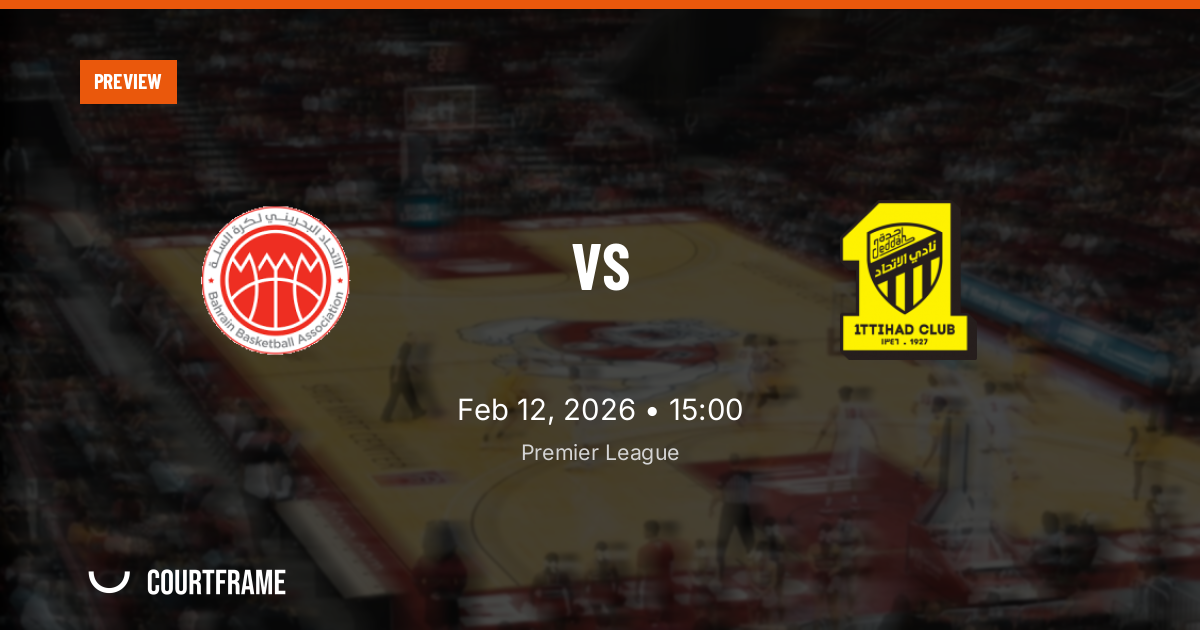
Game context
League: Premier League (2025–26)
Matchup: Bahrain Club (home) vs. Al Ittihad (away)
Date: February 12, 2026
Venue: TBD
Records and recent form: two teams moving in opposite directions
This game is defined by the starkest possible contrast in trajectory. Bahrain Club is 2–9 and currently on a five-game losing streak (LLLLL). Al Ittihad is 10–0 and riding five straight wins (WWWWW). In preview terms, that’s not just a gap in results—it’s a gap in week-to-week confidence, rotation stability, and the margin for error each team can tolerate.
Snapshot table
| Team | Record | Recent Form | Win % (to date) |
|---|---|---|---|
| Bahrain Club | 2–9 | LLLLL | 18.2% |
| Al Ittihad | 10–0 | WWWWW | 100.0% |
Probability lens: what the standings imply
With only the records available, the cleanest way to frame expectation is a baseline win-probability estimate derived from current win rates. Using a simple average of the teams’ win percentages as a neutral starting point, Al Ittihad’s implied edge is overwhelming: Bahrain Club is winning 18.2% of its games; Al Ittihad is winning 100.0%.
Custom metric: Baseline Expected Win Probability (BEWP)
Methodology: BEWP for Team A = (Win% of Team A) / (Win% Team A + Win% Team B). This is not a betting line or a predictive model with schedule strength; it’s a transparent “records-only” expectation.
| Team | Win % | BEWP |
|---|---|---|
| Bahrain Club | 18.2% | 15.4% |
| Al Ittihad | 100.0% | 84.6% |
Even with a deliberately conservative, records-only approach, Al Ittihad projects as the clear favorite. For Bahrain Club, the path to an upset is less about “playing better” in a generic sense and more about engineering a game state where a small number of possessions decide the outcome.
Matchup thesis: Bahrain Club must shrink the game
When an undefeated team meets a struggling side, the underdog’s most realistic strategy is to reduce variance exposure: fewer transition exchanges, fewer empty trips, fewer live-ball mistakes that create easy points. In practical terms, Bahrain Club’s best chance is to turn this into a possession-by-possession grind where late-clock execution and defensive rebounding decide the final margin.
What “shrinking the game” looks like in practice
Without player-level data, the tactical blueprint can still be framed clearly:
- Win the first five minutes: The goal isn’t a knockout—it’s to avoid early separation that forces Bahrain Club into higher-variance shot selection.
- Control the leverage possessions: End-of-quarter and end-of-game sequences disproportionately swing outcomes. Bahrain Club needs clean looks and set defenses in these windows.
- Make Al Ittihad play in the half court: Undefeated teams often punish mistakes with pace. Bahrain Club’s priority is to eliminate the “free points” portion of the opponent’s offense.
Al Ittihad’s advantage: consistency and error minimization
At 10–0 with a five-game winning streak, Al Ittihad has shown the most valuable trait in a long season: bankable outcomes. Undefeated records are rarely about perfection—they’re about consistently winning the middle of the game: the second and third quarters where focus can drift and rotations can wobble. Expect Al Ittihad to pressure Bahrain Club’s decision-making and look to convert small breakdowns into multi-possession runs.
Custom metric: Momentum Differential Index (MDI)
Methodology: MDI = (Current win-streak length) − (Current losing-streak length). It’s a simple proxy for psychological and rotational stability entering a game.
| Team | Streak | MDI |
|---|---|---|
| Bahrain Club | LLLLL | -5 |
| Al Ittihad | WWWWW | +5 |
The 10-point MDI gap doesn’t guarantee anything, but it underscores the likely game feel: Al Ittihad should be comfortable playing through mini-adversity, while Bahrain Club can’t afford extended droughts.
Key swing factors to watch
1) First-quarter shot quality vs. emotional shot selection
When a team is 2–9 and sliding, the temptation is to “answer back” quickly. That’s where games can tilt: rushed looks lead to runouts, and runouts lead to scoreboard pressure. Bahrain Club’s early patience matters.
2) Run management
Al Ittihad’s profile suggests it can stack wins by turning small edges into decisive stretches. Bahrain Club’s priority is to stop runs at one possession becoming three: timeouts, controlled possessions, and avoiding compounding errors.
3) Late-game composure
If Bahrain Club can keep the game within striking distance late, pressure shifts. An undefeated team has more to lose, and a struggling team can play freer. That’s the underdog’s best leverage point—keep the game close enough for variance to matter.
What to expect
On paper—based strictly on record and form—this projects as an Al Ittihad advantage game from the opening tip. The interesting question is not whether Bahrain Club can match Al Ittihad’s overall quality across 40 minutes; it’s whether Bahrain Club can create a slower, more deliberate contest where each possession is “priced” higher and the upset probability rises.
Prediction framework: If the game stays compact into the fourth quarter, Bahrain Club’s upset pathways multiply. If Al Ittihad generates early separation, the undefeated side’s consistency should take over.
Schedule note
Venue: TBD. If confirmed as a true home environment for Bahrain Club, it’s one of the few contextual levers that could nudge the game toward a more competitive script.