
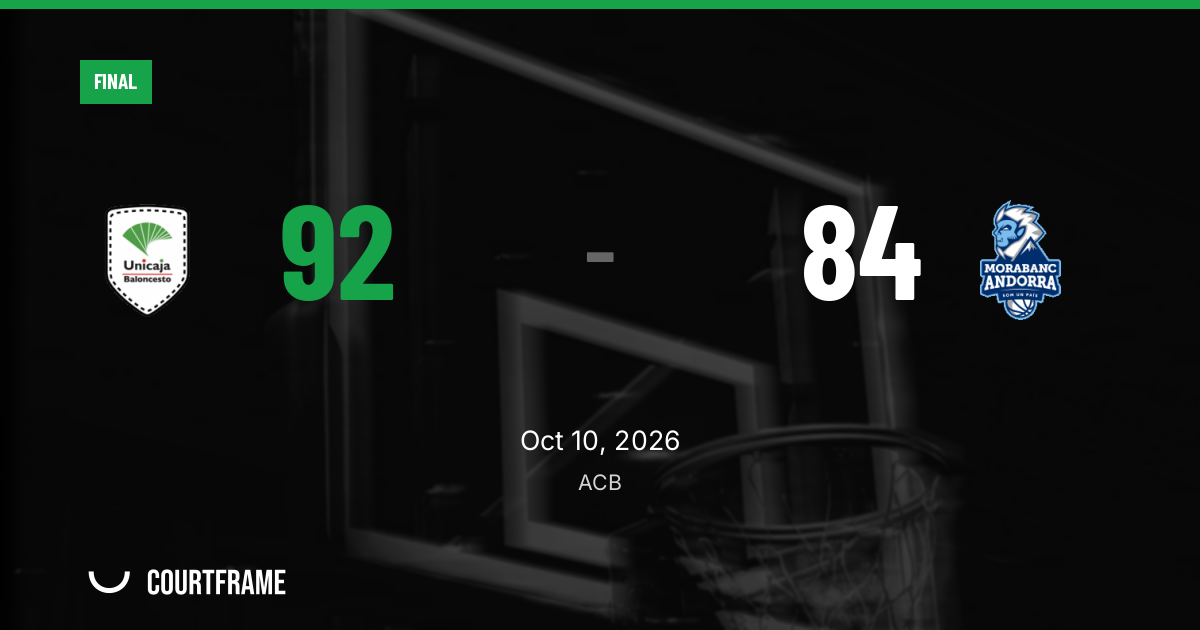
Unicaja defeated MoraBanc Andorra 92-84 on October 10, 2026, at Palacio de Deportes José María Martín Carpena, using a steady scoring profile across all four quarters to secure its first win of the ACB season.
The result moved Unicaja to 1-2 in Round 3 of the regular season, while MoraBanc Andorra fell to 0-2. Unicaja led 24-20 after the first quarter, extended the margin to 47-39 by halftime and answered Andorra’s 24-point third quarter with 25 points of its own. The home side closed the game with a 20-21 fourth quarter, enough to protect the advantage built earlier.
Unicaja’s depth showed in the possession battle
Unicaja won the game without a major turnover advantage. MoraBanc Andorra committed only eight turnovers, while Unicaja had 10. But the home team offset that with a stronger rebounding and defensive activity profile, finishing with 33 rebounds to Andorra’s 24, six steals to Andorra’s three and four blocks to Andorra’s one.
That nine-rebound edge mattered because Unicaja also generated more total shot volume. The home team attempted 63 field goals, making 34, while MoraBanc Andorra went 22-for-41. Unicaja’s ability to create more attempts helped neutralize Andorra’s efficient free-throw access and lower turnover count.
Unicaja also converted 13 of 15 free throws, a key stabilizer in an eight-point game. MoraBanc Andorra made 14 of 19 at the line, but the visitors could not pair that with enough perimeter accuracy, finishing 6-for-21 from three-point range.
Perimeter volume favored Unicaja, even without elite accuracy
Unicaja entered the game with a high three-point rate through three games, and that shot profile carried into the night. The home team attempted 31 threes and made nine, compared with Andorra’s 6-for-21 mark from deep. Neither side overwhelmed the game from the arc, but Unicaja’s willingness to keep spacing the floor created enough pressure to support a 92-point performance.
The contrast was especially important because both teams came in with similar scoring averages: Unicaja at 84.7 points per game and MoraBanc Andorra at 84.5. Andorra reached its season scoring level almost exactly with 84 points, but Unicaja exceeded its early-season average by more than seven points.
Unicaja’s 13 assists on 34 made field goals reflected a game driven more by shot creation and possession volume than heavy passing. MoraBanc Andorra finished with 12 assists on 22 made field goals, but its lower field-goal attempt total limited the impact of that distribution.
Pre-game indicators pointed toward Unicaja, and the result followed
Unicaja entered as the stronger side by CourtFrame Power Index, carrying a 20.34 mark and ranking 13th, compared with MoraBanc Andorra’s 12.88 and 16th-place ranking. The 7.5-point differential aligned with the final margin, as Unicaja won by eight.
The market also leaned heavily toward the home side, with Unicaja carrying an 82.3 percent implied probability across eight bookmakers. The final score matched that expectation, though Andorra remained competitive for all four quarters and scored at least 19 points in every period.
Rest was not a limiting factor for either roster. Unicaja had seven days rest and one game in the previous seven days, while MoraBanc Andorra had 14 days rest and no games in that span. Both teams entered with no significant injuries reported, so the matchup was decided more by execution and roster balance than availability.
Andorra’s guard-center structure kept it close
MoraBanc Andorra arrived with J. Akinjo averaging 14.5 points and 9.5 assists through two games, while Artem Pustovyi averaged 12.5 points and 7.5 rebounds. That inside-out structure helped the visitors maintain offensive rhythm, especially in the third quarter, when Andorra scored 24 points.
But Andorra’s rebounding deficit was difficult to overcome. Pustovyi and Leon Radosevic entered as the team’s main frontcourt producers, with Radosevic averaging 9 points and 5 rebounds, yet Unicaja’s collective size and activity controlled the glass. Amine Noua came in averaging 15 points and 7.7 rebounds, while Willy Hernangomez entered at 10 points and 6 rebounds, giving Unicaja multiple frontcourt pressure points.
Unicaja also had a broader scoring base entering the game, with Kendrick Perry averaging 13.3 points and 3.7 assists, Ignas Brazdeikis averaging 12.3 points and Cameron Hunt averaging 11.3 points. That balance showed in a game where the home team produced 92 points without needing to dominate a single statistical category beyond the glass and defensive events.
What the result means
For Unicaja, the win corrected an early-season defensive concern by pairing 92 points with enough stops, rebounds and rim protection to close out a home game. The team had allowed 114.6 points per 100 possessions through three games, but in this matchup it held Andorra to 84 points and limited the visitors to six made threes.
For MoraBanc Andorra, the 0-2 record does not fully capture the competitiveness of the performance. The visitors protected the ball, reached the line 19 times and won the fourth quarter by one point. The issue was the accumulation of smaller margins: fewer rebounds, fewer blocks, fewer steals and 22 fewer field-goal attempts.
Unicaja’s 92-84 victory was not built on one decisive run. It was built on four quarters of scoring consistency, a 33-24 rebounding advantage and enough defensive disruption to keep MoraBanc Andorra from turning efficiency into control.