

The Minnesota Timberwolves did not enter Game 2 with the cleaner résumé, the stronger market backing or the rest advantage. They left Frost Bank Center with control of the series.
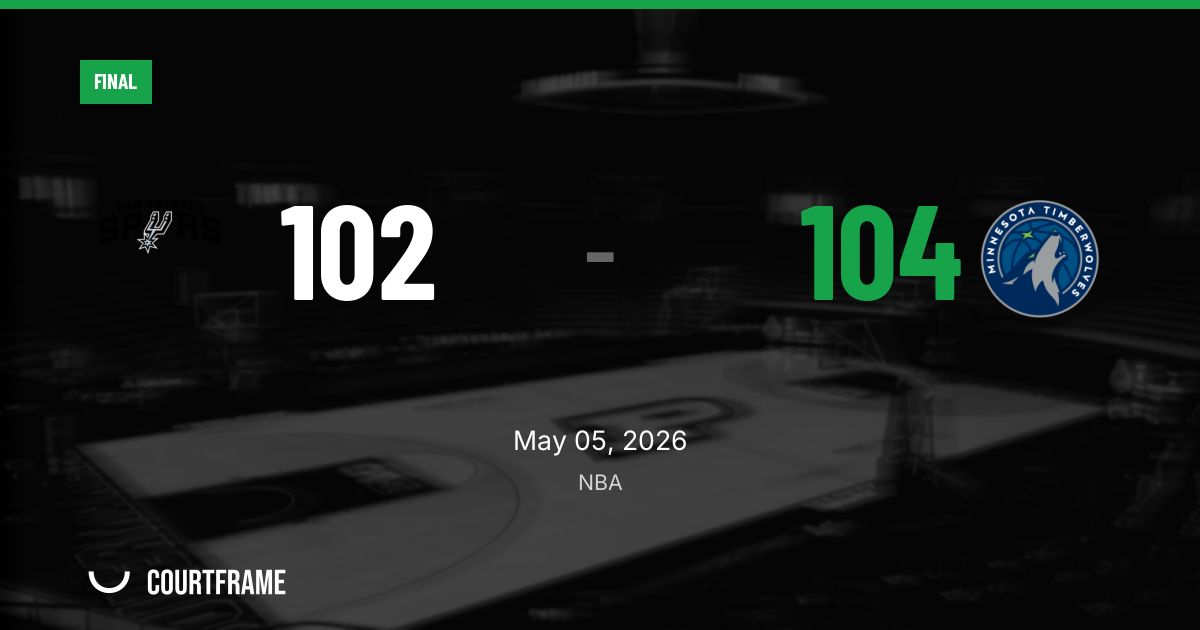
Minnesota beat San Antonio 104-102 on May 5, riding a 35-point fourth quarter to take a 2-0 lead in the best-of-seven quarter-finals. The Timberwolves trailed by three entering the final period after San Antonio won the third quarter 27-24, but the game turned late as Minnesota generated its best offensive stretch of the night at the exact moment the Spurs needed stops.
For San Antonio, the loss was damaging because it came in a spot that strongly favored the home side. The Spurs entered 62-20, had six days of rest, were 18-5 at home and carried a 77.64 CourtFrame Performance Index, fourth in the league. Minnesota came in 49-33, on four days of rest and with a 56.57 CPI ranked 11th. The market reflected that gap, giving San Antonio an 83.2 percent implied probability across six bookmakers.
None of that held once the fourth quarter arrived.
Minnesota’s fourth quarter flips the game
The first three quarters were tight but controlled at San Antonio’s preferred margin. Minnesota led 24-23 after the opening quarter, the teams played to a 45-45 tie at halftime, and the Spurs moved ahead 72-69 through three.
Then Minnesota scored 35 in the fourth, its highest-scoring quarter of the night, while San Antonio answered with 30. In a game decided by two points, that five-point final-period swing was the difference between the Spurs evening the series and the Timberwolves leaving Texas with a commanding advantage.
The late burst also ran counter to the pregame statistical indicators. Over the most recent 10-game sample, San Antonio had the better defensive profile, with a 110.7 defensive rating compared to Minnesota’s 114.1. The Spurs also carried a stronger net rating at plus-6.6, while the Timberwolves entered at plus-4.0. But Game 2 was not decided by season-long hierarchy. It was decided by execution under pressure, and Minnesota’s offense found enough late answers to erase San Antonio’s edge.
Spurs’ advantages did not produce separation
San Antonio’s offensive profile suggested a team built to dictate terms. The Spurs entered averaging 119.8 points per game on the season and had a 117.3 offensive rating over the recent 10-game sample, with a 70.5 true shooting percentage, 66.7 effective field goal percentage and an 88.4 assist rate.
But Game 2 never became the kind of high-control, high-margin performance those numbers implied. San Antonio scored 102, well below its season scoring average, and never created the sustained cushion expected from a 62-win team at home. The Spurs’ 30-point fourth quarter was enough to keep pressure on Minnesota, but not enough to cover for a defense that gave up 35 in the same period.
The matchup also narrowed in areas where San Antonio typically holds subtle advantages. The Spurs entered with a 51.5 rebound percentage, nearly identical to Minnesota’s 51.4, and a stronger recent assist profile. Yet the final score reflected a game played in Minnesota’s comfort zone: close, possession-by-possession and decided late rather than by San Antonio’s depth of advantages.
Timberwolves overcome injury uncertainty
Minnesota’s win was even more significant given its pregame availability concerns. Donte DiVincenzo was out with a right Achilles tendon injury, while Anthony Edwards was listed questionable with a left knee issue and Ayo Dosunmu questionable with a right calf issue.
That mattered because Edwards entered as Minnesota’s leading scorer at 27 points per game, while Dosunmu was another major offensive piece at 15.6 points per game. Julius Randle, Jaden McDaniels and Bones Hyland also entered as key rotation scorers, but the broader concern was whether Minnesota could sustain enough creation on the road against a top-four CPI opponent.
The answer came in the fourth quarter. The Timberwolves did not need to win the full statistical profile. They needed one elite closing stretch, and they delivered it.
Series pressure shifts sharply to San Antonio
This was not an elimination game, but the series context is now severe for the Spurs. Minnesota entered Game 2 already leading 1-0, and the road win pushes the Timberwolves ahead 2-0 in a best-of-seven series.
For San Antonio, the concern is not just the deficit. It is how the deficit was built. The Spurs had the better record, the better home split, the higher CPI, more rest and a clear pregame market edge. They also had the league’s most disruptive matchup presence in Victor Wembanyama, who entered averaging 25.2 points, 11.7 rebounds and 3.3 assists, alongside De’Aaron Fox and Stephon Castle as primary creators.
Still, Minnesota found the cleaner finishing kick. The Timberwolves’ road split entering the night — 13-9 with 116.5 points per game — suggested competence away from home, not dominance. But in Game 2, competence was enough until the fourth quarter, when they produced the game’s defining run.
San Antonio now faces the task of turning its superior regular-season indicators into playoff wins. Minnesota has already turned two games into a series lead, and Game 2 made the message clear: the Timberwolves are not waiting for the matchup model to validate them.