

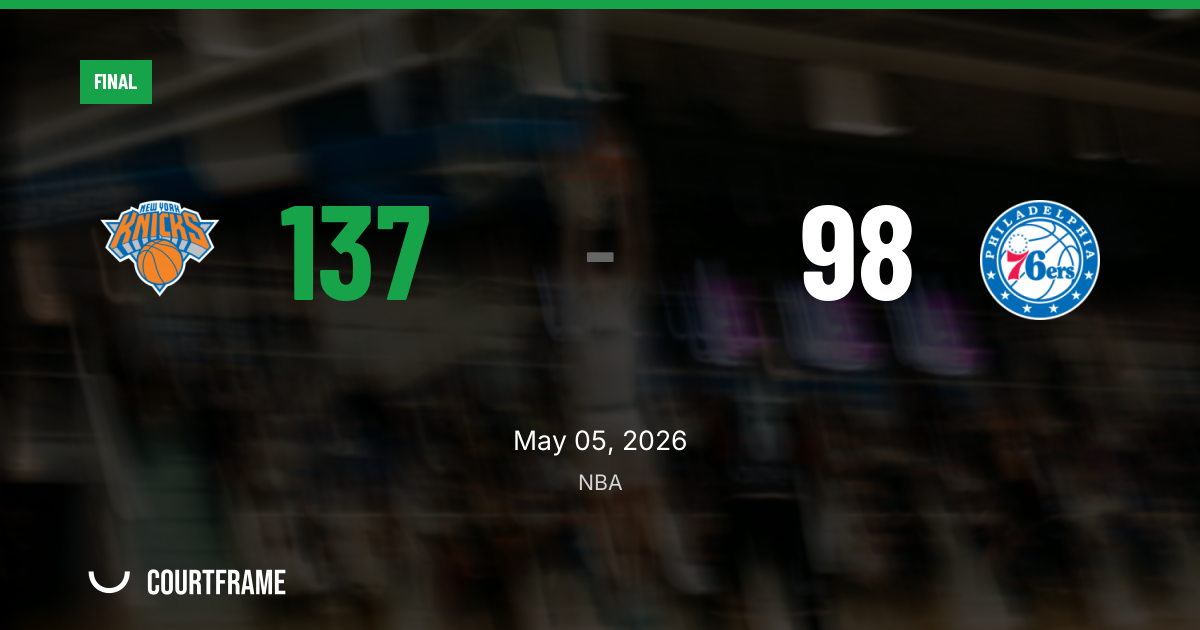
The Knicks did not just protect home court. They detonated Game 2.
New York beat Philadelphia 137-98 on May 5 at Madison Square Garden, moving ahead 2-0 in the NBA quarterfinals with a performance that matched the profile it carried into the night: sharper offense, stronger recent form, cleaner spacing and a deeper statistical foundation. The Knicks led by eight after the first quarter, stretched the margin with a 41-point second and never gave the 76ers a real path back.
By the end, the numbers told a simple story. New York made 19 3-pointers on 37 attempts, assisted on 34 baskets, won the rebounding battle 39-28 and forced Philadelphia into 19 turnovers. The 76ers had no significant injuries reported, but they looked like the more fatigued team on two days of rest and their third game in seven days. The Knicks, coming off four days of rest, played with the pace and precision of a team in full control.
New York’s offensive profile translated immediately
The pregame data pointed to a major efficiency gap, and Game 2 made it visible. Over the previous 10-game sample, the Knicks entered with a 123 offensive rating, 73.6 true shooting percentage, 71 effective field-goal percentage and an 86 assist rate. Those indicators showed up in the way New York generated clean looks and consistently turned Philadelphia rotations into open shots.
The Knicks’ 19-for-37 shooting from 3 was the clearest separator. Philadelphia made 11 3s on 30 attempts, which left the 76ers chasing math all night. New York did not need to live at the foul line, either, finishing 12-for-17 on free throws while Philadelphia went 27-for-34. The home team built a 39-point win despite Philadelphia holding a major edge in free throw makes.
That is usually a warning sign for the losing team. The 76ers got to the line, but they could not control the rest of the game. New York’s spacing, passing and shot volume overwhelmed them.
The decisive stretch came early
Philadelphia survived the first quarter well enough, trailing 33-25. Then the game broke open.
The Knicks scored 41 points in the second quarter, turning an eight-point edge into a 74-51 halftime lead. The 76ers had scored 25 and 26 points in the first two quarters, but they could not get enough stops to keep the game within reach. New York added 35 more in the third, and by then the matchup had lost its tension.
The quarter-by-quarter flow reflected the broader gap between the teams coming in. New York entered Game 2 with a 53-29 record, a 76.2 home win percentage in its split sample and four wins in its last five games. Philadelphia arrived at 45-37, below .500 in its away split sample and on a three-game losing streak. The market priced the Knicks as a 71.1 percent implied winner, and the game played even more one-sided than that.
Ball movement punished Philadelphia’s defense
The Knicks finished with 34 assists to Philadelphia’s 15. That was not a cosmetic difference. It defined the game.
New York entered with a major assist-rate advantage over the previous 10-game sample, and the 76ers never disrupted the rhythm enough to turn the game into isolation-heavy possessions. Jalen Brunson’s regular-season profile as a 24.6-point, 7.5-assist engine gave the Knicks the foundation. Karl-Anthony Towns’ 19.6 points and 11.8 rebounds per game added the frontcourt pressure. OG Anunoby, Mikal Bridges and Josh Hart gave New York enough two-way balance to keep the floor spaced and the defensive matchups flexible.
Philadelphia’s core had more than enough scoring pedigree on paper, led by Joel Embiid at 28.1 points per game, Tyrese Maxey at 25.3 and Paul George at 19.9. But the 76ers’ offensive possessions were too often disconnected. Fifteen assists against 19 turnovers is not a formula that travels in the playoffs, especially against a Knicks team that came in averaging 9.2 steals across its recent 10-game sample.
Turnovers and the glass closed the door
New York’s defense did not just hold Philadelphia under control. It created extra possessions and denied the 76ers the kind of volume needed to trade baskets.
The Knicks recorded 10 steals and six blocks. The 76ers finished with six steals and one block. New York also controlled the glass 39-28, aligning with a pregame rebounding edge reflected in the Knicks’ 53.2 rebound percentage over their recent sample compared with Philadelphia’s 47.
The turnover count was another critical separator. Philadelphia committed 19. New York committed 15. The difference was not only the raw number, but the timing and impact. When the Knicks made runs, they were fueled by stops, deflections and fast decisions on the other end. Philadelphia’s giveaways repeatedly prevented the game from settling into a half-court duel where Embiid, Maxey and George could dictate terms.
Rest and depth mattered
The schedule context favored New York, and the game reflected it. The Knicks had four days of rest and had played two games in the previous seven days. Philadelphia had two days of rest and was playing its third game in seven days.
New York looked fresher in the middle quarters, where playoff games are often decided. The Knicks outscored the 76ers 76-53 across the second and third quarters, the stretch that turned Game 2 from competitive to over. Philadelphia’s fourth-quarter output dipped to 20 points, while New York still added 28 despite the outcome being settled.
The injury report also offered no easy explanation for Philadelphia. The 76ers had no significant injuries reported. Jeremy Sochan was listed as questionable for New York with a left hamstring issue, but the Knicks’ collective execution rendered the availability note secondary to the broader mismatch.
A result that matched the indicators — and raised the stakes
This was not an upset, and it was not a coin-flip game that got away from Philadelphia. The Knicks came in with a superior CPI profile — 80.41, ranked third, compared with Philadelphia’s 50.96, ranked 14th — and a 29.4 differential. Their recent net rating was plus-13.8. Philadelphia’s was minus-9.5.
Game 2 turned those indicators into a 39-point playoff win.
New York now leads the best-of-seven series 2-0. The 76ers still have high-end talent and more listed playoff experience, but they leave Madison Square Garden with urgent questions: how to protect the ball, how to close out to New York’s shooters, how to win the possession game and how to keep the Knicks from turning every defensive breakdown into an assisted 3.
For the Knicks, the message was louder and cleaner. Their regular-season strength at home, recent form and advanced-metric edge were not just predictive. They were explanatory. Game 2 was the version of New York that can dictate a series.