

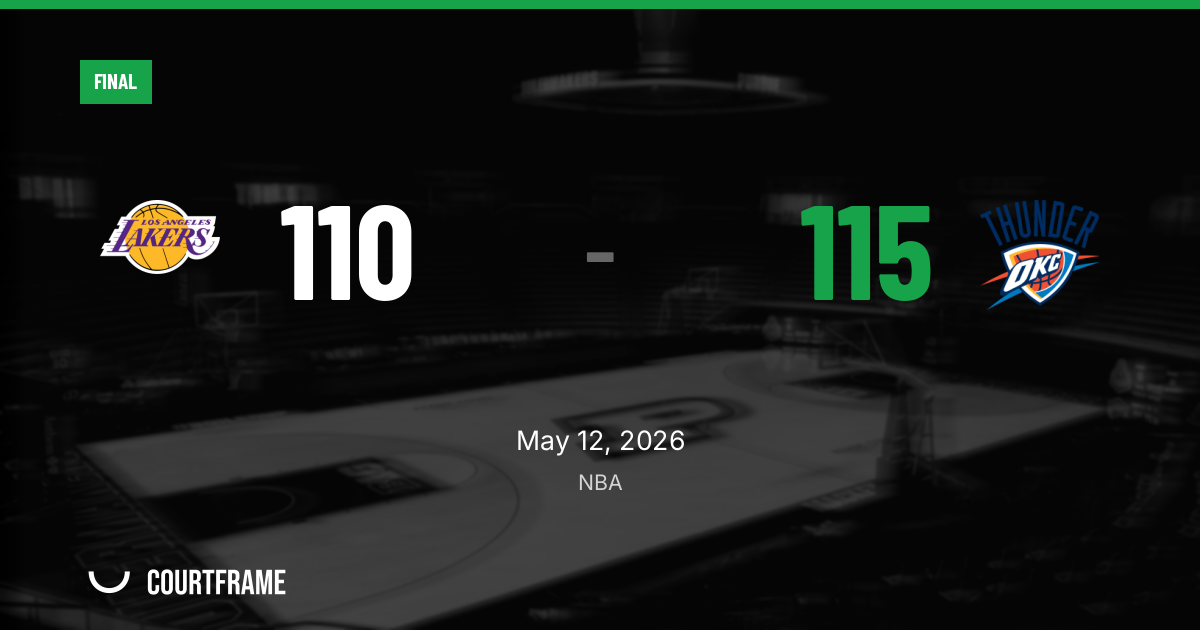
Oklahoma City entered Crypto.com Arena with the profile of a No. 1 contender and left with the result to match it.
The Thunder beat the Lakers 115-110 on Tuesday night, finishing off a 4-0 quarter-finals series sweep and turning a tight Game 5 into another data point in a matchup that consistently favored Oklahoma City’s efficiency and pressure. The Lakers, playing without Luka Doncic because of a left hamstring injury, led after the first quarter and erupted for 39 points in the third. It still was not enough.
Oklahoma City won the fourth quarter 35-26, the decisive stretch in a game that demanded late-game execution. The Thunder trailed 26-21 after one, steadied themselves with a 28-19 second quarter, absorbed the Lakers’ third-quarter burst, then closed with the kind of composure that reflected the pregame indicators.
Thunder’s pressure decided the margins
The clearest separator was possession quality. Oklahoma City committed 12 turnovers while forcing 19 from Los Angeles, a gap that became even more important in a five-point game. The Thunder also generated 12 steals; the Lakers had three.
That defensive activity tracked with the profile Oklahoma City brought into the matchup. Over the prior 10-game sample provided, the Thunder averaged 10.2 steals and carried a 16.4 turnover rate, compared with the Lakers’ 22.5 turnover rate. In Game 5, that weakness was not hidden. Los Angeles had enough scoring to push Oklahoma City, but the Lakers repeatedly had to overcome empty possessions.
The Lakers finished with 18 assists against 19 turnovers. Oklahoma City had 19 assists against 12 turnovers. In a closeout game, that difference was the backbone of the Thunder’s win.
Los Angeles found a third-quarter answer — but not a fourth-quarter one
The Lakers’ best stretch came in the third quarter, when they scored 39 points and turned the game back in their direction. Without Doncic, that was the kind of response Los Angeles needed: aggressive, efficient and forceful enough to make Oklahoma City play from pressure.
But the Thunder’s fourth quarter exposed the limits of that formula. Oklahoma City scored 35 in the final period, its highest-scoring quarter of the night, after producing 21, 28 and 31 over the first three. The Lakers, after their 39-point third, managed 26 in the fourth.
That swing aligned with the broader matchup. Oklahoma City entered with a 127.5 offensive rating and a plus-15.5 net rating over the listed 10-game sample. Los Angeles entered at 105.5 offensively with a minus-7.6 net rating. The Lakers had the home floor, but the Thunder had the stronger possession profile and the cleaner late-game pathway.
Injuries reshaped the star hierarchy
The series closeout came with major absences on both sides. Doncic was out for Los Angeles, removing a player listed at 33.6 points, 7.7 assists and 7.6 rebounds per game. Oklahoma City was without Jalen Williams, listed at 18.2 points, 5.1 assists and 4.2 rebounds, as well as Thomas Sorber.
The difference was structural. The Lakers were missing their highest-usage offensive engine. LeBron James and Austin Reaves entered as the next primary creators, both carrying major regular-season scoring and playmaking responsibilities, but the Thunder could still lean on Shai Gilgeous-Alexander, Chet Holmgren, A. Mitchell and Isaiah Joe within a system that had been producing elite efficiency.
Oklahoma City’s depth of creation mattered. The Thunder came in averaging 119 points per game for the season and 118.1 on the road split provided. Even short-handed, they had enough offensive balance to survive a road closeout setting.
Efficiency and expectations matched the outcome
The market leaned heavily toward Oklahoma City before tipoff, with an 81 percent implied probability across 12 bookmakers. The CourtFrame Power Index told the same story: Oklahoma City entered No. 1 with a CPI of 100.00, while Los Angeles sat 12th at 54.04, a differential of minus-46 from the Lakers’ perspective.
The final score was closer than those indicators suggested, but the result was consistent with them. Oklahoma City had the better season record at 64-18 compared with Los Angeles’ 53-29, the stronger road split at 17-5 and the superior recent advanced profile.
The Lakers did win the rebounding battle 37-34 and got to the line often, going 24-for-27 on free throws. They also made 10 3-pointers. But Oklahoma City shot 31-for-50 from the field, made 11 3-pointers and converted 20 of 24 free throws. The Thunder did not need a blowout formula. They needed enough scoring efficiency, enough forced mistakes and enough late execution.
What the sweep says
This was not a one-possession escape that contradicted the matchup. It was a close game that reinforced it.
Los Angeles had playoff experience, home-court urgency and a real third-quarter push. But without Doncic, the Lakers’ margin for error was thin, and their turnover issues gave Oklahoma City too many transition points of leverage even without a dominant rebounding night.
For the Thunder, the 115-110 win was a professional closeout: withstand the run, win the fourth, protect the ball and let the better full-series profile show through. Oklahoma City advanced because its strengths traveled — and because when the game tightened, the Thunder were the cleaner team.