

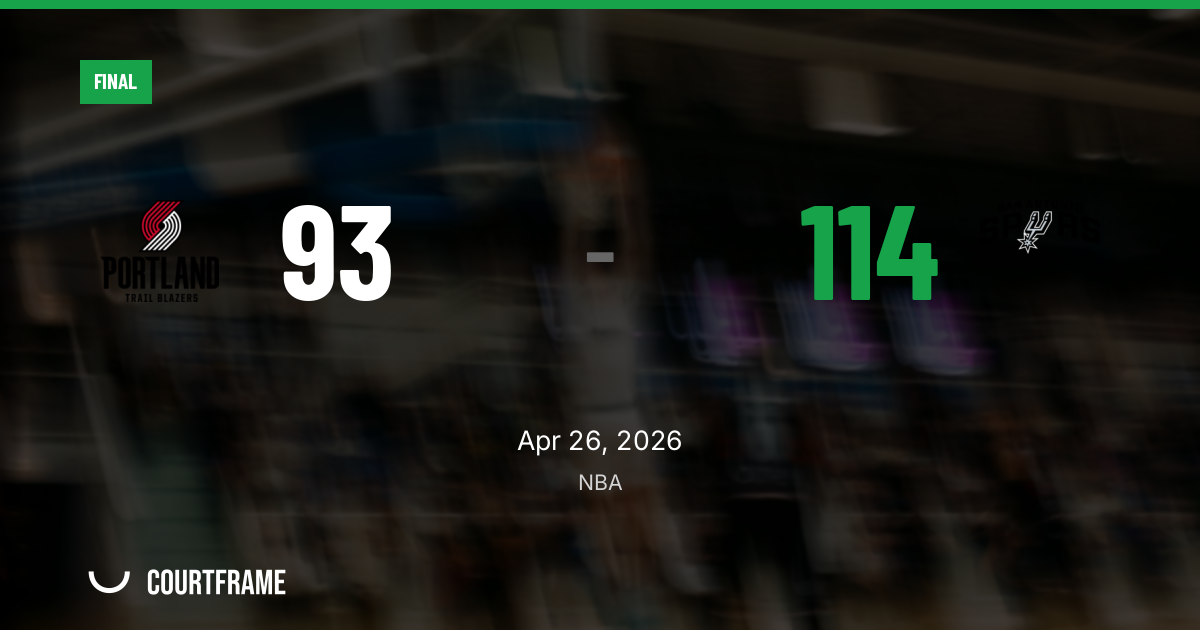
PORTLAND — The San Antonio Spurs did not just survive an elimination-game road environment. They took it apart after halftime.
Down 58-41 at the break, San Antonio overwhelmed Portland with a 33-16 third quarter and a 40-19 fourth, closing Game 5 with a 114-93 win at Moda Center to finish the first-round series. The Spurs entered with a 3-1 series lead and a clear statistical profile as the stronger team. By the end, the data matched the result: better shot creation, cleaner decision-making and a defensive gear Portland could not answer without Damian Lillard.
The Trail Blazers, playing with their season on the line, owned the first half. They led 25-23 after one quarter and exploded for 33 points in the second. But the game flipped completely after halftime. Portland managed only 35 points over the final two quarters, while San Antonio scored 73 and controlled the closing stretch with the poise of a 62-win team.
San Antonio’s defense changed the game
The Spurs’ second-half rally started with pressure. San Antonio finished with 12 steals and 10 blocks, turning the game into a half-court grind for a Portland offense already missing Lillard because of a left Achilles tendon injury.
Portland’s offensive profile showed the strain. The Blazers had 18 turnovers against only 14 assists, a damaging ratio in an elimination game. San Antonio, by contrast, posted 26 assists with 13 turnovers, a cleaner and more connected performance that became more pronounced as the game tightened.
That gap reflected a pregame indicator. Over the previous 10 games analyzed, San Antonio had the better turnover rate, offensive rating and net rating. The Spurs entered with a 117.2 offensive rating and plus-7 net rating in that sample. Portland came in at 113 and plus-3.7. The difference showed up when the first-half emotion faded and execution mattered most.
The third quarter broke Portland
The decisive stretch came immediately after halftime. San Antonio’s 33-16 third quarter erased Portland’s advantage and shifted the pressure back onto the Blazers. What had been a controlled Portland game became a possession-by-possession test against a Spurs team with more creation points and more defensive playmaking.
San Antonio’s 3-point volume was central to the comeback. The Spurs shot 14-for-33 from beyond the arc, while Portland went 10-for-31. The difference was not only accuracy but timing. San Antonio’s spacing stretched Portland’s defense in the second half, creating cleaner passing windows and forcing longer closeouts.
The Spurs also held up on the glass, finishing with 40 rebounds to Portland’s 39. That mattered because Portland had little margin elsewhere. The Blazers got to the line, making 19 of 23 free throws, but San Antonio’s overall balance — 29-for-54 from the field, 14 made 3s and 26 assists — gave the visitors a broader path to points.
Portland’s Lillard absence loomed late
The Trail Blazers entered the night already facing elimination and doing so without Lillard. That absence was always going to sharpen late-game questions: Who organizes possessions when San Antonio loads up? Who generates efficient looks when the first option is cut off?
For a half, Portland found enough answers. The Blazers’ 58 first-half points suggested their supporting cast had enough rhythm to extend the series. But after halftime, San Antonio’s pressure exposed the lack of a steadying on-ball hub. Portland’s 14 assists against 18 turnovers told the story of an offense that lost its structure as the Spurs raised the force level.
Deni Avdija, Jrue Holiday, Jerami Grant, Scoot Henderson and Toumani Camara had carried much of Portland’s scoring profile entering the game, but the matchup demanded sustained half-court creation across four quarters. Without Lillard, Portland could not keep the same shot quality or pace once San Antonio’s defense settled in.
Result followed the pregame market and matchup data
This was not an upset by profile. The market gave San Antonio a 65.1 percent implied probability entering the game, and the broader matchup data leaned heavily toward the Spurs. CourtFrame’s CPI matchup had San Antonio at 78.08, ranked sixth, compared with Portland at 50.29, ranked 31st, a differential of minus-27.8 from the Blazers’ perspective.
San Antonio’s road strength also stood out. The Spurs entered with a 17-3 away split and 121.7 average points in those games. Portland had been solid at home, with an 11-8 split and 118.2 average points, but this matchup required more than home-court energy. It required four quarters of execution against a team built to punish mistakes.
The fatigue factor was even. Both teams had one day of rest and were playing their third game in seven days on a back-to-back sequence. That made the second-half separation more revealing. San Antonio looked like the team with more ways to win; Portland looked like the team running out of counters.
Spurs advance with a statement close
San Antonio’s Game 5 win was not clean from start to finish, but it was authoritative where it mattered. The Spurs trailed by 17 at halftime in a hostile building, then won the second half by 38 points. That kind of swing is not just a hot stretch. It is a reflection of defensive disruption, offensive depth and playoff composure.
For Portland, the season ends with the reality of a compromised roster and an offense that could not withstand San Antonio’s second-half pressure. The Blazers showed enough early fight to make Game 5 uncomfortable. The Spurs showed why they were the higher seed, the market favorite and the more complete team.
San Antonio moves on. Portland exits. And the defining image of the series is the one the Spurs delivered in Game 5: a dominant closing half that turned elimination pressure into a rout.