

Boston did not leave the door open.
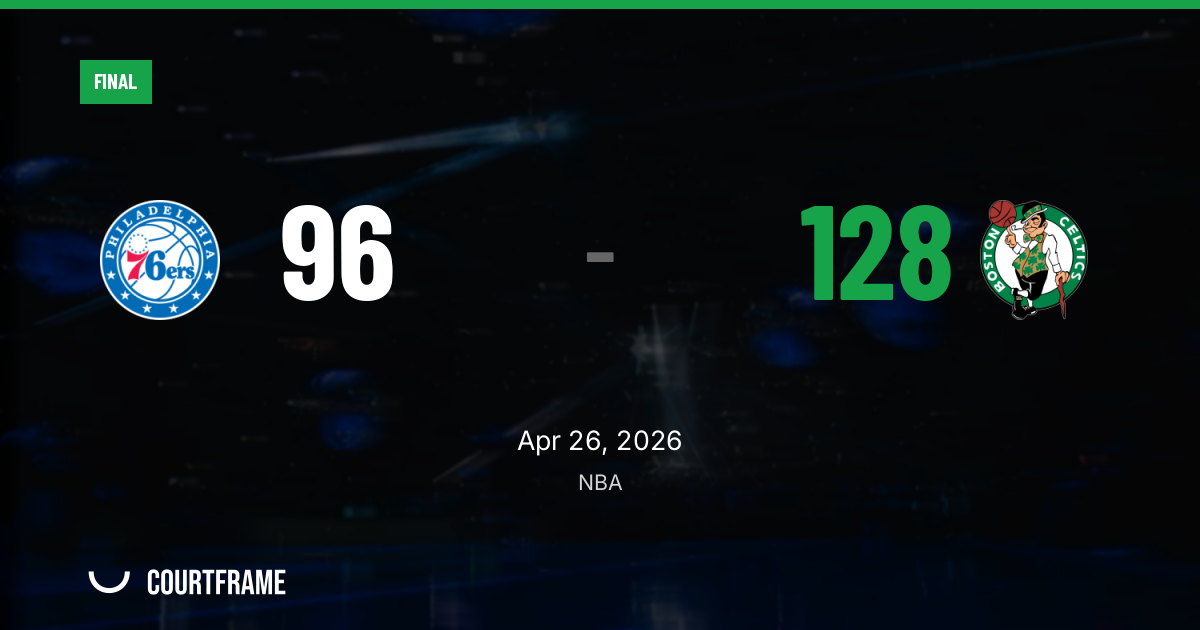
The Celtics closed out their first-round series Sunday at Xfinity Mobile Arena with a 128-96 win over the Philadelphia 76ers, eliminating the Sixers in Game 5 and advancing after taking the series 4-1. In an elimination game for Philadelphia, Boston landed the first punch, controlled the glass and turned the third quarter into the stretch that removed any suspense.
The result matched the pregame indicators. Boston entered with a 56-26 record, a 3-1 series lead, no significant injuries reported and a market implied win probability of 71.3 percent. Philadelphia, 45-37, came in with Joel Embiid listed as doubtful and Kelly Oubre Jr. questionable with a right adductor issue. The matchup already tilted toward the Celtics. By the final buzzer, it had become a blowout.
Boston’s Shot Profile Decides the Night
The Celtics won this game with volume, spacing and pressure from the perimeter. Boston attempted 53 3-pointers and made 24 of them, a decisive contrast against Philadelphia’s 9-for-30 night from deep. That 15-make gap from 3-point range created the mathematical separation the Sixers never solved.
Boston’s postseason offense looked like the same unit that had been trending well entering the game. Over the previous 10-game sample provided, the Celtics carried a 128.6 offensive rating, a 78.7 effective field goal percentage and a 39.5 percent mark from 3. Against Philadelphia, the formula translated directly: spread the floor, generate attempts and force the Sixers to keep pace possession after possession.
Philadelphia actually kept its turnover count low with only eight giveaways and finished with 25 assists, but the clean ball security did not offset the shot-value gap. Boston turned 28 assists into a broader offensive rhythm, and its willingness to lean into the 3-point line defined the game.
The First Quarter Set the Terms
Boston’s 34-18 opening quarter put Philadelphia in immediate chase mode. In a closeout setting, that mattered. The Sixers needed early leverage at home, particularly with their injury report already threatening their margin for error. Instead, Boston established pace, spacing and control before Philadelphia could settle in.
The 76ers did stabilize briefly in the second quarter, holding Boston to 22 points while scoring 20. But that only kept the deficit manageable, not meaningful. The Celtics still went into halftime with control, then delivered the decisive surge after the break.
The third quarter was the knockout: Boston 39, Philadelphia 36. The Sixers produced their best offensive quarter of the night, but still lost ground. That sequence captured the core problem. Philadelphia could score in spurts, but Boston’s shot-making ceiling was higher, and the Celtics’ possessions carried more force.
Rebounding Margin Removes the Comeback Path
The glass was another separator. Boston finished with 51 rebounds to Philadelphia’s 30, a 21-rebound advantage that repeatedly denied the Sixers the kind of extended momentum an elimination game requires.
That edge also aligned with the pregame advanced profile. Boston entered with a 55.0 rebound percentage over the analyzed sample, compared with Philadelphia’s 47.1. In Game 5, the Celtics’ physical advantage became one of the clearest statistical themes of the night.
Philadelphia had defensive activity — six steals and seven blocks — but those plays did not translate into enough control of the game. Boston committed 12 turnovers, yet the Celtics’ rebounding and perimeter efficiency gave them enough cushion to absorb mistakes.
Injuries Tightened Philadelphia’s Margin
The Embiid factor hung over the series finale before tipoff. He entered the game listed as doubtful, and Philadelphia’s top-end identity was compromised against a fully available Boston roster. Embiid’s season profile — 29.2 points, 8.6 rebounds and 4.5 assists over 12 games — represented the kind of production the Sixers needed to pressure Boston’s defense and change the geometry of the series.
Oubre’s questionable status added another layer. His season line of 13.6 points and 5.4 rebounds over 31 games would have mattered in a matchup where Philadelphia needed size, transition pressure and secondary scoring. The Sixers had enough creation on paper with Tyrese Maxey and Paul George, but Boston’s depth and continuity were better suited for a closeout game.
The Celtics entered with Jaylen Brown averaging 27.4 points, 7.1 rebounds and 5.2 assists, Jayson Tatum at 22.4 points, 9.8 rebounds and 6.0 assists, and a supporting group that included Payton Pritchard, Derrick White and Anfernee Simons. That breadth showed up in the team result more than any single matchup note.
A Series That Followed the Data
This was not an upset. Boston carried the stronger regular-season record, the better recent form, the higher CPI profile and the better advanced indicators. The Celtics’ CPI sat at 99.53, ranked fourth, while Philadelphia’s was 40.74, ranked 41st. The differential was steep, and the game reflected it.
Both teams entered with equal rest — two days off and two games in the previous seven days — so fatigue offered no meaningful explanation. Boston simply imposed the cleaner, more scalable playoff formula: win the 3-point battle, dominate the boards, move the ball and avoid letting the home team manufacture belief.
Philadelphia’s season ends with a 45-37 team unable to overcome a difficult health picture and a superior opponent. Boston, now through the first round, exits Game 5 looking every bit like the team the market and the metrics suggested: deeper, healthier and better equipped to punish mistakes over 48 minutes.