

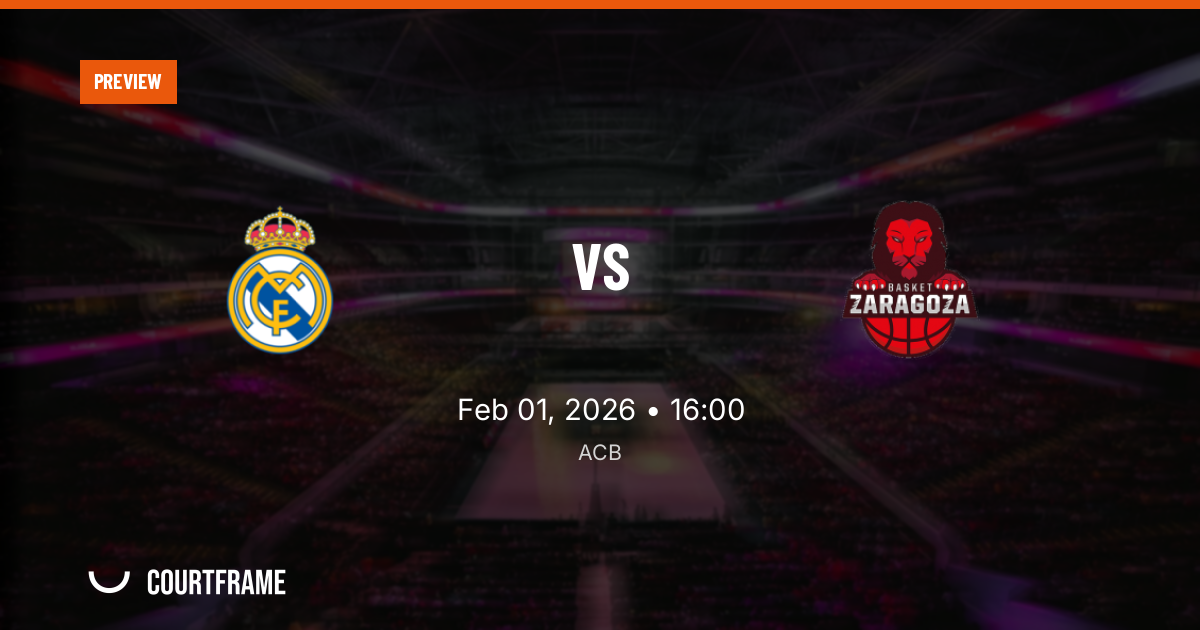
Game snapshot
League: ACB
Season: 2025-2026
Date: February 1, 2026
Venue: Movistar Arena
Matchup: Real Madrid vs. Basket Zaragoza
Context: two seasons moving in different directions
This matchup is defined by separation in the standings and separation in baseline performance. Real Madrid enters at 15-2, while Basket Zaragoza arrives at 6-11. Even before style considerations, that record gap shifts the expected-value landscape: Madrid can play from a position of structural advantage, while Zaragoza’s winning paths typically require higher-variance outcomes—extended shot-making runs, favorable turnover sequences, or a game that stays within a narrow band late.
Recent form: trendlines and what they imply
Both teams’ last-five sequences contain useful signal, especially when interpreted as momentum and volatility rather than as a standalone predictor.
| Team | Record | Last 5 | Form Index (W=1, L=0) | Momentum (Last 2 minus First 3) |
|---|---|---|---|---|
| Real Madrid | 15-2 | WWWLW | 4/5 | -0.33 |
| Basket Zaragoza | 6-11 | LLLWW | 2/5 | +1.00 |
Methodology note (custom, context-only metrics)
Form Index is simply wins in the last five games (W=1, L=0). Momentum compares the last two games to the first three: (wins in last two / 2) − (wins in first three / 3). This is not a claim about true team strength; it’s a compact way to describe whether recent results are trending upward or downward.
Madrid’s 4-of-5 form suggests stability—fewer performance valleys—while Zaragoza’s LLLWW profile is the classic “rebound attempt”: early struggles followed by a small surge. The key question is whether that surge is portable to a road environment against a 15-win opponent, or whether it’s an isolated two-game spike.
The expected-value framing: what each team should optimize
Without play-by-play or efficiency data, the cleanest way to preview is through decision leverage—how much each possession’s variance helps or hurts.
Real Madrid: maximize floor, punish mistakes
With a 15-2 record and a WWWLW run, Madrid’s highest-EV plan is typically the lowest-drama one: keep the game in a “repeatable” state where talent and execution advantages compound. That usually means valuing possessions, managing runs, and avoiding the kind of stretched sequences that invite underdogs back into the game.
Basket Zaragoza: pursue controlled volatility
Zaragoza’s 6-11 record implies fewer reliable scoring/stop cycles across the season. Their recent LLLWW suggests they can find winning stretches, but sustaining them is the challenge. Against a top record, the underdog’s EV often rises when the game becomes more variable—yet “more variable” can’t mean reckless. The goal is controlled volatility: selectively increasing variance while still protecting against self-inflicted empty trips.
Key matchup themes to watch
1) Start quality vs. late-game pressure
Zaragoza’s recent sequence (three losses, then two wins) makes their opening performance especially important. If they can avoid an early deficit, they increase the probability that late-game possessions carry real leverage. Madrid, conversely, benefits from forcing early separation—turning the second half into a test of discipline rather than a coin-flip finish.
2) Run management at Movistar Arena
Venue context matters even without splits: playing at Movistar Arena generally tilts comfort and communication toward the home side. The practical effect is that Zaragoza’s margin for error in “run prevention” shrinks; a two-minute lapse can become a multi-possession swing that changes how both teams allocate risk.
3) Psychological math: how each team interprets a one-score game
For Madrid, a close game is often a prompt to tighten execution and reduce variance. For Zaragoza, a close game is an invitation to believe their two-win uptick is real. The team that best aligns its in-game choices with its EV incentives—Madrid lowering volatility, Zaragoza choosing the right moments to raise it—usually dictates the final shape of the contest.
What to expect
On paper, the records point to Madrid controlling the median outcome: 15-2 versus 6-11 is a steep season-long gap. The more interesting angle is whether Zaragoza’s LLLWW finish to the last five translates into a competitive first half that forces Madrid into higher-leverage decisions. If Madrid establishes early rhythm, their recent consistency (Form Index 4/5) suggests they can keep the game in a low-variance lane. If Zaragoza can keep the game within striking distance into the fourth, their recent momentum (+1.00 by the table’s definition) gives them at least a plausible upset pathway—one that depends on sustaining pressure without gifting possessions.
Quick reference
- Real Madrid: 15-2, last five: WWWLW
- Basket Zaragoza: 6-11, last five: LLLWW
- Date/Venue: February 1, 2026 — Movistar Arena