

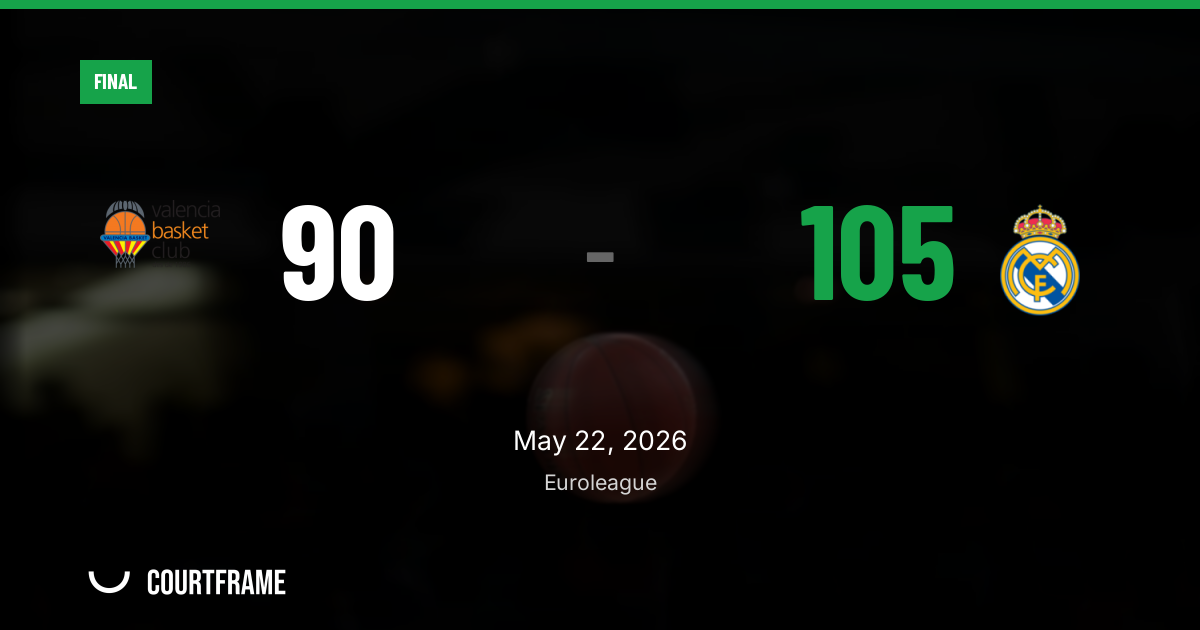
Real Madrid did not need long to flip Game 2. Valencia landed the first punch, but Madrid delivered the defining stretch, riding a 36-point second quarter and a 45-31 rebounding advantage to a 105-90 win on May 22 at Telekom Center Athens.
The result gives Real Madrid a 2-0 lead in the Euroleague semi-finals after entering the night already up 1-0 in the best-of-seven series. It also cut through a matchup that looked narrow on paper: Valencia carried a 25-13 record, Madrid came in at 24-14, and the market priced it nearly even with Valencia at a 51.5 percent implied probability and Real Madrid at 48.5 percent.
On the floor, it was not even. Valencia scored 28 points in each of the first two quarters but collapsed after halftime, managing only 17 points in both the third and fourth. Madrid, meanwhile, had already built enough separation behind a 62-point first half, then protected the margin with a controlled final 20 minutes.
The second quarter decided the night
Valencia led 28-26 after the first quarter, a start that fit its profile as the higher-rated team by CourtFrame Performance Index. Valencia entered with a 95.43 CPI, ranked No. 2, compared with Madrid’s 79.98 CPI, ranked No. 3. The early pace also matched Valencia’s season-long scoring profile, with the club averaging 89.9 points per game.
Then Madrid broke the game open. The 36-28 second quarter gave Real Madrid a 62-56 halftime lead and shifted the pressure completely onto Valencia. From there, Madrid’s defense tightened, holding Valencia to 34 total points after the break.
That second-half drop-off was the key contrast. Valencia had entered the game with strong recent advanced indicators, including a 118 offensive rating, 74.3 true shooting percentage and 96.5 assist rate over the analyzed sample. But after halftime, the offense stopped matching those markers. Madrid’s ability to flatten Valencia’s rhythm turned what began as a shot-making contest into a control game.
Madrid won the glass and stretched the floor
The box-score split tells the story of Madrid’s formula: more possessions through the glass and more damage from 3-point range. Real Madrid outrebounded Valencia 45-31, a decisive edge in a game where both teams finished with 23 assists and 9 turnovers.
Madrid also hit 14 3-pointers on 34 attempts, while Valencia made 10 on 29. That perimeter volume mattered because Madrid entered with the stronger 3-point percentage profile over the recent sample, shooting 38.3 percent from deep compared with Valencia’s 34.3 percent. In Game 2, that advantage carried into the result.
Valencia still shot efficiently inside the available team data, going 27-for-44 from the field, but Madrid’s combination of extra rebounding pressure and 3-point output created the separation. The turnover battle was neutral. The assist battle was neutral. The glass was not.
No injury caveats, no fatigue excuse
Neither team entered with significant injuries reported, and both had a clean rest profile. Valencia had eight days of rest and no games in the previous seven days. Real Madrid had 15 days of rest and no games in the previous seven.
That made the performance less about availability and more about execution. Madrid’s playoff experience matched Valencia’s at 12, and the neutral-site setting in Athens stripped away most of the usual home-road framing. Valencia’s home split — 7-4 with an 87.4-point average — and Madrid’s away split — 4-7 with an 85.4-point average — suggested a slight Valencia lean. Madrid erased it with shot volume, rebounding and a cleaner second-half defensive stretch.
Series pressure shifts hard toward Valencia
Real Madrid’s win changes the tone of the semi-final. This was not a narrow escape in a near pick’em market. It was a 15-point result built on a dominant middle phase and sustained control after halftime.
For Valencia, the concern is not simply the loss. It is how quickly the game moved away from its strengths. The club’s recent profile showed a major net-rating edge at 18.2, with strong ball movement and efficient finishing. In Game 2, the assists were there, the turnovers were contained, and the first half produced enough offense to compete. But the defensive glass and second-half scoring drought proved too costly.
For Madrid, the path is clear. Facundo Campazzo, Mario Hezonja, Trey Lyles, Edy Tavares and Gabriel Deck headline a rotation built to pressure multiple areas of the floor, and in Game 2 the collective structure mattered more than any single matchup. Madrid generated balance, controlled the boards and punished Valencia from deep.
The series is not at an elimination point yet, but Real Madrid now owns the leverage. Valencia entered with the stronger CPI, the better record and the slight market edge. Madrid left Athens with the scoreboard, the series lead and the clearest statement of the semi-finals so far.