

Olympiacos did not need a shootout to validate its profile. It needed control.
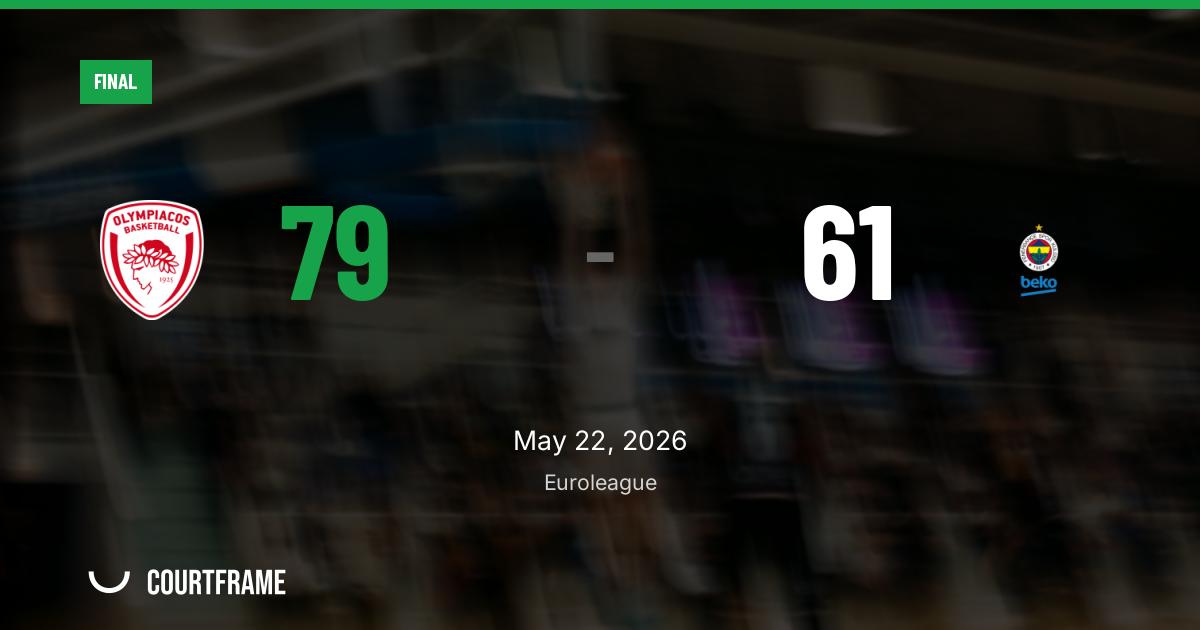
The Euroleague’s top CPI team handled Fenerbahce 79-61 on May 22 at Telekom Center Athens, taking a 2-0 lead in the best-of-seven semifinal series. Olympiacos led by nine at halftime, broke the game open with a 23-point third quarter and never allowed Fenerbahce to find the rhythm required to challenge a team that entered the night unbeaten at home.
The win pushed Olympiacos’ home split to 11-0, a mark backed by an average of 92.6 points in those games. This one was not that explosive, but it was every bit as convincing. Fenerbahce arrived with a 5-7 away record and a 41.7 percent road win rate, and the matchup played out along those lines.
Olympiacos set the tone early
The first half decided the shape of the game. Olympiacos held Fenerbahce to 12 points in the first quarter and 12 more in the second, building a 33-24 halftime lead without needing a major offensive burst.
That mattered because Fenerbahce entered the semifinal with a recent offensive profile already trailing Olympiacos by a wide margin. Over the available 10-game sample, Olympiacos carried a 115.3 offensive rating and plus-13.2 net rating, while Fenerbahce sat at a 96.5 offensive rating and minus-3.9 net rating. The gap was visible immediately: Olympiacos was cleaner, more connected and more capable of manufacturing quality looks without overextending possessions.
Fenerbahce did generate volume from deep, finishing 8-for-36 from 3-point range, but the shot diet never forced Olympiacos into sustained rotation stress. Olympiacos countered with better efficiency from the arc, going 11-for-27, and that difference shaped the scoreboard as the game moved into the second half.
The third quarter created separation
Fenerbahce needed the opening minutes after halftime to change the game. Instead, Olympiacos delivered the decisive stretch.
The home side won the third quarter 23-17, extending its lead to 56-41 entering the fourth. That cushion effectively put Fenerbahce in a chase position against a team built to manage margins. Olympiacos then matched the third-quarter output with another 23 points in the fourth, closing the game without giving Fenerbahce a realistic path back.
The final quarter was Fenerbahce’s best scoring period at 20 points, but it came too late to shift the result. The damage had already been done in the first half, when Olympiacos dictated tempo, protected the paint through positioning and kept Fenerbahce from stacking productive possessions.
The glass and ball movement tilted toward the favorite
Olympiacos won the rebounding battle 39-31 and paired that edge with 16 assists. Fenerbahce finished with 14 assists and nine turnovers, matching Olympiacos in giveaways but failing to match the home team’s shot quality.
The rebounding margin tracked with the pregame data. Olympiacos entered with a 54.9 rebound percentage over the available 10-game sample, ahead of Fenerbahce’s 52.0. Nikola Milutinov’s season profile — 9.1 points and 6.5 rebounds per game — gave Olympiacos a central interior presence, while Aleksandar Vezenkov’s 18.7 points and 5.7 rebounds per game remained the headliner of a balanced core.
Fenerbahce’s top-end creation profile depended heavily on Talen Horton-Tucker, Tarik Biberovic and Wade Baldwin. Horton-Tucker entered averaging 16.4 points, Biberovic 14.1 and Baldwin 13.9 with 5.1 assists. But the collective output never reached the level required to stress Olympiacos over four quarters.
No injury caveat, no fatigue excuse
This was a clean read on form and matchup. Neither team reported significant injuries, and neither had played in the previous seven days. Olympiacos had 16 days of rest; Fenerbahce had 13.
The market leaned toward Olympiacos before tip, with a 64.2 percent implied probability across 13 bookmakers. The CourtFrame Performance Index was even stronger: Olympiacos entered ranked No. 1 with a 100.00 CPI, while Fenerbahce ranked No. 6 at 60.75. The differential was 39.3, and the game reflected that gap.
Fenerbahce’s recent form also carried warning signs. Olympiacos entered 26-12 with a WWWWL run, while Fenerbahce came in 24-14 but with WLLLL form. In a semifinal setting with no injury imbalance and no major fatigue discrepancy, those indicators were difficult to ignore.
What it means for the series
Olympiacos now leads 2-0 in the semifinal series and has controlled the first two games without facing an elimination-game response. Fenerbahce’s playoff experience edge — six to five — remains relevant, but experience only matters if it translates into cleaner offensive execution and better shot selection.
The immediate concern for Fenerbahce is not simply the 18-point margin. It is how it arrived there. The visitors scored 24 first-half points, leaned heavily into low-efficiency perimeter volume and lost the rebounding battle. Against an Olympiacos team with superior recent efficiency, a perfect home record and the league’s top CPI profile, that formula was not sustainable.
Olympiacos, meanwhile, reinforced its identity: efficient enough to separate, disciplined enough to defend a lead and deep enough to win without requiring a scoring avalanche. In a semifinal series, that is often the more dangerous version.