

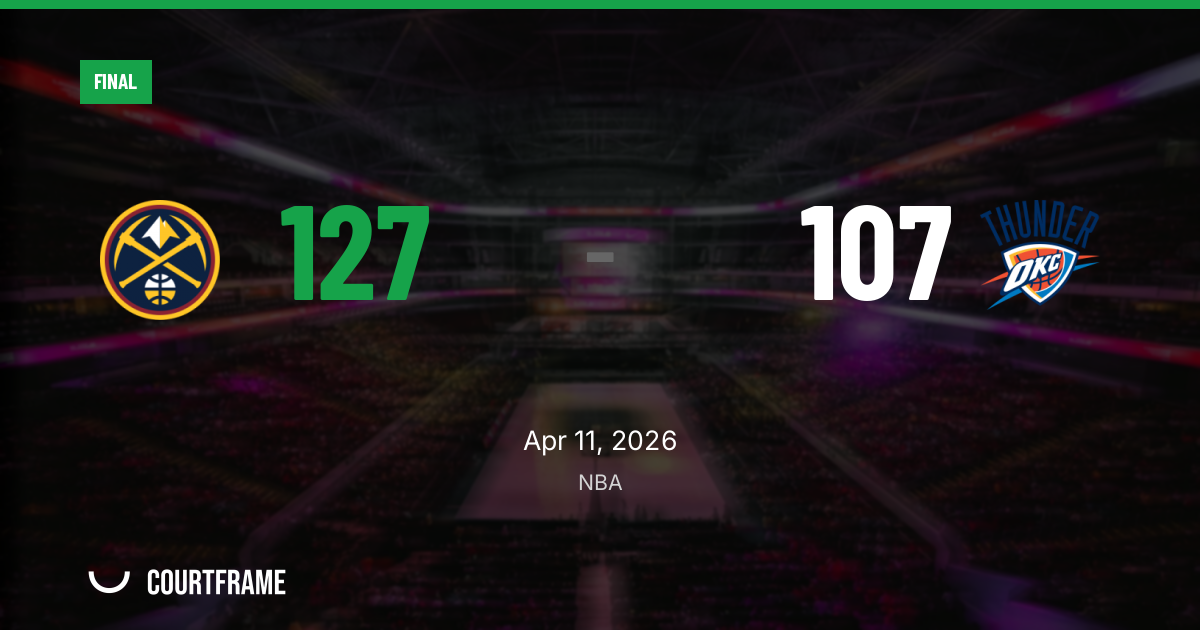
DENVER — The Thunder arrived with a 64-17 record and the No. 2 CPI profile in the matchup. They left Ball Arena with a 127-107 loss that never truly escaped Denver’s control — not once the Nuggets’ perimeter volume started to bend the math.
Denver led 34-27 after one, stayed in front at halftime, and answered Oklahoma City’s best stretch (a 34-point third quarter) with a decisive 37-22 closing frame. In a game shaped by availability, the Nuggets’ shot profile did the rest: 21 made 3s on 43 attempts, paired with 12-for-13 at the line.
Game flow: Denver’s early edge, OKC’s third-quarter swing, Denver’s knockout
The Nuggets’ tone was set immediately. They won the first quarter by seven and kept the Thunder at arm’s length through the second. Oklahoma City made its run coming out of halftime, scoring 34 in the third to briefly threaten the margin.
Denver’s response was the defining sequence of the night: a 37-point fourth quarter that flipped a competitive stretch into a comfortable finish. The Nuggets’ ability to keep generating threes — and keep converting them — turned every Thunder push into a trade that Oklahoma City couldn’t win.
The math problem: Denver’s 3-point barrage
Denver’s team numbers tell the story. The Nuggets went 21-for-43 from three, a massive volume that aligned with their recent profile: over their last 10 games, Denver carried a 78.4 three-point rate with 41.9% accuracy in the provided advanced sample. Saturday looked like that trend fully weaponized.
Oklahoma City also leaned into the perimeter (44 three-point attempts), but the efficiency gap mattered: 14 makes on 44 tries. When one team is matching volume and losing accuracy, the margin tends to grow quickly — especially when the opponent also takes care of the easy points. Denver hit 12 of 13 free throws.
Injuries and availability: OKC’s short-handed ceiling shows up
This matchup was always going to be about who could manufacture offense with limited shot creation available. The Thunder were without Shai Gilgeous-Alexander (Right Oblique), Jalen Williams (Right Hamstring), Chet Holmgren (Low Back), Alex Caruso (Unknown), Isaiah Hartenstein (Left Soleus), Isaiah Joe (Left Knee), and several others. That’s a significant chunk of Oklahoma City’s listed key-player production removed from the ecosystem.
Denver had its own uncertainty — Nikola Jokic (Right Wrist), Jamal Murray (Right Shoulder), and Aaron Gordon (Right Hamstring) were all listed as questionable pregame, along with Christian Braun and Cameron Johnson. But the outcome reflected which team could still access its identity. Denver played a clean, spacing-heavy game that didn’t require a perfect night inside; it required volume, movement and conversion from deep.
Possession battle: Denver’s extra stops and rim protection
Neither team played a pristine turnover game — Denver committed 16 turnovers to Oklahoma City’s 13 — but the Nuggets compensated with defensive playmaking and interior resistance. Denver finished with 10 steals and seven blocks, while the Thunder recorded 11 steals but just one block.
That gap in rim protection mattered in the flow of the game: Denver could press up on shooters and still trust the back line. Oklahoma City, missing key size and defensive personnel, couldn’t generate the same deterrence at the rim, and it couldn’t win the three-point exchange to make up for it.
Context: A result that defied the CPI gap — but matched the availability
On paper, Oklahoma City’s CPI advantage was substantial (Thunder 100.00 vs. Nuggets 67.67, a -32.3 differential). But CPI doesn’t shoot the ball, and Saturday’s version of the Thunder was built around survival more than dominance. With Oklahoma City on the second night of a back-to-back (one day of rest) and missing top-end creators, Denver’s home environment (16-5 at home with 121.5 average points in the provided split) became a multiplier.
The Nuggets improved on a five-game win streak entering the night, and they played like a team already in playoff form: fast decisions, relentless spacing, and a fourth-quarter closer that left no ambiguity.