

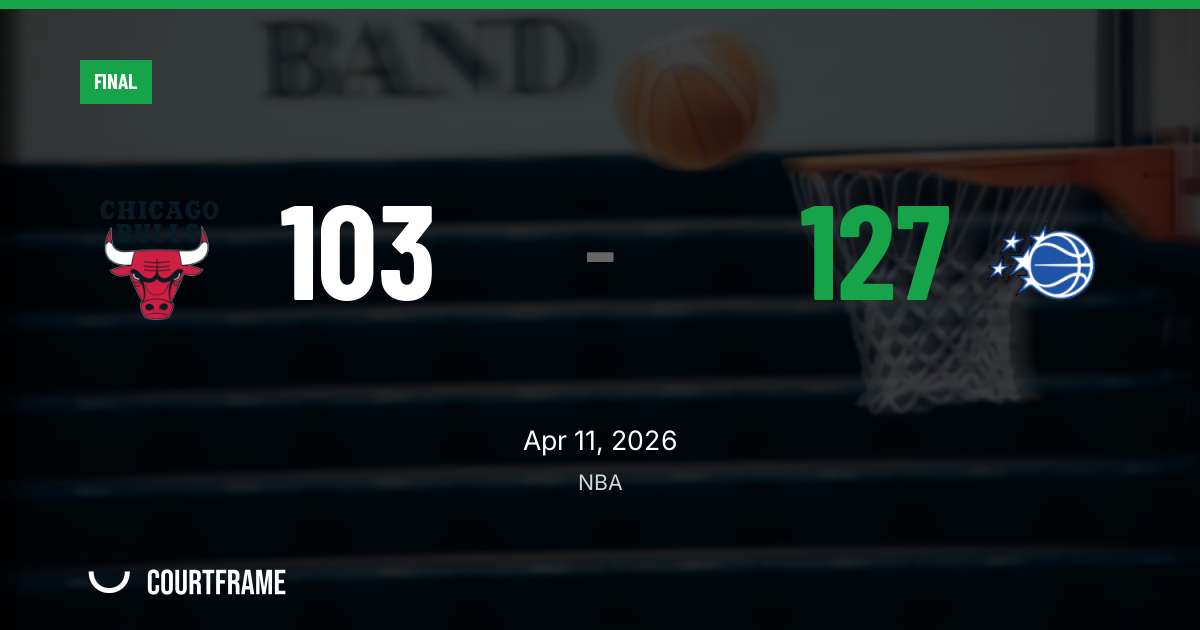
Orlando arrived in Chicago playing its cleanest basketball of the season — five straight wins, a top-end offensive profile over its last 10 games (116.3 offensive rating), and the rest advantage (two days) against a Bulls team on a back-to-back. The Magic left the United Center with exactly the kind of wire-to-wire statement that profile suggested: a 127-103 win that never truly tightened after halftime.
Game flow: Orlando’s second-quarter punch, then a third-quarter knockout
The Bulls hung around early (Orlando led 28-26 after one), but the game turned in the second quarter when the Magic’s offense sped up and Chicago’s mistakes piled up. Orlando won the period 36-27, then came out of the break and effectively ended it with a 35-26 third quarter. By the time the fourth arrived (28-24 Orlando), the result was already decided.
The separator: pace, passing and turnover pressure
Orlando’s identity in this one was simple: move the ball, force chaos, and let the possession math do the damage. The Magic finished with 33 assists and 12 steals, repeatedly turning Chicago’s broken possessions into easy offense. Chicago committed 20 turnovers — five more than Orlando — and that gap, paired with Orlando’s ability to generate shots without sticking, tilted the game quickly after the opening quarter.
The pregame indicators pointed to this exact stress point. Over the last 10, both teams carried elevated turnover rates (Chicago 20.5, Orlando 19.8), but Orlando’s recent assist rate (89.7) and Chicago’s defensive rating (123.9) hinted that if the game became a decision-making test, the Magic were better equipped to win it.
Shot profile: Orlando’s volume from deep vs. Chicago’s empty possessions
Orlando leaned into the math with 37 three-point attempts, hitting 13. Chicago took even more (39) but made only 10 — and the bigger issue was what happened between those attempts. The Bulls’ 20 turnovers and Orlando’s 12 steals created too many empty trips to survive a high-variance perimeter game.
Even with Chicago getting to the line (17-of-26) and Orlando leaving points there as well (16-of-24), the Magic’s ability to consistently manufacture quality looks — reflected in 33 assists — kept the scoreboard moving every quarter.
Rebounding and interior resistance: Magic win the margins
Orlando also won the glass 47-42, taking away one of the cleaner ways for an undermanned team to shorten a game. Chicago’s recent rebound percentage over its last 10 games (48.9) has been a problem area, and it showed again: the Bulls didn’t generate enough extra possessions to offset the turnover deficit.
Defensively, Orlando’s activity popped in the box score (6 blocks, 12 steals), and it matched the team’s recent profile: strong disruption (8.1 steals per game over its last 10) without needing to overcommit.
Context that mattered: availability and fatigue
Chicago’s margin for error was already thin at 31-50, and it got thinner with a heavy injury report: Matas Buzelis, Zach Collins, Noa Essengue, Josh Giddey, Isaac Okoro, Nick Richards, Anfernee Simons and Jalen Smith all out. Add in the schedule spot — one day of rest and a back-to-back — and the Bulls were forced into a game that demanded precision against a hotter, deeper opponent.
Orlando, meanwhile, managed its own absences (Jett Howard and Jonathan Isaac out) without losing the connective tissue of its offense. The Magic’s recent two-way baseline (116.3 offensive rating, 118.9 defensive rating over the last 10) isn’t perfect, but it’s stable — and on a night when Chicago couldn’t protect the ball, stability was more than enough.
What it means going forward
Orlando (45-36) continues to look like a team that can win in multiple ways: it can score with pace (86.0 pace over the last 10), it can share the ball, and it can turn defense into offense. Chicago (31-50) remains stuck in the same loop — too many turnovers, too many lineup constraints, and too little defensive margin — especially at home, where it entered at 4-14.
This one didn’t require a late-game script. The Magic wrote it in the second quarter, then edited it into a blowout in the third.