

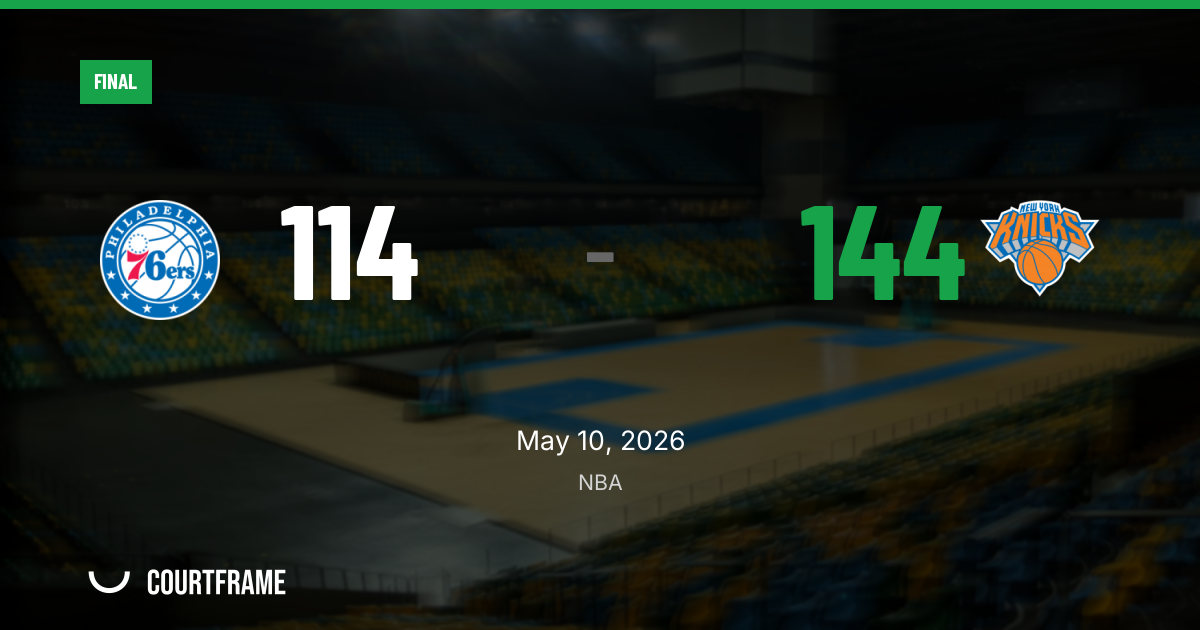
NEW YORK — The Knicks did not ease into Game 5. They hit Philadelphia with 43 first-quarter points, built an 81-57 halftime lead and rolled to a 144-114 win over the 76ers on May 10 at Xfinity Mobile Arena.
The result was decisive, and it tracked with the broader data entering the matchup. New York came in 53-29, with a 52.3 percent market-implied win probability, a 68 percent away split and a dominant recent efficiency profile. Philadelphia had home court and a clean injury report, but the 76ers’ underlying numbers pointed to concern: a minus-10.5 net rating over the previous 10 games and a defensive rating of 122.6.
Those issues showed up immediately. New York scored 43 in the opening quarter, 38 more in the second and 41 in the third. Philadelphia won the fourth quarter 31-22, but by then the game had already been decided.
New York’s efficiency edge became the story
The Knicks entered with a 121.6 offensive rating, 73.1 true shooting percentage and 69.7 effective field goal percentage over the previous 10 games. Against Philadelphia, their shot profile and ball movement were overwhelming enough to break the game open before halftime.
New York finished with 33 assists against 11 turnovers, a continuation of the playmaking profile that had them at an 88 assist rate over the recent sample. The Knicks also leaned into the spacing indicators that separated the teams pregame: New York entered shooting 40.8 percent from 3 over its previous 10 games, compared with Philadelphia’s 34.9 percent.
The box score data carried some internal inconsistency between final score and team-stat point totals, but the game flow was clear from the quarter-by-quarter scoring: the Knicks’ offense dictated the terms for three quarters and created a margin Philadelphia could not realistically chase.
The rebounding gap was just as damaging
Philadelphia’s pre-game rebounding concerns were not theoretical. The 76ers entered with a 45.3 rebound percentage over the previous 10 games, while New York came in at 56 percent. The Knicks won the glass 47-30.
That 17-rebound gap helped New York control possession quality and tempo. Karl-Anthony Towns entered as a central part of that advantage, averaging 11.5 rebounds, while Josh Hart’s 7.5 rebounds per game gave the Knicks another high-end rebounding piece on the wing. Philadelphia, despite having Joel Embiid available and no significant injuries reported, could not close that gap.
Philadelphia’s offense was not enough
The 76ers were not undone by turnovers. They had 10, close to their recent average of 11.6. They also produced 24 assists, slightly above their 21.4 average over the previous 10 games.
The problem was defensive resistance. Philadelphia entered allowing a 122.6 defensive rating over the prior 10-game sample, and New York’s first three quarters exposed that weakness. Even with Embiid, Tyrese Maxey, Paul George, J. V. Edgecombe and Kelly Oubre Jr. forming the core scoring group, the 76ers needed stops to make their half-court offense matter. They did not get them early enough.
Maxey’s creation and Embiid’s interior gravity gave Philadelphia a foundation entering the series, but the broader team trend was pointing downward. The 76ers came in with a WWLLL recent form line and a CourtFrame Performance Index of 42.02, ranked 20th. New York entered with a CPI of 84.39, ranked third, and a LWWWW form line.
Anunoby question did not slow the Knicks
OG Anunoby was listed as questionable with a right hamstring issue before the game, but the Knicks’ structure held up. New York’s offense did not depend on one pressure point. Jalen Brunson entered averaging 24.8 points and 7.4 assists, Towns provided frontcourt scoring and rebounding, and Mikal Bridges and Hart gave the Knicks two-way lineup stability.
That depth mattered against a Philadelphia team operating on the same rest profile. Both teams had one day of rest and were playing their third game in seven days as part of a back-to-back stretch. Fatigue was not an asymmetric factor. Execution was.
The market leaned Knicks. The data leaned Knicks. The game followed.
Despite Philadelphia’s home court, the pre-game market gave New York the slight edge at 52.3 percent implied probability. The advanced profile was far less subtle. New York had the superior offensive rating, defensive rating, net rating, rebound percentage, assist rate, true shooting percentage and effective field goal percentage over the previous 10 games.
Game 5 turned those advantages into a 30-point road win. The Knicks did not just outscore the 76ers. They validated the matchup data with pace, spacing, ball movement and control of the glass.