

LAS VEGAS — The Aces had the market lean, the cleaner early-season profile and the deeper two-way indicators. Then they backed it up with a second-half blitz.
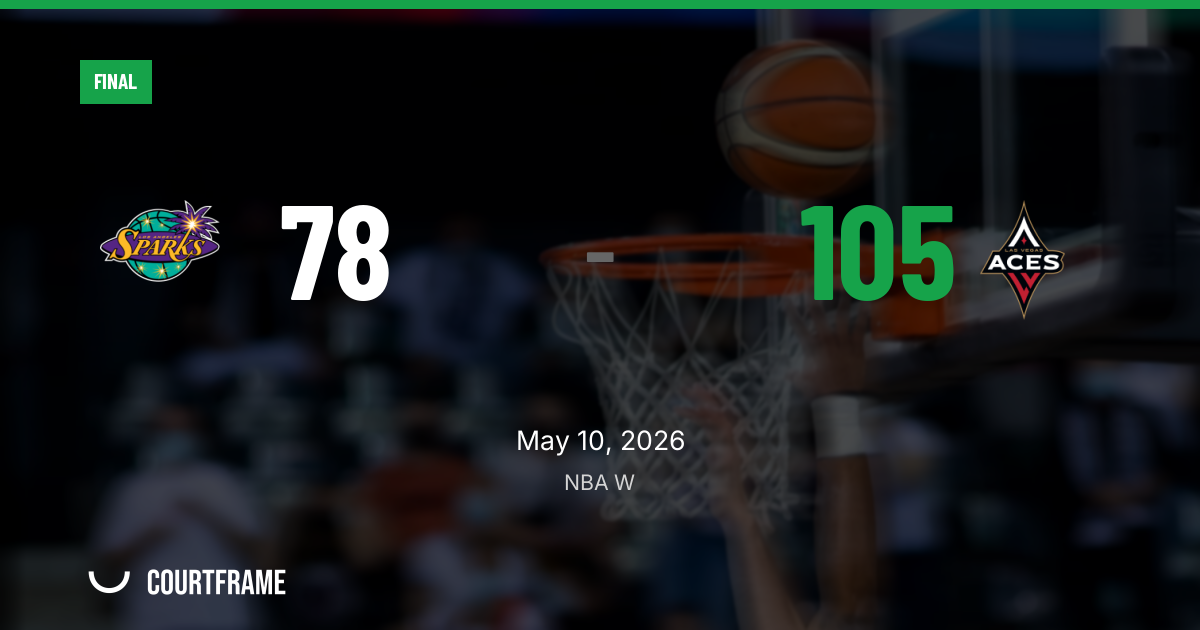
Las Vegas beat the Los Angeles Sparks 105-78 on May 10 at Crypto.com Arena, breaking open a game that had narrowed before halftime with a 33-point third quarter and a 30-point fourth. The Aces led 29-14 after the first quarter, watched Los Angeles answer with a 27-point second, then reclaimed full control after the break.
The result aligned with the pregame numbers. Las Vegas entered with a stronger CourtFrame Performance Index profile — 38.79, ranked ninth, compared with Los Angeles’ 10.26, ranked 12th — and a positive net rating. The Aces also carried a 54.5 percent market-implied win probability despite playing on the second night of a back-to-back.
Las Vegas wins the math and the physicality
The Aces’ statistical edge showed up everywhere that mattered. Las Vegas finished with 28 assists, 11 steals and 10 blocks, turning defensive pressure and rim protection into the game’s defining themes. Los Angeles had 11 assists and 19 turnovers, a damaging combination against a team already entering with superior offensive efficiency indicators.
Las Vegas’ ball movement was the clearest separator. The Aces came in averaging 20.3 assists across their analyzed sample, and that passing profile translated cleanly into this matchup. Their 28 assists reflected an offense that consistently created advantages before the Sparks could reset defensively.
The defensive disruption was just as important. Las Vegas entered averaging 7 blocks, and its 10 blocks underscored how difficult Los Angeles found it to generate clean looks inside or build downhill rhythm. The Sparks were credited with zero blocks, leaving the Aces with the clear interior deterrence advantage.
Sparks’ turnover issue becomes decisive
Los Angeles entered with a 27.8 turnover rate and 19.5 average turnovers, one of the biggest red flags in its early profile. That weakness carried directly into the game. The Sparks committed 19 turnovers, giving Las Vegas enough extra possessions to separate even after Los Angeles briefly stabilized the game in the second quarter.
The Sparks’ first half showed the outline of a competitive response. After being outscored by 15 in the opening quarter, Los Angeles won the second quarter 27-13. But the recovery did not hold. Las Vegas responded with 63 second-half points, and the Sparks managed only 37 after halftime.
That third quarter was the hinge point. Las Vegas outscored Los Angeles 33-18, flipping the game from competitive to controlled. The Aces then closed with another 30-point period, ensuring the margin matched the underlying imbalance.
Rest advantage fails to lift Los Angeles
The scheduling setup favored the Sparks on paper. Los Angeles had six days of rest and only one game in the previous seven days. Las Vegas was playing on one day of rest with two games in the previous seven, including a back-to-back.
It did not matter. The Aces played with more pace, more force and more execution over the final 20 minutes. Their pregame profile suggested the more reliable offense: a 102.4 offensive rating and 65.7 true shooting percentage across the analyzed sample, compared with the Sparks’ 90.6 offensive rating. Los Angeles’ defensive rating of 109.2 also loomed as a concern, and Las Vegas exploited it after halftime.
The Sparks did win the rebounding column 32-31, but that narrow edge could not offset the turnover gap, assist disparity or Las Vegas’ defensive playmaking. The Aces’ 11 steals and 10 blocks gave them control of the game’s rhythm even when the glass was close.
What it means
Las Vegas improved to 1-1 and reinforced the strongest parts of its early-season data: efficient offense, high-end passing and disruptive defense. A’ja Wilson entered as the Aces’ leading scorer at 19 points per game, with N. Smith adding 11.5 points and 6 rebounds, and Las Vegas’ collective structure proved more important than any single matchup.
Los Angeles dropped to 0-1 and left with familiar questions. K. Plum entered averaging 20 points, N. Ogwumike 18 points and 7 rebounds, and D. Hamby 12.5 points, but the Sparks’ broader offensive profile still needs cleaner possession management. Their 89.2 assist rate in the pregame data suggested willingness to share the ball, yet the game produced only 11 assists against 19 turnovers.
For the Aces, this was a road response with substance. For the Sparks, it was a reminder that rest and home court mean little without ball security and defensive resistance.