

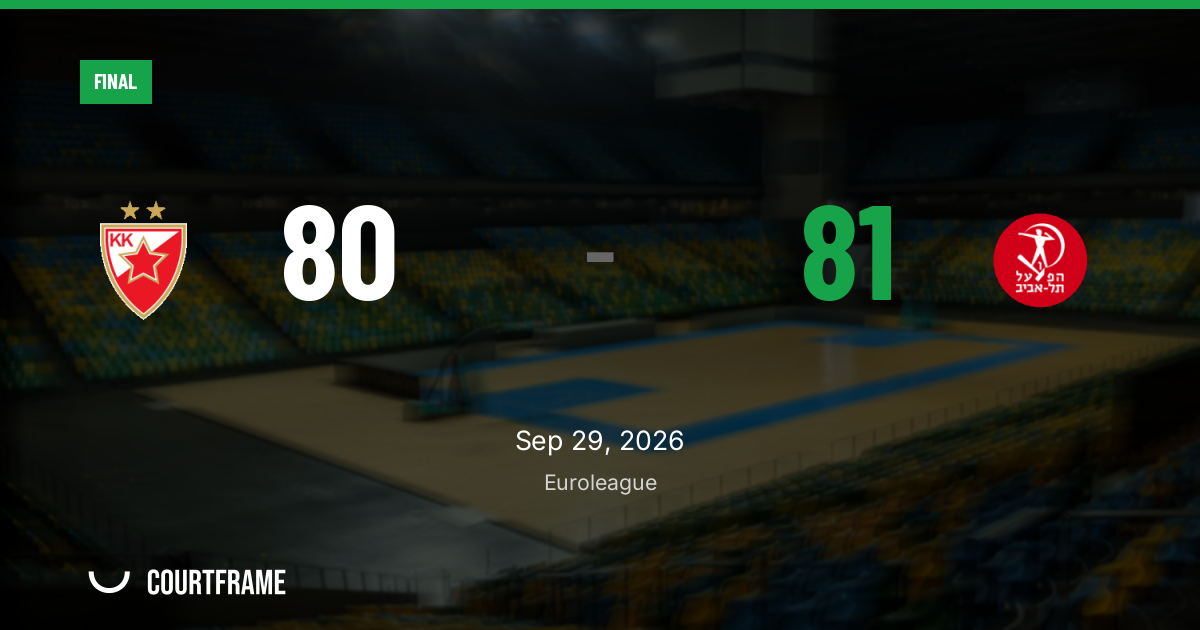
Hapoel Tel-Aviv did not need to control the glass, win the assist battle or shoot efficiently from the field to take Game 2. It needed the margins that travel in playoff basketball: turnovers, free throws and early force.
Hapoel beat Crvena zvezda 81-80 on September 29 at Beogradska arena, turning a 28-point first quarter and a six-turnover night into a one-point road win. The result gives Hapoel a 2-0 lead in the best-of-seven Euroleague series and leaves Zvezda searching for answers after another narrow failure to convert its structural advantages into a result.
Crvena zvezda entered as the market favorite with a 56.8 percent implied win probability and significantly more playoff experience, listed at 97 compared with Hapoel’s 30. But the pre-game analytics pointed to a more complicated matchup. Hapoel carried the stronger offensive rating, better true shooting percentage, lower turnover rate and higher CourtFrame Performance Index profile. Those indicators held up when the game tightened.
Hapoel’s first quarter created the cushion
The game’s defining stretch came immediately. Hapoel opened with 28 points in the first quarter, putting Crvena zvezda in a 10-point hole after 10 minutes. That early burst mattered because the rest of the game tilted toward the home side.
Crvena zvezda won the third quarter 24-22 and the fourth 21-14, nearly erasing the deficit with a stronger second-half push. But Hapoel’s opening punch gave it enough room to absorb a late scoring slowdown. The visitors scored only 14 points in the fourth quarter, yet still escaped because the first-quarter separation had already changed the game state.
For Zvezda, the comeback showed resilience. It also exposed the cost of another slow start from a team that entered the night with a minus-7.4 net rating through two games and an offensive rating of 85.7. Against a Hapoel side that had already profiled as more efficient offensively, the margin for early mistakes was thin.
The turnover gap decided the possession game
Crvena zvezda produced the cleaner half-court passing profile, finishing with 20 assists to Hapoel’s 11. That matched the pre-game trend: Zvezda came in with a 77.4 assist rate, far above Hapoel’s 44.4. The ball moved. The looks came. But the possessions did not always survive.
Zvezda committed 13 turnovers. Hapoel committed just six.
That was the clearest continuation of the pre-game data. Hapoel entered with a 11.6 turnover rate and only 10 turnovers per game, while Zvezda came in at 14.7 with 13.5 turnovers per game. In a one-point playoff game, that difference was not cosmetic. It was the game.
Hapoel also generated seven steals to Zvezda’s two, reinforcing its ability to pressure the ball without letting the game become too chaotic for its own offense. The visitors did not need a high-assist night because they protected the ball and created enough pressure events to keep Zvezda from fully leveraging its playmaking edge.
Zvezda owned the glass, but Hapoel owned the line
Crvena zvezda had the rebounding advantage the matchup suggested it might. The home team finished with 45 rebounds to Hapoel’s 35, building on a pre-game profile that included a 51.3 rebound percentage compared with Hapoel’s 47.5.
That edge helped Zvezda stay connected even after the poor start. Semi Ojeleye entered as one of the team’s key rebounders at 7.0 per game, while Jordan Nwora and Chima Moneke each came in averaging 5.0. The team-level rebounding identity translated.
But Hapoel offset that with volume at the free-throw line. The visitors went 22-for-30 from the stripe, while Zvezda finished 16-for-20. Hapoel entered with the higher free-throw rate, 32.1 to Zvezda’s 28.1, and that pressure showed up in the final box score.
The contrast was stark: Zvezda made more field goals, 26 to 23, and won the rebounding battle by 10. Hapoel still won because it took more free throws, made more 3s and protected the ball.
Shooting remained imperfect on both sides
This was not a clean offensive showcase. Hapoel shot 23-for-66 from the field and 9-for-30 from 3. Crvena zvezda shot 26-for-66 overall and 7-for-26 from deep.
Those numbers fit the early-season profiles. Zvezda entered with a 50.3 true shooting percentage, 44.2 effective field goal percentage and 30.9 percent shooting from 3. Hapoel came in slightly better overall at 53.9 true shooting and 45.9 effective field goal percentage, despite a lower 27.3 percent mark from beyond the arc.
In Game 2, Hapoel’s 3-point volume mattered more than its overall field-goal efficiency. The visitors made two more 3s than Zvezda, a small but decisive edge in a game decided by one point.
No injury excuse, no rest imbalance
There were no significant injuries reported for either team, and the schedule offered no obvious fatigue imbalance. Both teams entered with five days of rest and one game in the previous seven days.
That makes the result more revealing. Hapoel did not win because of availability luck or a rest advantage. It won because the matchup’s key indicators translated: better ball security, more defensive disruption and a stronger ability to manufacture points at the line.
What it means for the series
Hapoel now leads the series 2-0, a major swing after entering Game 2 as the road underdog by market probability. Its CPI profile already suggested a stronger baseline, with a 52.97 mark and rank of 12 compared with Zvezda’s 25.05 and rank of 17. Game 2 gave that gap a playoff result.
For Crvena zvezda, the concern is not effort. The home team rallied, rebounded, assisted on offense and nearly stole the game late. The concern is precision. A team averaging 20.5 assists and 39.5 rebounds has enough structure to compete, but 13 turnovers and a 10-point first-quarter deficit left too much to solve.
Hapoel’s win was narrow, but not random. It followed the data: fewer mistakes, more pressure, more free throws. In a series that has already tilted 2-0, those are the margins Crvena zvezda must reverse quickly.