

Fenerbahce did not wait for the game to settle. It took the floor in Game 3 of the Euroleague Finals and immediately changed the series math.
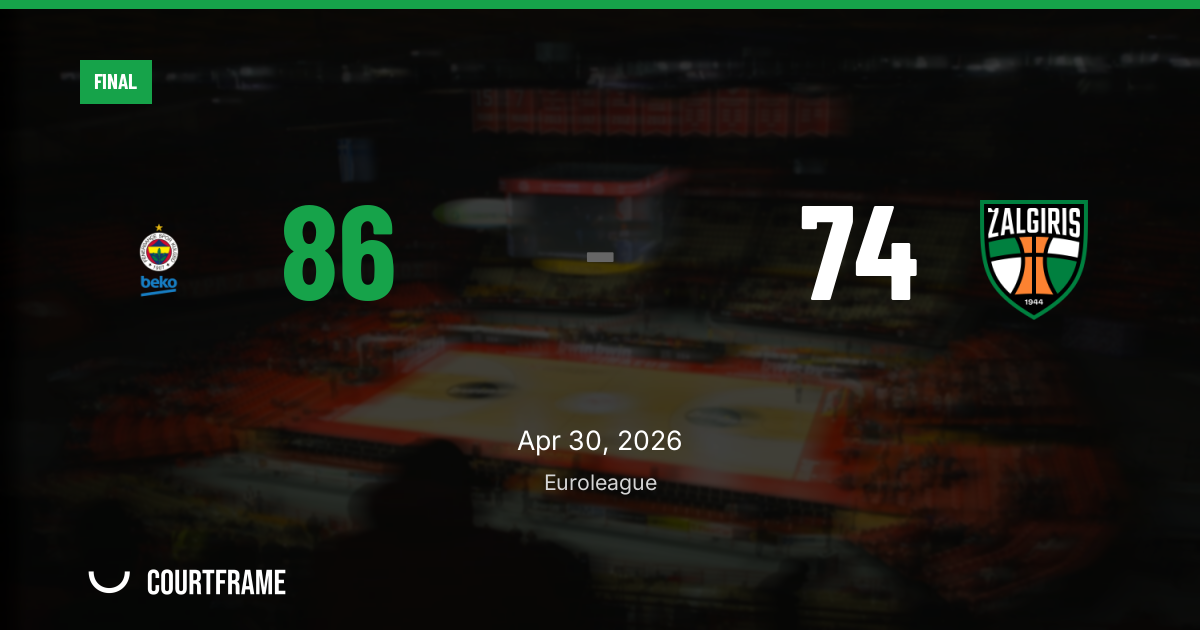
Behind a 26-14 first quarter and a 51-point first half, Fenerbahce beat Zalgiris Kaunas 86-74 on April 30 at Ulker Spor ve Etkinlik Salonu, moving ahead 3-0 in the best-of-seven Finals. The result put Zalgiris in a position where the series is no longer about adjustments alone. It is about survival.
The final margin was built early. Fenerbahce won the opening period by 12, added another 26 points in the second quarter and led 51-33 at halftime. Zalgiris won the fourth quarter 27-20, but the damage had already been done.
Fenerbahce’s first-half punch decided Game 3
The shape of the game was clear by the end of the first quarter. Fenerbahce’s offense played with pace, spacing and clarity, while Zalgiris spent most of the opening half chasing matchups and late closeouts.
Fenerbahce’s shot profile told the story. The home team made 13 of 27 from 3-point range, using volume and accuracy from the perimeter to stretch a Zalgiris defense that entered with a strong recent defensive profile. Over its previous 10 analyzed games, Zalgiris carried a 96.5 defensive rating and a positive 4.6 net rating. In Game 3, that structure cracked early.
Fenerbahce also moved the ball with purpose, finishing with 22 assists. That tracked with a recent profile built on high assist creation, but the execution was sharper than its pre-game form suggested. Fenerbahce entered having lost four of its previous five, with a negative 7.5 net rating over the recent 10-game sample. None of that showed in the opening 20 minutes.
Zalgiris’ efficiency inside the arc was not enough
Zalgiris did plenty well enough to stay competitive statistically. It shot 24 of 33 on 2-point field goals and finished with 21 assists against 11 turnovers. It also generated 9 steals and 4 blocks, winning several possession-level battles that usually travel well in playoff basketball.
But the perimeter gap was too large. Zalgiris made only 5 of 23 from 3-point range, while Fenerbahce hit 13 from deep. In a game without a free-throw component listed in the team statistics, the 3-point line became even more decisive. Fenerbahce did not need to dominate every category. It needed to win the math that mattered most.
Rebounding also tilted the game. Fenerbahce finished with 30 rebounds to Zalgiris’ 19, an important reversal against a Zalgiris team that entered with a slightly higher recent rebounding profile and Moses Wright averaging 7.6 rebounds among the key players. That edge helped Fenerbahce limit extended Zalgiris runs after building its halftime cushion.
Pre-game indicators missed Fenerbahce’s home-floor surge
The market leaned toward Fenerbahce before tipoff, with an implied home win probability of 68.5 percent across 11 bookmakers. That confidence was rooted less in recent form and more in location, matchup context and the series state.
The broader indicators were more complicated. Zalgiris entered with a 23-15 record, an 86.9 points-per-game average and a stronger CPI profile: 68.17, ranked fourth, compared with Fenerbahce’s 54.58, ranked eighth. Zalgiris also arrived in better form at WWLWW, while Fenerbahce came in at WLLLL.
But Fenerbahce’s home split mattered. It entered 6-2 at home with an average of 81.6 points, and Game 3 played directly into that strength. The 86-point output cleared its home scoring average and came against a Zalgiris team that had struggled away from home, entering with a 2-6 road split despite averaging 84.4 points in those games.
No injury excuse, no fatigue edge
There was no significant injury imbalance. Both teams entered with no major injuries reported, and both were on equal rest: two days off and one game in the previous seven days.
That made the outcome less about availability and more about execution. Fenerbahce handled the same rest window better, converted its home-court energy into a fast start and forced Zalgiris to play from behind for most of the night.
What it means for the series
Fenerbahce now leads the Finals 3-0. Game 3 was not an elimination game, but it created one-sided pressure. Zalgiris has had the stronger recent efficiency profile, the better CPI ranking and the higher season scoring average. None of it prevented Fenerbahce from controlling the terms of the night.
The deciding stretch was not late-game shotmaking or a single defensive stand. It was the opening half: 51 points, 13 made 3s by the end of the night, a rebounding edge and enough ball security to withstand Zalgiris’ defensive activity.
For Fenerbahce, this was the cleanest kind of Finals win: early separation, tactical clarity and no reliance on an opponent’s injuries or fatigue. For Zalgiris, the box score leaves a harsher conclusion. Winning the turnover margin and creating defensive events did not matter because the arc and the glass belonged to Fenerbahce.