

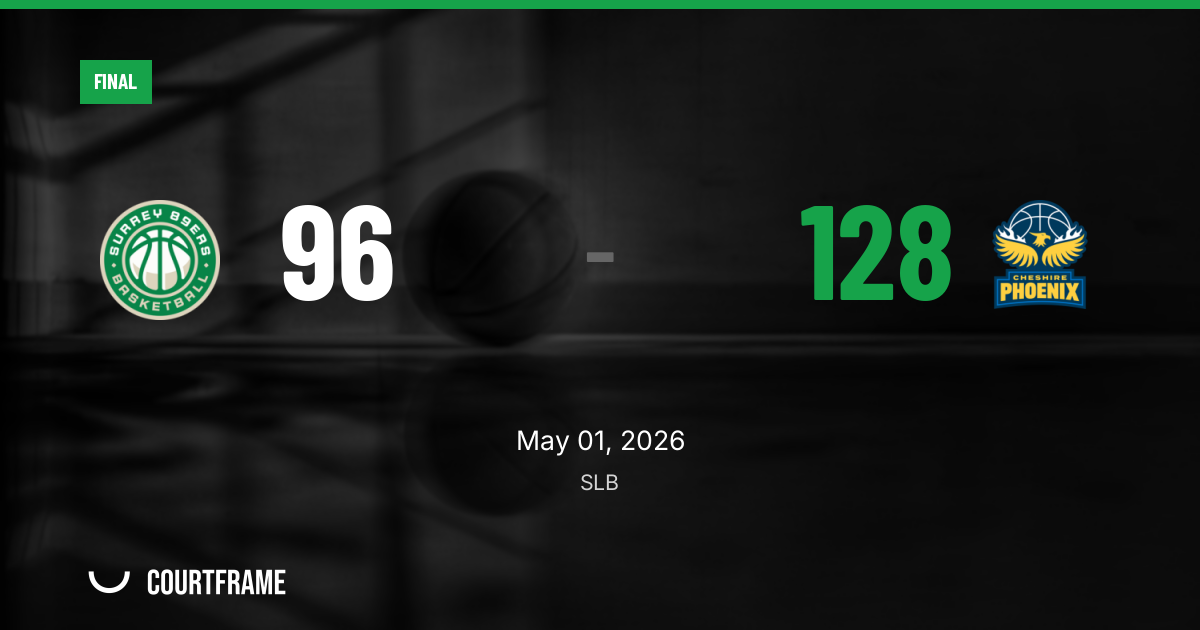
Cheshire Phoenix turned Game 2 into a statement.
After trailing by five through the opening quarter, Cheshire detonated for 42 points in the second and never gave Surrey 89ers a route back, winning 128-96 on May 1 at Surrey Sports Park. The result gives Phoenix a 2-0 lead in the best-of-seven SLB Quarter-Finals and shifts more pressure onto a Surrey side that entered the matchup with the weaker profile across nearly every major team indicator.
Surrey started sharply, taking the first quarter 28-23. Then the game flipped. Cheshire won the second quarter 42-22, added a 34-23 edge in the third and closed with a 29-23 fourth. From the start of the second quarter onward, Phoenix outscored Surrey 105-68.
Second-quarter surge decides it
The defining stretch was not subtle. Cheshire’s 42-point second quarter transformed a controlled Surrey start into a Phoenix runaway. That single period matched the broader pre-game warning signs: Cheshire entered with the superior season record, stronger recent form and a major CPI advantage.
Phoenix came in 20-12, averaging 95.8 points per game, with a 6-2 away split and 95.3 points per road game. Surrey entered 14-18, with a 3-5 home split despite averaging 90.9 points at home. The early energy belonged to Surrey, but the sustainability belonged to Cheshire.
The quarter scores told the story of a team able to absorb the first punch, then dictate tempo, spacing and execution. Cheshire did not just win the middle quarters; it buried the game there.
Phoenix’s profile translated cleanly
This was a matchup that tilted toward Cheshire before tip, and the data played out accordingly. Over the previous 10 games analyzed, Phoenix carried a 117.8 offensive rating, 102.1 defensive rating and 15.7 net rating. Surrey’s profile was competitive but less imposing: 112.9 offensive rating, 108.6 defensive rating and 4.4 net rating.
The clearest separator was possession control and glass work. Cheshire finished with 56 rebounds to Surrey’s 34, a massive edge that aligned with the pre-game rebounding gap. Phoenix had entered with a 54.8 rebound percentage and 42.6 average rebounds, while Surrey sat at 46.5 percent and 34.3 average rebounds.
Cheshire also generated cleaner team offense. Phoenix recorded 35 assists and 11 turnovers, while Surrey had 23 assists and 14 turnovers. For a Phoenix team that already came in with a 93.2 assist rate over the recent sample, the ball movement held up under playoff conditions.
Perimeter volume remains Cheshire’s weapon
Cheshire’s shot profile was another pre-game indicator that carried into the result. Phoenix entered with an 87.3 three-point rate over the recent 10-game sample, alongside a 38.8 percent mark from beyond the arc. In Game 2, Cheshire went 17-for-38 from 3-point range.
Surrey also leaned heavily into the perimeter, finishing 12-for-35 from deep, but could not match Cheshire’s combination of volume, rebounding and playmaking. The 89ers’ recent profile had featured strong shooting efficiency — including a 70.5 true shooting percentage and 67.0 effective field-goal percentage — but Phoenix’s defense and second-quarter pressure prevented that efficiency from controlling the game.
The free-throw line did not swing the result. Cheshire went 15-for-27, while Surrey finished 16-for-25. The separation came from the arc, the boards and the assist-to-turnover gap.
No injury excuse, no fatigue edge
Neither team entered with significant injuries reported, and the rest profile was close enough to remove fatigue as a major explanation. Surrey had six days of rest and one game in the previous seven days. Cheshire had five days of rest and one game in the previous seven days.
That made the outcome more about level than circumstance. Cheshire looked like the higher-seeded, more complete team. The CPI matchup pointed the same direction: Phoenix entered No. 2 with a 90.04 CPI, while Surrey ranked No. 7 at 40.08. The differential was substantial, and Game 2 reflected it.
Surrey’s stars now face a response game
Surrey’s core came in with enough scoring to challenge. K. Lilly averaged 20.2 points and 4.3 assists, R. Polite averaged 16.6 points and 5.6 assists, and T. Lawrence added 15.3 points per game. Small Isiah and M. Graham also gave Surrey frontcourt production, with Graham averaging 9.8 rebounds and Small 7.2.
But against Cheshire, Surrey’s collective profile was overwhelmed. The 89ers were beaten 56-34 on the boards and forced into a game script where every empty possession became more expensive.
For Phoenix, the formula remains clear. P. Robinson entered as the lead scorer at 21.4 points per game, with Rideau Laquincy providing 13.1 points, 6.8 assists and 5.7 rebounds. Around them, White Skyler, F. A. Policelli and T. Cameron give Cheshire multiple scoring and rebounding options. That balance showed up in the way Phoenix generated 35 assists and controlled the game after the first quarter.
What it means
Cheshire now leads the series 2-0 and has reinforced its status as the stronger side in the quarter-final matchup. The Phoenix had the better record, better road form, better recent net rating, stronger rebounding profile and higher CPI ranking entering Game 2. The 128-96 final was not an upset in shape — only in margin.
Surrey’s opening quarter offered a blueprint built on pace, shot-making and early pressure. The final three quarters showed the problem: sustaining that against a deeper, more efficient Phoenix team is a different task. With no elimination game yet on the board, the series is not over. But Cheshire has already put Surrey in a position where response is no longer optional.