

Breogan did not look like the team carrying the weaker pre-game profile.
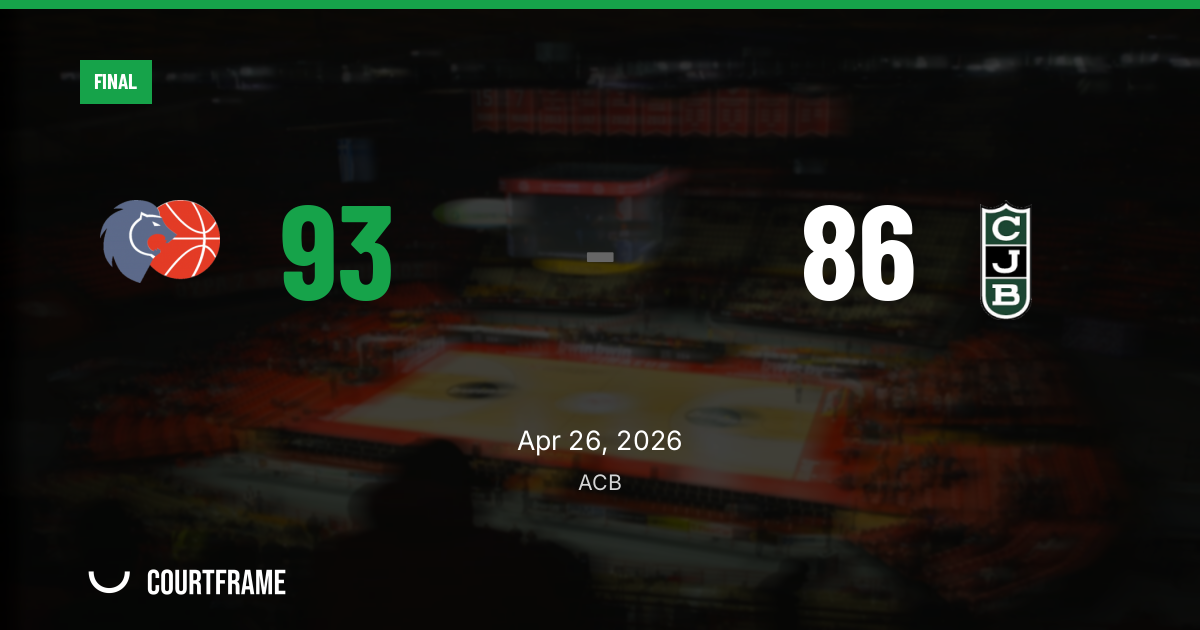
At Pazo dos Deportes, Breogan beat Joventut Badalona 93-86 on April 26, taking a 2-0 lead in the best-of-seven ACB playoff series. The home side broke the game open with a 29-point third quarter and held off Joventut’s 28-point fourth-quarter push, turning a matchup that leaned toward the visitors on paper into a statement win.
The result cut against the pre-game indicators. Joventut entered with a 17-11 record, a stronger recent advanced profile and a 57 percent market-implied win probability across 11 bookmakers. Breogan came in 12-16, ranked 12th in CPI at 30.44, while Joventut ranked seventh at 64.28. None of it mattered once Breogan found rhythm.
Third-quarter surge decides it
The game stayed tight through halftime. Breogan led 22-19 after the first quarter before Joventut answered with a 19-16 second period, leaving the teams level at the break.
Then Breogan changed the game. The hosts scored 29 points in the third quarter, their highest-scoring period of the night, while holding Joventut to 20. That nine-point swing gave Breogan the control it needed before both teams played a high-scoring fourth quarter.
Joventut did not go quietly, producing 28 points in the final period, but Breogan matched enough of that pressure with 26 of its own. The home team’s late-game offense prevented Joventut from turning the fourth quarter into a full comeback.
Breogan’s passing profile shows up
Breogan’s offensive identity was clear in the numbers. The hosts finished with 23 assists, well above Joventut’s 14, reinforcing a pre-game profile built around an 83.4 assist rate over the previous 10-game sample.
That ball movement was the cleanest separator in a game where both teams committed 15 turnovers. Breogan did not win the possession-control battle by taking better care of the ball, but it created higher-value rhythm through distribution. The assists also aligned with the team’s recent shooting indicators: a 72.8 true shooting percentage and 68.7 effective field-goal percentage across the advanced sample.
Breogan also leaned into its perimeter-heavy profile. The hosts were listed with a 71.9 three-point rate in the pre-game data and attempted 31 shots from beyond the arc in the team statistics, making 13. Joventut made nine 3s on 30 attempts.
Joventut’s usual efficiency edge slips
Joventut arrived with the cleaner two-way statistical case. Over its previous 10 games, it owned a 112.8 offensive rating, 104.5 defensive rating and plus-8.3 net rating. Breogan’s corresponding profile was sharply worse: 107.9 offensive rating, 122.7 defensive rating and minus-14.8 net rating.
But Game 2 did not follow that script. Joventut’s defense could not contain Breogan’s third-quarter shot creation, and its offense became too dependent on late scoring to repair the damage. The visitors had advantages on the glass, finishing with 36 rebounds to Breogan’s 29, and they converted 19 of 22 free throws. Those edges kept them close, but they did not offset the assist gap or Breogan’s perimeter output.
The turnover context was also important. Joventut’s recent turnover rate was 16, far cleaner than Breogan’s 25.9. In this game, that expected advantage disappeared, with both teams finishing on 15 turnovers. For Breogan, simply neutralizing that category was a win.
No injury caveats, no schedule excuse
Both teams entered without significant injuries reported, and the rest profile was balanced enough that fatigue did not define the outcome. Breogan had six days of rest and one game in the previous seven days. Joventut had seven days of rest and no games in the previous seven days.
That put the focus squarely on execution. Breogan delivered the cleaner offensive structure, especially in the second half. Joventut had the deeper pre-game analytics case and the better regular-season record, but Breogan’s shot-making and passing produced the more convincing playoff performance.
Series pressure shifts to Joventut
Breogan now leads the series 2-0, a significant swing for a team that entered Game 2 as the market underdog and the lower CPI side. The win also continued a home split that had been productive offensively, with Breogan averaging 90.8 points in its recent home sample.
Joventut has enough indicators to suggest the series is not settled. Its recent net rating, rebounding profile and season record still point to a capable response. But after two games, Breogan has already disrupted the expected hierarchy.
Game 2 was not about a fluke run or a single mismatch. It was about Breogan turning its strengths — passing volume, perimeter willingness and home scoring — into a playoff result. Joventut had the better pre-game résumé. Breogan has the 2-0 lead.