

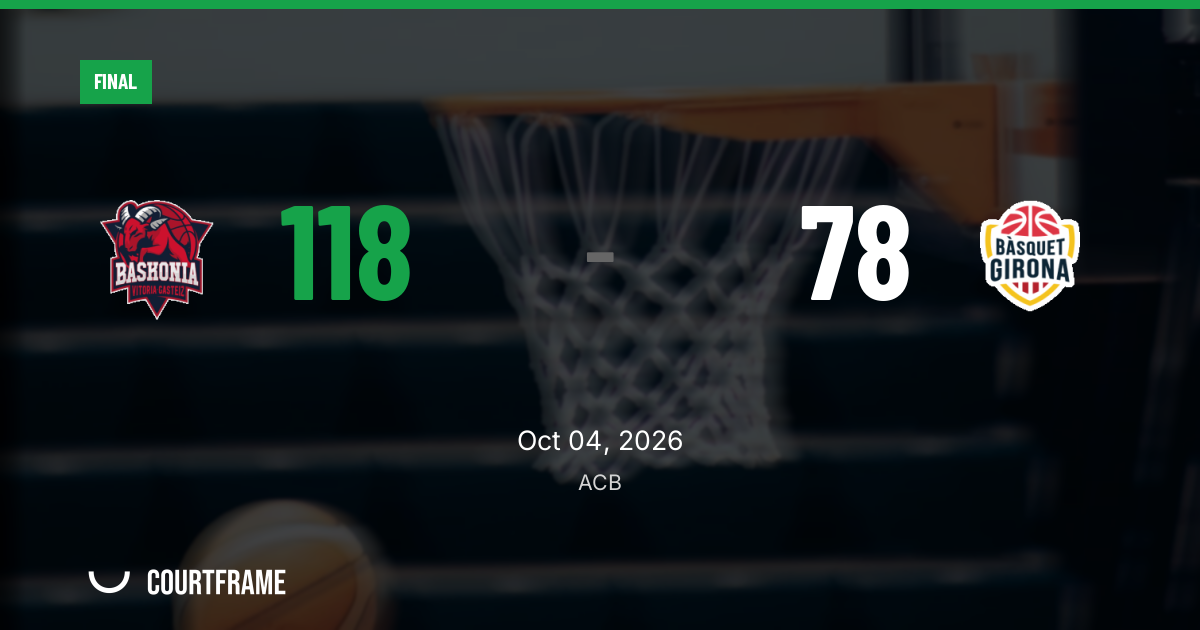
Baskonia did not just protect home court. It detonated the game.
Down after the first quarter, Baskonia answered with three straight 30-point periods and overwhelmed Basquet Girona 118-78 on October 4 at Fernando Buesa Arena, moving to 2-0 in the series. The result matched the pre-game indicators: the league’s No. 1 CPI team, carrying a 100.00 CPI and a 66.1-point matchup differential, looked every bit like the superior side against a Girona team ranked 12th by CPI.
The market had Baskonia as an 80.5 percent implied favorite across nine bookmakers. The final margin made that number look conservative.
The game flipped in the second quarter
Girona opened with purpose, winning the first quarter 26-20 and briefly disrupting Baskonia’s rhythm. That was the last stretch in which the visitors controlled the terms.
Baskonia responded with a 34-16 second quarter, turning a six-point deficit into a double-digit halftime advantage. From there, the home side never let the game breathe. Baskonia scored 32 points in the third quarter and another 32 in the fourth, building the kind of sustained offensive pressure Girona could not match.
The quarter-by-quarter arc told the story: Baskonia’s offense accelerated as the game went on, while Girona’s scoring fell from 26 in the opening period to 16, 19 and 17 over the final three quarters.
Shooting gap became the separation point
Baskonia entered the game with elite early-season offensive indicators: 108 points per game, a 126.5 offensive rating, 71.6 true shooting percentage and 61.8 effective field goal percentage through two analyzed games. Those strengths carried directly into Game 2.
The home team shot 33-for-65 from the field and 16-for-33 from 3-point range. Girona also made 32 field goals on 65 attempts, but the difference was shot value. Baskonia’s 16 made 3s dwarfed Girona’s 6-for-23 mark from deep, creating a 30-point advantage from beyond the arc alone.
The free-throw line widened the gap further. Baskonia went 26-for-28, while Girona attempted only four free throws and made three. That disparity reinforced what the pre-game profile suggested: Baskonia’s attack, already carrying a 42.5 free-throw rate, had more ways to pressure a defense than Girona could handle.
Girona’s turnover problem resurfaced
Girona came in with a 16.4 turnover rate and 14.5 turnovers per game. Against Baskonia, that weakness became a central factor.
The visitors committed 18 turnovers against just 14 assists. Baskonia, by contrast, finished with 22 assists and only 9 turnovers, maintaining the ball security that has defined its early run. The home side entered with an 11.7 turnover rate and 10 turnovers per game, and it improved on that baseline in a playoff setting.
That contrast mattered because Girona needed a cleaner game to offset the shooting and free-throw disadvantages. Instead, the visitors gave away possessions while Baskonia generated efficient offense without sacrificing control.
Baskonia’s depth of creation showed
Baskonia’s pre-game profile was built on balance. Duarte Chris entered averaging 16 points per game, K. Faried added 12 points and 6.5 rebounds, while Marcio, Lawson A.J. and K. Simmons gave the rotation multiple secondary options.
That collective structure showed up in the team numbers. Baskonia’s 22 assists matched its season average, and its offensive output hit 118 points — the same as its home scoring average entering the game. This was not a one-off explosion as much as a continuation of what Baskonia has already been: efficient, connected and difficult to contain when the 3-point volume is paired with free-throw pressure.
Girona had credible individual production entering the matchup, led by J. Perez at 17.5 points per game and S. Whittaker at 13.5 with 4 assists. But the team-level creation gap was stark. Girona entered with a 40.0 assist rate and finished with 14 assists, while Baskonia’s 66.7 assist rate profile translated into another high-assist performance.
No injury caveats, no fatigue excuse
Neither team entered with significant injuries reported, and both had seven days of rest with no games in the previous week. That made the result cleaner analytically: this was not a schedule loss or a roster-depletion game.
It was a matchup that played directly into Baskonia’s strengths. The home side had the better offensive rating, defensive rating, net rating, shooting profile and ball-security indicators entering the night. It also had the playoff experience edge, 197 to 93, and a 1-0 series lead. Game 2 only sharpened that gap.
What it means
Baskonia now leads the best-of-seven series 2-0 and has done so with a performance that confirmed its early-season ceiling. The team’s net rating profile, 34.0 entering the game, already pointed to dominance. A 40-point playoff win gives that profile more weight.
For Girona, the path back into the series starts with the basics: reduce turnovers, defend without sending Baskonia to the line and find enough perimeter efficiency to keep pace. In Game 2, none of those boxes were checked.
Baskonia, meanwhile, looks like a team in full command — not just of the series, but of the matchup’s math.