

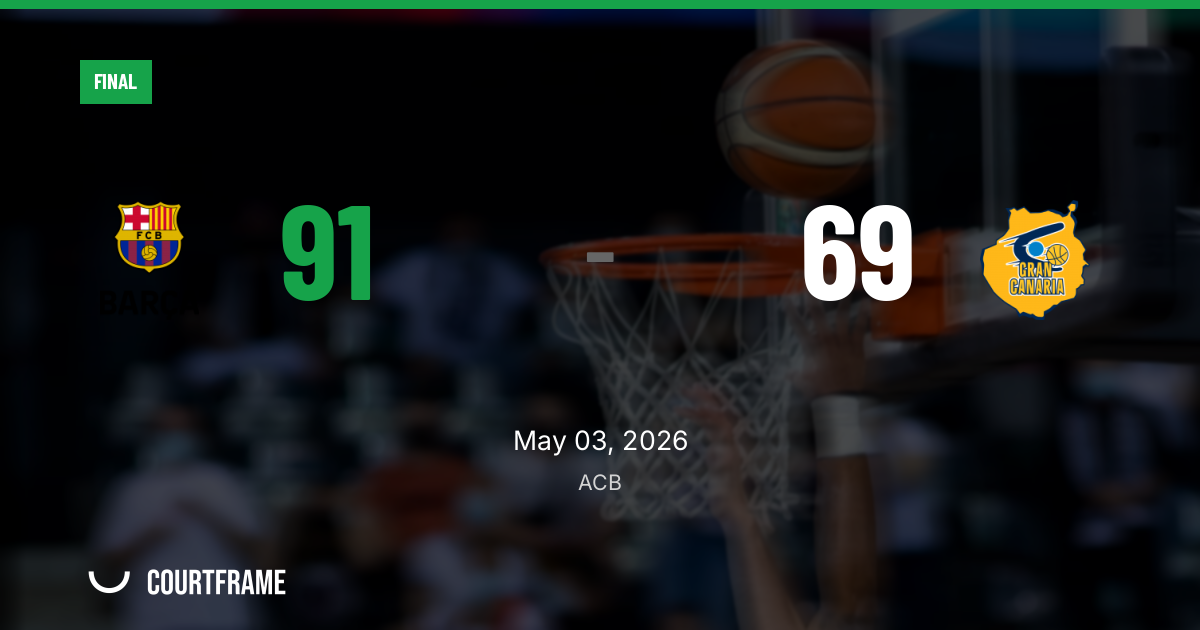
Barcelona did not leave much room for doubt in Game 2.
Behind a 29-point first quarter and a defensive squeeze through the middle periods, Barcelona beat Gran Canaria 91-69 on May 3 at Palau Blaugrana, moving to 2-0 in the best-of-seven series. The hosts entered with a 20-9 record, a 78 percent market-implied win probability and a major CPI edge. The game followed that script.
Gran Canaria arrived with no significant injury absences, but also with less rest and a thinner statistical profile. Barcelona had seven days between games and no contests in the previous week. Gran Canaria had three days of rest and one game in the last seven days. Over 40 minutes, the difference showed in shot quality, rebounding and sustained pressure.
Barcelona seized control early
The first quarter set the terms. Barcelona scored 29 points in the opening period while Gran Canaria managed 20, giving the home side immediate separation. By halftime, Barcelona led 48-34 after holding Gran Canaria to 14 points in the second quarter.
The third quarter tightened Barcelona’s grip. Gran Canaria scored only 12 points in the period, its lowest quarter of the night, and Barcelona carried a 65-46 lead into the fourth. Even when Gran Canaria found more rhythm late with 23 fourth-quarter points, the game had already been shaped by Barcelona’s early shot-making and defensive control.
The final margin reflected a wire-to-wire performance more than a single burst. Barcelona won three of the four quarters and never allowed Gran Canaria to build enough offensive momentum to put pressure on the series favorite.
The matchup indicators held up
This was not a result that came out of nowhere. Barcelona entered with a 20-9 record, a WWLWW form line and strong home splits: 5-2 with 90 average points. Gran Canaria came in 9-21, with a LWWLL form line and a 2-5 away split.
The broader team profile also pointed toward Barcelona. Over the recent sample provided, Barcelona carried a 123 offensive rating, 112.3 defensive rating and plus-10.8 net rating. Gran Canaria’s profile was far closer to neutral at 115.8 offensively, 115.6 defensively and plus-0.2 net.
The CPI matchup was even more pronounced. Barcelona entered with an 83.97 CPI, ranked third, while Gran Canaria sat at 31.34, ranked 13th. The 52.6 differential showed up in the way Barcelona dictated the game’s physical and tactical terms.
Rebounding and possession control tilted the floor
Barcelona’s rebounding advantage was decisive. The hosts finished with 39 rebounds to Gran Canaria’s 21, a gap that aligned with the pregame profile: Barcelona had a 54.3 rebound percentage in the recent sample, compared with Gran Canaria’s 45.4.
That edge mattered because Gran Canaria could not afford empty possessions on the road. Barcelona also committed fewer turnovers, finishing with 9 to Gran Canaria’s 11, while generating 7 steals to Gran Canaria’s 3. The home side’s ability to protect the ball and disrupt Gran Canaria’s rhythm made it difficult for the visitors to sustain runs.
Gran Canaria entered with a higher turnover rate in the recent sample, 21.6 to Barcelona’s 19.3. Game 2 did not become a turnover avalanche, but the possession battle still leaned clearly toward Barcelona because of the combined rebounding and pressure advantage.
Shot profile told the story
Barcelona’s efficiency came through inside the arc. The hosts shot 31-for-50 on field goals and 4-for-14 from 3-point range, while adding 17-for-24 at the free-throw line. Gran Canaria went 9-for-24 on field goals, 12-for-31 from 3 and 15-for-18 at the line.
Gran Canaria leaned heavily on the perimeter, consistent with its recent three-point rate of 80.8. But Barcelona’s defense prevented that approach from becoming enough to offset the rebounding gap and the early deficit. The visitors made 12 3-pointers, yet still finished with only 69 total points.
Barcelona’s recent statistical identity suggested a team capable of scoring efficiently without needing extreme pace. Its recent true shooting percentage was 76.3, with a 73.9 effective field-goal percentage and a 37.8 percent mark from 3. In Game 2, the 3-point volume was modest, but the overall offensive control remained clear.
Series pressure shifts to Gran Canaria
Barcelona now leads the series 2-0. It has protected home court, played from ahead and turned pre-series advantages into tangible separation. No significant injuries were reported for either team, removing an obvious mitigating factor from the result.
For Gran Canaria, the problem is not just the deficit. It is the manner of the two-game hole. Barcelona’s depth of advantages — form, rest, home performance, CPI, net rating and rebounding profile — translated cleanly into Game 2. Gran Canaria will need more than improved shot-making to change the series. It must find a way to keep Barcelona off the glass, reduce live-ball mistakes and avoid the early-quarter damage that buried it at Palau Blaugrana.
Barcelona entered as the favorite. On Sunday, it played like one.