
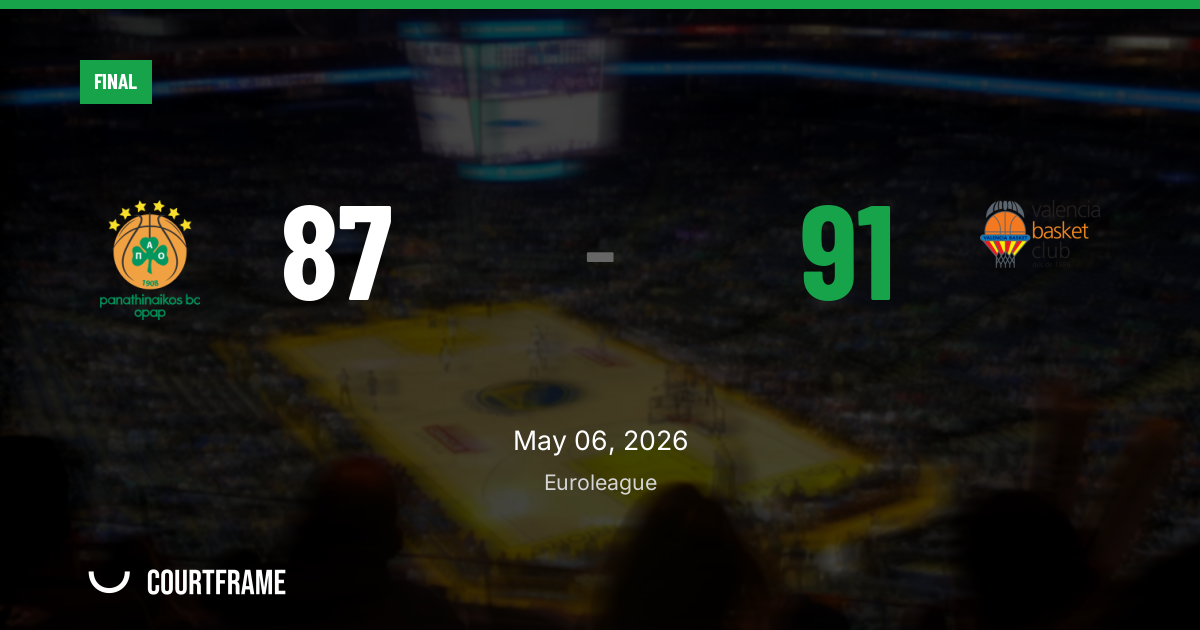
Valencia did not arrive in Athens looking like a team protecting itself on the road. It played like the sharper, deeper and more connected side — and left with the Euroleague Finals tied.
Behind a blistering first half and a 38-31 rebounding advantage, Valencia beat Panathinaikos 91-87 on May 6 at Telekom Center Athens, evening the best-of-seven series at 2-2. The result flipped the pressure back onto Panathinaikos, which entered Game 4 with a 2-1 series lead and a 67.8 percent market-implied probability to win at home.
Valencia led 24-18 after the first quarter and widened the margin with a 28-point second, taking control before halftime. Panathinaikos responded with 27 points in the third and 21 in the fourth, but the early deficit held up.
Valencia’s First-Half Offense Set the Terms
The game was effectively shaped before Panathinaikos found its best rhythm. Valencia scored 52 points across the first two quarters, combining pace control with clean half-court execution. That mattered against a Panathinaikos team that came in averaging 90.7 points in its home split and had no injury concerns to explain a slow start.
The pre-game profile pointed to a Valencia team capable of sustaining elite shot quality. Over its last 10 games, Valencia carried a 117.2 offensive rating, 77.2 true shooting percentage and a 17.4 net rating. Those indicators translated directly into Game 4: Valencia finished with 23 assists and only 10 turnovers, keeping Panathinaikos from turning the game into a scramble.
Jean Montero entered as Valencia’s leading scorer at 16.6 points per game and top playmaker at 5.1 assists per game, while Brancou Badio, Nathan Reuvers, Kameron Taylor and Darius Thompson gave the visitors multiple secondary pressure points. The collective profile mattered more than any single matchup. Valencia’s offense came in with a 100.4 assist rate over the last 10 games, and the ball movement remained a defining feature in Athens.
Panathinaikos’ Rally Was Real, But the Margins Were Too Thin
Panathinaikos did not fold. After being outscored by 13 points in the first half, the home side won the third quarter 27-23 and continued to press in the fourth. Kendrick Nunn, Panathinaikos’ leading scorer at 17.1 points per game, headlined a group with enough shot creation to make the closing minutes tense. Nigel Hayes, Cedi Osman, T.J. Shorts and Kostas Sloukas gave Panathinaikos the depth to fight back into the game.
But the possession battle leaned Valencia. Panathinaikos finished with 22 assists, close to Valencia’s 23, but committed 12 turnovers to Valencia’s 10. The bigger issue was on the glass. Valencia’s 38 rebounds exceeded Panathinaikos’ 31, matching the pre-game advanced profile: Valencia entered with a 53.4 rebound percentage over its last 10 games, compared with 49.6 for Panathinaikos.
That edge denied Panathinaikos the clean finish it needed after its second-half surge. The hosts had the better rim protection line with four blocks to Valencia’s one, but Valencia’s eight steals and superior rebounding helped offset that defensive resistance.
The Data Pointed Toward a Dangerous Underdog
The market treated Panathinaikos as the favorite, but the underlying numbers never made Valencia look like a typical road underdog. Valencia entered with the stronger record at 25-13, better recent form at WWWWL, and the superior CourtFrame Performance Index profile: a 93.27 CPI, ranked No. 2, compared with Panathinaikos’ 64.01 CPI, ranked No. 5.
The CPI differential of minus-29.3 from the Panathinaikos perspective was a warning sign. So was Valencia’s trend line: plus-8.8 entering the game, while Panathinaikos carried a minus-4.8 trend. Game 4 followed that direction more than the market price.
Both teams came in with identical rest conditions — five days off and one game in the previous seven days — and neither had significant injuries reported. That stripped away the usual external explanations. Valencia simply executed better for longer stretches.
Series Reset at 2-2
Panathinaikos still owns the home profile of a contender, with a 66.7 percent win rate in its home split entering the game and a roster built around high-level creators. But Game 4 exposed the narrowness of the matchup. Valencia’s combination of ball movement, rebounding and first-half shot-making was enough to overcome the road environment and the series deficit.
For Valencia, the win does more than tie the Finals. It validates the pre-game indicators that suggested this was one of the strongest teams in the competition, regardless of venue. For Panathinaikos, the task is immediate: start faster, clean up the possession margins and keep Valencia from dictating the first half again.
After four games, there is no longer separation in the series. There is only a reset — and Valencia has seized the momentum.