
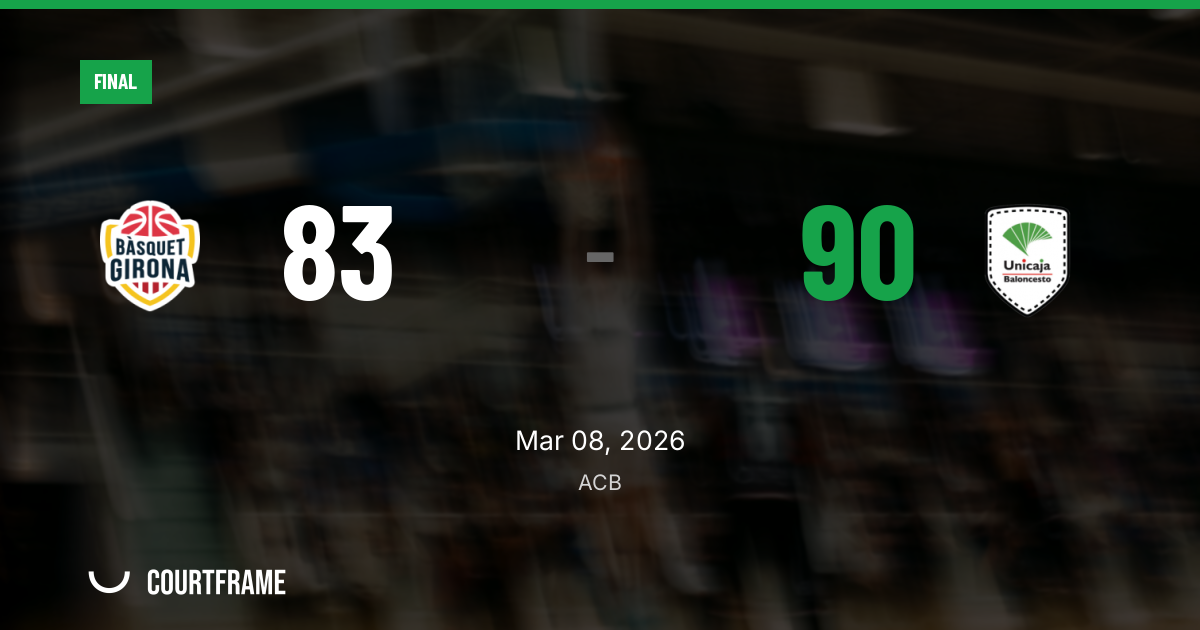
Unicaja arrived at Pavelló Fontajau with momentum and left with a road win, outlasting Bàsquet Girona 90-83 on March 8, 2026 in the ACB’s 2025-26 season. The visitors did their damage early, then leaned on composure and connectivity to absorb Girona’s best punch after the break.
Game flow: Unicaja’s first-half control, Girona’s third-quarter push
The story was written in two distinct halves. Unicaja won the opening quarter 20-17, then broke the game open in the second, outscoring Girona 27-16 to take a 47-33 lead into halftime. That 14-point cushion mattered, because Girona flipped the energy in the third, winning the period 26-19 to cut the deficit to seven (66-59) heading to the fourth.
Girona matched Unicaja 24-24 in the final quarter, but couldn’t find the extra defensive stops needed to erase the early hole. Unicaja’s ability to keep the game on its terms—especially after the third-quarter swing—was the separator.
Key differentiator: Assisted offense and shot quality
With limited shooting and rebounding data available, the clearest statistical edge comes from playmaking. Unicaja finished with 25 assists to Girona’s 20, a meaningful gap in a seven-point road win. That assist advantage reflects cleaner offensive sequencing: more possessions ending in organized advantages rather than late-clock improvisation.
In a game where Girona’s comeback hinged on pace and rhythm coming out of halftime, Unicaja’s passing helped stabilize the fourth quarter. Even as Girona’s pressure rose, the visitors continued to generate enough quality looks to keep the margin from collapsing.
Turning points
Second-quarter separation
The 27-16 second quarter was the swing segment. Unicaja’s ability to extend the lead before halftime forced Girona into chase mode for the final 20 minutes—and that’s a costly way to live against a team that can manage the game with ball movement.
Girona’s third-quarter response, and the answer
Girona’s 26-point third quarter gave Fontajau life and briefly shifted the pressure onto Unicaja. But the visitors avoided the kind of turnover-heavy, rushed possessions that typically fuel a full comeback. The fourth quarter became a possession game, and Unicaja’s early work plus steadier execution carried them home.
What it means going forward
For Unicaja, the win reinforces their profile as a team that can win away from home by controlling structure: build a lead, share the ball, and survive the inevitable run. They improved on a 14-7 record and kept their strong recent form intact (WLWWW).
For Girona, now 10-11, the mixed message is clear. The fight after halftime showed their ceiling when the defense and tempo click, but the first-half deficit—especially the second quarter—left too little margin. Their recent form (LWLWW) suggests competitiveness, yet this one underlined how quickly a single cold stretch can dictate the night.