
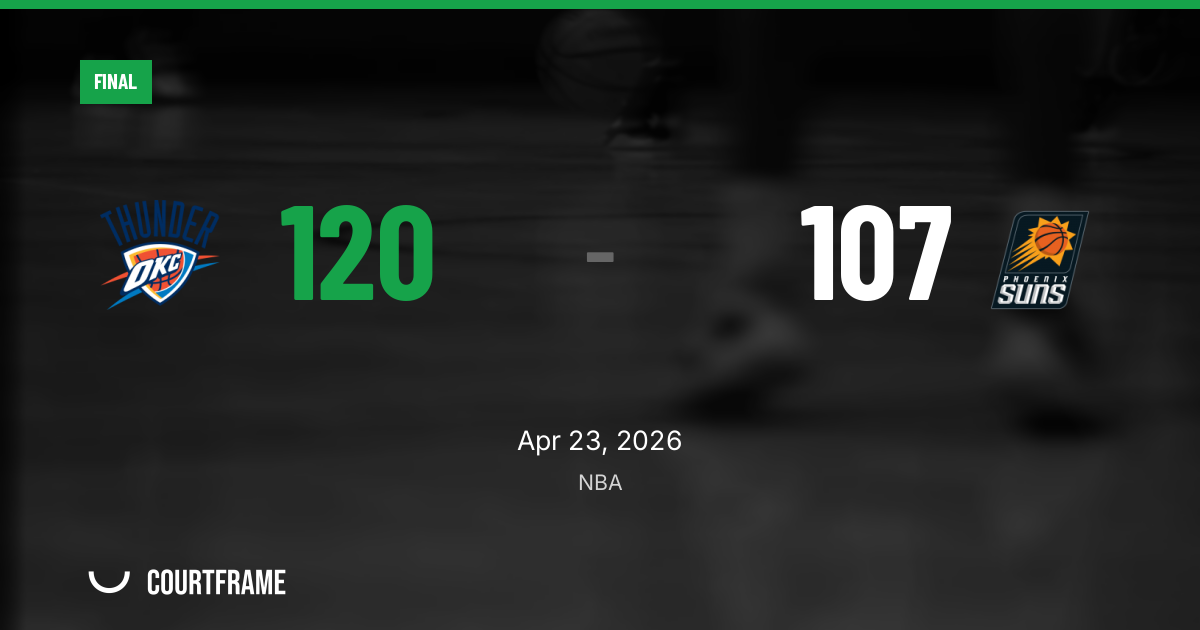
Oklahoma City didn’t need a perfect night — it needed separation. It got it in two decisive bursts, hanging 35 points in the second quarter and 35 more in the third to put Phoenix away in a 120-107 win Thursday at Paycom Center.
The Thunder (64-18) absorbed a competitive opening, then dictated the middle 24 minutes. Phoenix (45-37) won the fourth quarter 30-20, but the game was effectively decided by the time the Suns made their late run.
Game flow: OKC’s middle quarters decided it
The first 12 minutes were essentially even: Oklahoma City 30, Phoenix 29. From there, the Thunder’s advantage showed up in the kind of sustained scoring pressure that has defined their recent profile.
Oklahoma City won the second quarter 35-28 to take a 65-57 lead into halftime, then delivered the knockout in the third, again winning 35-20. That 70-48 combined margin across the second and third quarters created a 100-77 cushion entering the fourth — too much for Phoenix to overcome even with its 30-point closing frame.
Why this result tracked with the pregame indicators
The market treated this as a Thunder-heavy matchup (home implied probability 91.3%), and the underlying form data pointed in the same direction. Over the last 10 games analyzed, Oklahoma City carried a massive edge in efficiency: a 124.7 offensive rating paired with a 103.6 defensive rating (plus-21.1 net rating). Phoenix entered with a 111.8 offensive rating and a 114.1 defensive rating (minus-2.4 net rating).
That gap showed up in the middle quarters, where Oklahoma City’s shot-making and execution created repeated scoring waves. The Thunder’s recent efficiency markers — 75.3% true shooting and 73.3% effective field goal percentage across the 10-game sample — are the profile of a team that can turn a two-point game into a 20-point game quickly when it finds a groove.
Turnovers and connectivity: the possession battle leaned Thunder
Even without play-by-play turnover totals from this game, the matchup set up cleanly: Oklahoma City’s recent turnover rate (17.2) versus Phoenix’s (21.3) suggested the Suns were more likely to leak possessions. Combine that with OKC’s extremely high recent assist rate (96.1) compared to Phoenix (79.3), and the blueprint is clear — the Thunder were positioned to generate cleaner looks more consistently.
That’s exactly what the scoreline implies: Phoenix needed a big fourth quarter just to make the final margin respectable, while Oklahoma City’s advantage was built earlier through steadier offense and fewer empty trips during the game’s highest-leverage stretch.
Context that mattered: records, rest, and availability
Oklahoma City entered 64-18 and had been strong at home (16-4, 116.1 average points). Phoenix arrived 45-37 with a more uneven road profile (7-10, 111.1 average points). Both teams had three days of rest, but OKC had played just one game in the last seven days compared to Phoenix’s two — a small edge in schedule load that can matter when the game turns into a sprint during the middle quarters.
On the injury front, Oklahoma City remained without Thomas Sorber (out, right ACL). Phoenix listed Grayson Allen (left hamstring), Jordan Goodwin (left calf), and Mark Williams (left foot third metatarsal) as questionable in the pregame report, adding volatility to a rotation already facing a steep matchup.
What it means going forward
For Oklahoma City, this was a clean reminder of its defining trait: when the offense is humming, the Thunder can decide games in short, brutal segments. For Phoenix, the fourth-quarter response was real, but the 48-point deficit across the second and third quarters underscored the challenge against elite teams — the margin for error shrinks fast when you can’t control possessions and shot quality for sustained stretches.