
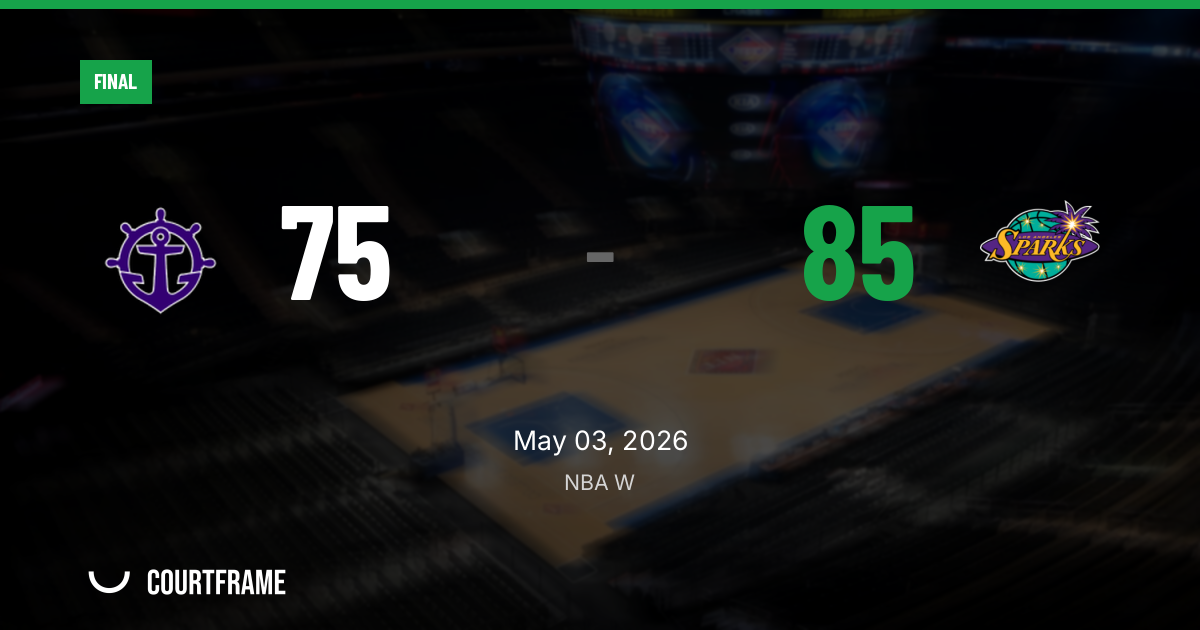
Los Angeles Sparks W did not need long to impose the shape of the game.
A 19-9 first quarter gave the Sparks immediate separation, and their 29-point second quarter created the cushion that carried them through an 85-75 win over Portland W on May 3, 2026, at Moda Center. Portland kept pushing after halftime, but the opening deficit and a turnover-heavy night left too much ground to recover.
The Sparks moved to the result the data suggested was available. Los Angeles entered with a 99.9 offensive rating, a 91.5 defensive rating and a plus-8.4 net rating in the available advanced sample. Portland came in at minus-6.0 net rating with a 27.9 turnover rate. On Sunday, the same pressure point surfaced again: Portland committed 24 turnovers, four more than Los Angeles, and finished with fewer assists, fewer steals and fewer blocks.
Fast start decides the night
The first quarter was the cleanest separator. Los Angeles held Portland to nine points in the opening period while scoring 19, immediately forcing the home side into chase mode. Portland’s offense stabilized from there — 23 points in the second, 22 in the third and 21 in the fourth — but the Sparks had already built the framework of the game.
The second quarter was the decisive offensive burst. Los Angeles scored 29 in the period, its best quarter of the night, and went into halftime having put up 48 points. Portland had 32 at the break, meaning the Sparks’ halftime edge matched the biggest problem in the matchup: Portland’s margin for error was too thin against a team entering with a superior efficiency profile.
Portland did win the fourth quarter 21-13, but that rally came after Los Angeles had already done enough damage. The Sparks’ 24-point third quarter prevented Portland from turning the game into a one-possession finish.
Sparks’ passing profile shows up
Los Angeles entered with a major assist-rate advantage in the early-season data, and that translated directly into the box score. The Sparks finished with 22 assists, compared with Portland’s 15. That gap mattered because both teams dealt with turnover issues — Los Angeles had 20, Portland had 24 — but the Sparks created more connected offense when they did get into actions.
Los Angeles also held small but important margins across possession stats. The Sparks had 31 rebounds to Portland’s 30, 10 steals to Portland’s eight and four blocks to Portland’s two. None of those edges were overwhelming in isolation. Together, they reinforced the same theme: Los Angeles generated more disruption, more ball movement and more resistance at the rim.
The shot profiles also reflected the matchup. Los Angeles was 17-for-33 on two-point field goals, 9-for-31 from 3-point range and 24-for-32 at the foul line. Portland went 20-for-36 inside the arc, 4-for-18 from 3 and 23-for-30 at the line. Portland found enough interior efficiency and free throws to stay competitive, but the 3-point gap was a major swing: Los Angeles made five more threes.
Pregame indicators pointed toward Los Angeles
This was not a result that came from nowhere. The Sparks entered with the stronger early-season advanced profile, including a 71.2 true shooting percentage and 65.2 effective field goal percentage in the available sample. Portland’s shooting indicators were solid — 64.9 true shooting and 62.5 effective field goal percentage — but the broader team profile tilted toward Los Angeles.
The CPI matchup was even more lopsided. Los Angeles entered with a 99.69 CPI, ranked second, while Portland was at 0.00 and ranked 16th. The differential was listed at minus-99.7 from Portland’s perspective. That gap captured the pregame expectation more than the final 10-point margin did: the Sparks were the cleaner, more complete side entering the night.
Schedule context did not create a clear excuse for Portland. The home team had three days of rest and one game in the previous seven days, while Los Angeles entered with no listed fatigue burden and no games in the last seven days. Both teams also had clean injury reports, so the outcome leaned more toward execution than availability.
Portland’s turnover issue remains the concern
Portland’s offensive flashes were real. The home team scored at least 21 points in each of the final three quarters and got to the line 30 times. But the 24 turnovers undercut those gains and fit a larger pattern from the early data, where Portland had been averaging 20 turnovers with a 27.9 turnover rate.
That is the central issue coming out of this game. Portland’s assist rate in the available sample suggested the ball could move — and the team had averaged 15.5 assists — but against Los Angeles, the passing production did not offset the giveaways. Fifteen assists against 24 turnovers is not a sustainable ratio, especially against a team with enough creation to punish empty trips.
Los Angeles had its own ball-security problems with 20 turnovers, but the Sparks had the better counterweights: 22 assists, 10 steals, four blocks and a double-digit scoring lead built early. That combination gave them enough control to absorb an uneven fourth quarter.
Bottom line
Los Angeles won this game in the first half and protected it through the third quarter. The Sparks’ early pressure, superior assist creation and stronger perimeter production aligned with the pregame data and produced an 85-75 road win.
For Portland, the game was competitive after the opening 10 minutes, but not clean enough. The home side showed response after a poor start, yet the turnover count and 3-point deficit defined the night. Against a Sparks team that entered with a top-end CPI profile and positive net rating, that was enough to decide it.