
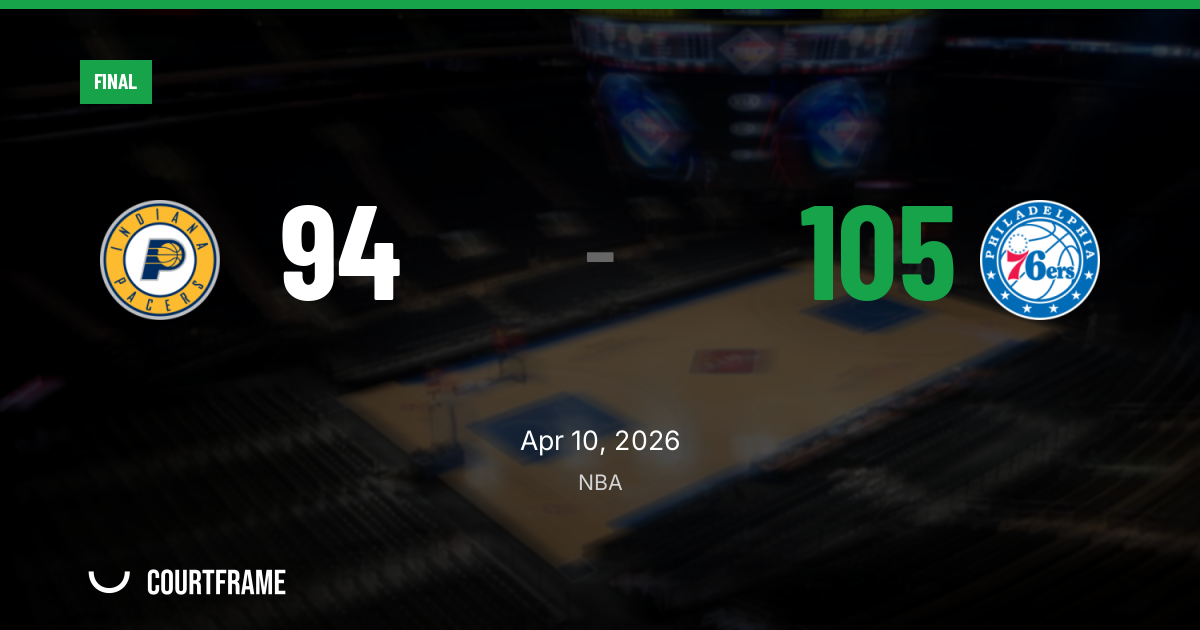
Philadelphia didn’t need a barrage of threes to take care of business. The 76ers won the possession battle, owned the third quarter, and closed out a 105-94 road win over the injury-ravaged Pacers on April 10 at Gainbridge Fieldhouse.
The Sixers (44-37) came in on zero days’ rest and still played cleaner basketball: just eight turnovers to Indiana’s 21. That gap — plus a 31-26 third quarter that tilted the game — was the separator in a matchup where both offenses labored to generate clean looks late.
Game flow: third-quarter punch, then a controlled finish
Philadelphia set the tone early with a 28-21 first quarter, then traded blows in a 30-30 second to take a 58-51 lead into halftime. The decisive stretch came out of the break: the Sixers won the third 31-26 to push the margin to 12 heading into the fourth, then finished the job despite a low-scoring 16-17 final period.
Indiana never found the sustained offensive rhythm needed to erase that third-quarter damage, and the turnover count kept turning every small run into a reset.
Possessions decided it: turnovers and extra chances
Philadelphia’s biggest edge was ball security. The Sixers committed eight turnovers while forcing 13 steals, a profile that consistently created extra possessions and prevented Indiana from getting set in transition defense. Indiana’s 21 turnovers were a direct tax on an offense already operating without its primary creators.
The Sixers also won the rebounding battle, 58-52, giving them more second looks and further widening the possession gap. Even without elite perimeter shooting (5-for-29 from three), Philadelphia’s shot volume and free-throw pressure were enough to keep the Pacers at arm’s length.
Shooting profile: Indiana’s threes didn’t translate into control
Indiana leaned heavily into the three-point line, taking 50 attempts and making 14. That volume matched their recent tendency in the provided 10-game advanced profile (a high three-point rate), but it didn’t solve the core problem: too many empty possessions. Even with 25 assists, the Pacers couldn’t pair ball movement with ball protection.
Philadelphia, meanwhile, generated points without relying on the arc. The Sixers went 37-for-75 from the field and 16-for-19 at the line, using efficient two-point scoring and free throws to offset the cold three-point night.
Injuries shaped the script
Indiana’s rotation was severely compromised: Tyrese Haliburton (Right Achilles Tendon), Pascal Siakam (Left Ankle), Andrew Nembhard (N/A), T.J. McConnell (Bilateral Hamstring), Aaron Nesmith (Cervical), Ivica Zubac (Rib) and Johnny Furphy (Right ACL) were all listed out, with Jarace Walker (Sacral), Kobe Brown (Lumbar) and Ben Sheppard (Right Hip) questionable. The result looked like a team trying to manufacture offense by committee — and paying for every mistake with immediate Philadelphia runouts and extra possessions.
Philadelphia wasn’t whole either — Joel Embiid (N/a), Cameron Payne (Right Hamstring) and Johni Broome (Right Knee) were out — but the Sixers’ structure held. They kept turnovers low, defended aggressively enough to generate steals, and rode a steady three-quarter advantage to a comfortable finish.
What it means going forward
On a night where the pregame CPI differential favored Philadelphia (49.48 to 26.16), the game played to the indicators: the better team, even shorthanded and on no rest, found the cleaner path to points by winning the possession battle. Indiana (19-62) showed flashes — particularly in matching the Sixers in the second quarter — but the combination of absences and turnover volume left too thin a margin for error.