
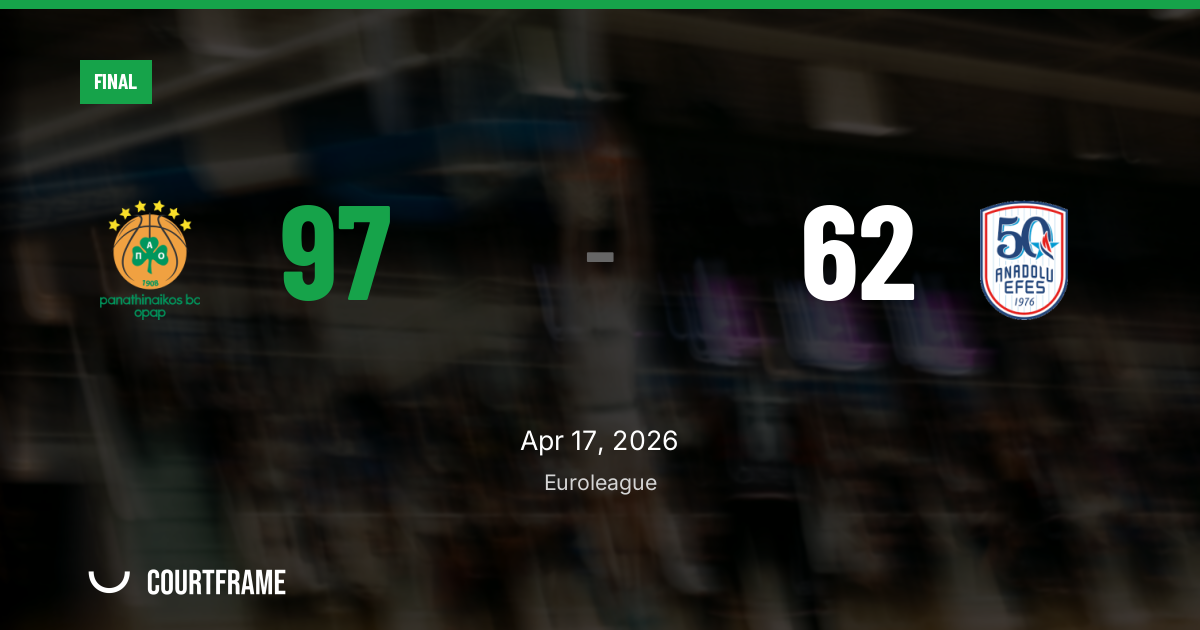
Panathinaikos didn’t just win Thursday — it erased Anadolu Efes after halftime.
Behind a 52-24 second half and a clinic-level possession game (29 assists, six turnovers), Panathinaikos rolled to a 97-62 EuroLeague Regular Season win at Telekom Center Athens. The result matched the pregame profile: a 22-16 home team with an 83.3% market-implied win probability and a massive CPI gap (70.81 vs. 33.08) played like it.
The swing: a third-quarter knockout
The game was still within reach at intermission — Panathinaikos led 45-38 after Anadolu Efes put up 22 points in the second quarter. Then Efes’ offense collapsed into a five-point third quarter, and the night was over.
Panathinaikos won the third 26-5, turning every empty Efes possession into flow offense the other way. By the time the fourth quarter mirrored the third (another 26-19 edge), the margin reflected total control rather than late-game noise.
Possession math decided it
This was a blowout built on the cleanest separator in EuroLeague games: how often you give the ball away, and what you do with it when you keep it.
- Panathinaikos: 29 assists, six turnovers
- Anadolu Efes: 15 assists, 15 turnovers
That gap showed up in the shot quality and rhythm. Panathinaikos shot 30-of-50 from the field and 8-of-18 from three, pairing efficient finishing with consistent advantage creation. Efes, meanwhile, leaned heavily into the three-point line and paid for it: 5-of-25 from deep. When your perimeter volume doesn’t come with perimeter efficiency — and it’s paired with 15 turnovers — the offensive floor caves in.
Panathinaikos’ identity translated, Efes’ didn’t
The pregame indicators pointed to a stylistic mismatch. Over their last 10 analyzed games, Panathinaikos brought an 113.9 offensive rating with a 70.4% true shooting and an 85.2% assist rate — numbers that suggest a team comfortable generating clean looks without needing chaos. That’s exactly how this win read: organized, connected, and ruthless once the screws tightened in the third.
Efes entered with a lower offensive baseline (100.8 offensive rating over the same 10-game sample) and a much higher turnover tendency (24.6% turnover rate). Against a Panathinaikos group that coughed it up just six times and also posted six steals, those weaknesses weren’t survivable — especially once Efes stopped scoring in the half-court after the break.
Rebounding stayed neutral — everything else tilted
Efes competed on the glass (32 rebounds to Panathinaikos’ 35), but the game never turned on second chances. It turned on shot creation and shot conversion.
Panathinaikos’ assist volume (29) nearly doubled Efes’ (15), and the home side’s efficiency from the floor made every possession feel like it carried extra weight. Efes’ two steals and three blocks weren’t enough to manufacture the extra possessions they needed to offset the shooting gap.
Context that mattered
Both teams came in with identical rest profiles — seven days off, no games in the last week — and neither reported significant injuries. This wasn’t fatigue or availability. It was execution.
Panathinaikos also played to its home split profile: they entered averaging 91.7 points in their home split sample and finished at 97. Efes, with a 25% away win rate and 75.3 points per game in their away split sample, never found a stable offensive gear once Panathinaikos raised the defensive pressure after halftime.
What it means going forward
For Panathinaikos, this was a reminder of the team’s ceiling when the ball doesn’t stick and the turnovers stay low: high-efficiency offense fueled by passing, not isolation.
For Efes, the third quarter was the warning flare. Heavy three-point reliance is workable only if you can protect the ball and generate quality attempts. Against a connected defense — and especially on the road — the margin for error disappears fast.