
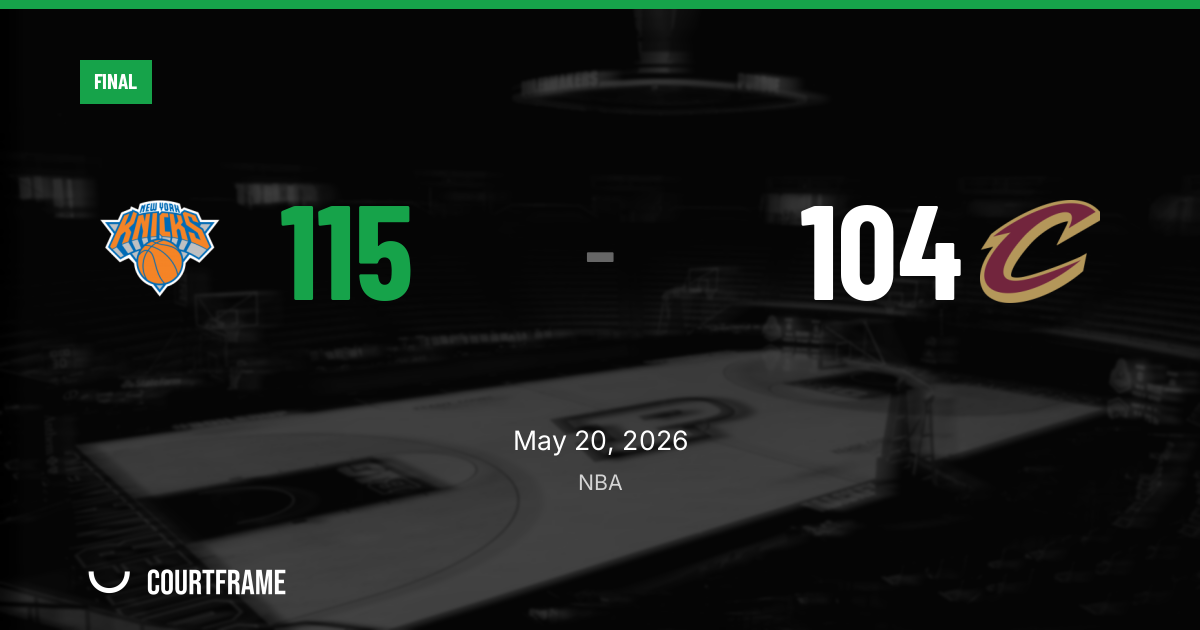
The Knicks did what a top home team is supposed to do in May: absorb the run, win the margins and finish the game with force.
New York beat Cleveland 115-104 on Wednesday night at Madison Square Garden, taking a 2-0 lead in the best-of-seven NBA semifinal series. The Cavaliers surged in the middle quarters, but the Knicks owned the fourth, closing with a 32-point period after being outscored 67-46 across the second and third.
The result tracked with the pregame profile. New York entered with a 53-29 record, a 78.3 percent home win rate and nine days of rest. Cleveland came in 52-30 but was playing on two days’ rest after three games in the previous seven days. The market also leaned heavily toward the Knicks, with a 70.1 percent implied probability across six bookmakers.
Fourth Quarter Flips the Game
Cleveland’s path into the game came through a sharp response after a slow start. The Cavaliers scored just 16 points in the first quarter, then answered with 32 in the second and 35 in the third. That 67-point middle stretch put real pressure on New York’s defense and tested whether the Knicks’ long layoff would become rust rather than recovery.
It did not. New York’s fourth quarter was the separator. The Knicks scored 32 points in the final period while holding Cleveland to 18, turning a contested game into an 11-point win. That late swing was the clearest reflection of the fatigue gap: New York had fresher legs, more shot-making stability and enough defensive pressure to slow a Cavaliers offense that had found rhythm in the middle of the night.
The Knicks also carried a 14-3 edge in overtime scoring as listed in the quarter breakdown, further underscoring how decisively they controlled the extra late-game segment of the box score data.
Rebounding and Turnovers Define the Margins
New York entered the matchup with the stronger recent rebounding profile, posting a 56.3 rebound percentage over the previous 10-game sample compared with Cleveland’s 51.4. That showed up again. The Knicks won the glass 47-38, a critical edge in a game where both teams had turnover issues.
Cleveland committed 21 turnovers, one more than its already elevated recent average of 16.4. New York had 19 turnovers, also above its recent 13.8 average, but the Knicks offset those giveaways with rebounding volume and a more efficient interior scoring foundation. New York shot 32-for-56 on field goals, while Cleveland went 20-for-40 and leaned heavily into the perimeter game.
The Cavaliers attempted 50 3-pointers and made 16. That shot profile fit their recent trend — Cleveland entered with an 84.5 three-point rate in the provided advanced sample — but the volume did not produce enough separation. New York, by contrast, made 10 3s on 32 attempts and still controlled the scoring environment through free throws, rebounding and fourth-quarter execution.
Knicks’ Pre-Series Strengths Hold Up
The Knicks entered Game 2 with the stronger CourtFrame Performance Index profile: an 89.08 CPI, ranked third, compared with Cleveland’s 80.84, ranked fifth. The 8.2-point differential showed up in the way New York handled the key pressure points.
Recent-form indicators also favored the Knicks in the areas that matter most in playoff basketball. Over the 10-game sample, New York carried a 120.9 offensive rating and plus-11.4 net rating. Cleveland was strong as well, with a 113.7 offensive rating and plus-8.3 net rating, but the Cavaliers’ higher turnover rate — 22.1 compared with New York’s 17.7 — was always a potential pressure point against a rested, physical Knicks team.
That weakness became costly. Cleveland’s 21 turnovers gave New York enough transition and possession leverage to survive the Cavaliers’ third-quarter push. The Knicks were not perfect with the ball, but they were the more stable team when the game tightened.
Health and Rest Tilt Toward New York
The injury report also favored the home side. New York had no significant injuries reported, while Larry Nance Jr. was listed as questionable for Cleveland due to illness. The larger issue for the Cavaliers was the schedule: three games in seven days before facing a Knicks team coming off nine days of rest.
That gap mattered late. Cleveland had the stronger third quarter, scoring 35 points, but could not sustain the pressure. New York’s fourth-quarter response was not just shot-making; it was pace control, possession control and physical follow-through on the glass.
Series Outlook
The Knicks now lead the series 2-0 with no elimination game looming yet, but the shape of the matchup is becoming clear. Cleveland has enough creation with Donovan Mitchell, James Harden, Evan Mobley and Jarrett Allen to generate stretches of offense, and the Cavaliers’ 35-point third quarter proved they can bend New York’s defense.
But the Knicks have controlled the broader structure. Their home dominance, rebounding base, cleaner advanced profile and late-game endurance have all translated through two games. With Jalen Brunson, Karl-Anthony Towns, OG Anunoby, Mikal Bridges and Josh Hart anchoring a deeper two-way framework, New York has forced Cleveland to play from behind in both the game and the series.
Game 2 was not a wire-to-wire cruise. It was more telling than that. The Knicks took Cleveland’s best middle-quarters surge, then won the fourth by 14 points and walked out of Madison Square Garden with command of the semifinal.