
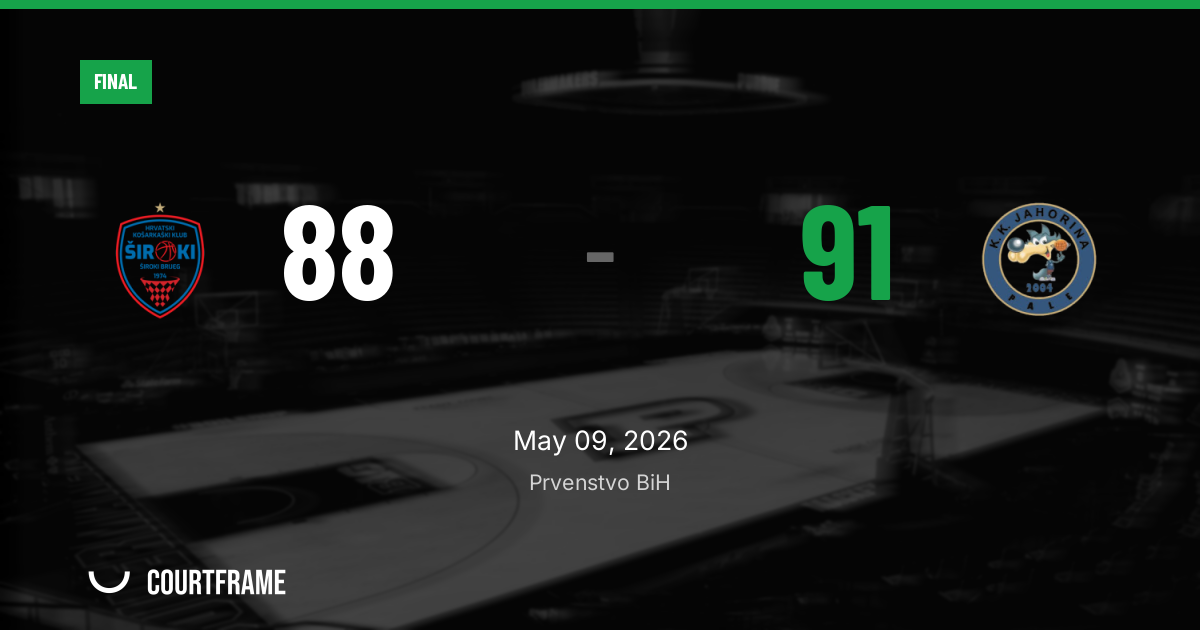
Jahorina walked into Gradska sportska dvorana Pecara as the lower-ranked side in the matchup profile. It left with control of the series.
Behind a 10-7 overtime edge, Jahorina defeated Siroki Brijeg 91-88 on May 9 in Game 2 of their Prvenstvo BiH playoff series, moving ahead 2-0 in a best-of-seven round. The win was not just a road result. It was a direct challenge to the indicators that pointed toward Siroki: a 20-4 record, an 85.7 percent home win rate and the No. 2 CPI mark at 84.81.
Jahorina entered at 14-10 with a 56.56 CPI, ranked fifth, but its recent upward CPI trend carried into the night. The visitors did enough early, absorbed Siroki’s third-quarter push and found the cleaner finish in overtime.
How the game turned
Jahorina set the tone immediately, winning the first quarter 24-19 and adding a 21-point second quarter to take a 45-41 halftime lead. That start mattered. Siroki had the better season-long profile and came in averaging 89.8 points per game, but Jahorina forced the home side to chase the game from the opening stretch.
Siroki answered in the third quarter, outscoring Jahorina 25-22 to tighten the margin. The fourth quarter became a grind: Jahorina scored 14, Siroki scored 15, and neither side could create enough separation before overtime.
In the extra period, Jahorina’s 10-7 advantage decided it. For a team that entered with a negative net rating over its last 10 analyzed games, this was a high-leverage correction. Jahorina did not merely hang around; it won the possession game late in the one segment that mattered most.
Jahorina’s shot profile beat the matchup math
The pre-game data framed Siroki as the more efficient team. Over the last 10 analyzed games, Siroki carried a 110 offensive rating, 66.7 true shooting percentage and 64.3 effective field goal percentage. Jahorina’s offensive rating sat at 102.9 with a minus-4 net rating.
But this game did not follow that clean hierarchy. Jahorina’s team line showed 24 made field goals on 38 attempts, plus 9 made threes on 30 attempts and 16 free throws on 28 attempts. The visitors generated enough scoring volume from the perimeter and the foul line to offset Siroki’s rebounding and ball-security advantages.
Siroki finished with 42 rebounds to Jahorina’s 36 and committed only six turnovers. Jahorina had eight turnovers. On paper, that is usually the foundation of a home playoff win. Instead, the game swung on Jahorina’s ability to keep pace offensively and manufacture the final burst in overtime.
Siroki’s strengths were not enough
Siroki did several things that normally travel well in postseason basketball. It moved the ball, finishing with 19 assists. It protected possessions, committing just six turnovers. It controlled the glass by six rebounds. It also came in with no significant injuries reported, so there was no obvious availability explanation for the result.
The issue was conversion from distance. Siroki made 5 of 28 from three-point range, a sharp contrast to a profile built around efficiency and a high three-point rate over the last 10 analyzed games. When a team with Siroki’s offensive rating loses at home despite a turnover edge and a rebounding edge, the half-court math usually tells the story.
Jahorina, meanwhile, matched Siroki with 19 assists and got enough two-way disruption with four steals and three blocks. It was not a dominant defensive box score, but it was sufficient in a game where Siroki needed one more clean scoring stretch to finish the job.
Series context: Jahorina flips home-court pressure
This was the type of game Siroki was expected to control. The hosts entered with a 6-1 home split and an 88.1-point home average, while Jahorina’s away split stood at 4-4 with an 80.8-point average. Both teams were rested — Siroki had six days off, Jahorina had seven — and neither had significant injuries reported.
That leaves the result as a tactical and execution win for Jahorina. The visitors were not aided by a clear fatigue gap or an injury imbalance. They won on the road, in overtime, against a team with the stronger record, better CPI ranking and deeper home dominance.
Siroki’s key names entered with clear production markers: J. McCreary at 20.7 points and 8.3 rebounds per game, Bosnjak Matej at 15.8 points and 7.1 rebounds, Trice D'Mitrik at 14.5 points and 5.3 assists, and Skedelj Miha at 8.6 rebounds. Jahorina countered with its own high-usage group, led by M. Kovacevic at 18.2 points per game, M. Gutalj at 13.9 points and 8.6 rebounds, N. Honor at 13.1 points, and B. Vujadinovic at 12.5 points, 5.4 rebounds and 3.9 assists.
Game 2 reinforced the depth of Jahorina’s challenge. This was not a one-quarter steal. The visitors won the first half, survived Siroki’s best response, then took overtime. Now the series shifts with Jahorina ahead 2-0, and Siroki facing immediate pressure despite entering the round with the stronger statistical profile.