
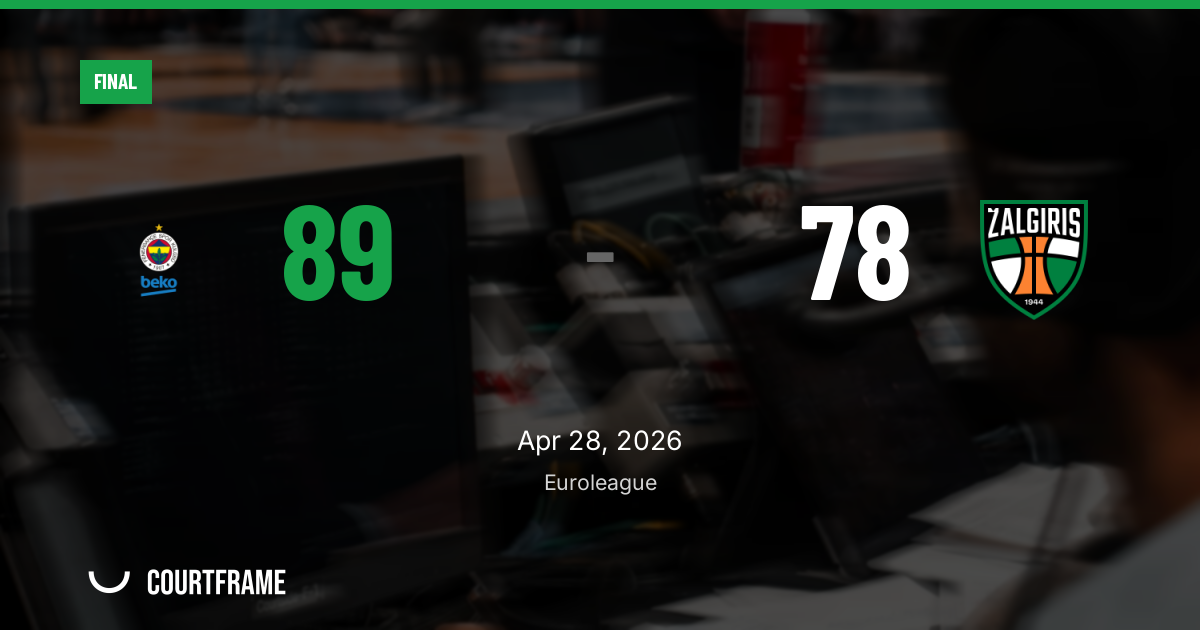
Fenerbahce turned Game 2 into a statement of control.
Behind a decisive second quarter and cleaner ball security, Fenerbahce defeated Zalgiris Kaunas 89-78 on April 28, 2026, at Ulker Spor ve Etkinlik Salonu, moving ahead 2-0 in the best-of-seven Euroleague Finals. The result backed up the market’s view of Fenerbahce as the stronger side at home, where the club entered with a 71.4 percent win rate in its split profile.
Zalgiris arrived with the better recent form, a stronger CPI profile and the higher season scoring average. None of that mattered once Fenerbahce imposed the game’s first major break. After a tight opening quarter, Fenerbahce won the second 25-9, turning a 22-20 edge into a 47-29 halftime lead.
The second quarter decided the night
The first quarter played to the expected balance of a Final: Fenerbahce 22, Zalgiris 20. Then the floor tilted sharply.
Fenerbahce’s 25-point second quarter was the game’s defining stretch, but the defensive number was even louder. Zalgiris managed just 9 points in the period, its lowest-scoring quarter of the night by a wide margin. That drought left Zalgiris chasing for the final 20 minutes, even after a strong third-quarter response.
Zalgiris did win the third quarter 28-18, cutting into the deficit and briefly restoring the offensive rhythm suggested by its pregame profile. But Fenerbahce answered with a 24-point fourth quarter, closing without allowing the game to fully flip.
Fenerbahce’s pressure showed up in the turnover battle
The cleanest statistical separator was possession management. Fenerbahce committed 9 turnovers, while Zalgiris gave it away 13 times. That four-turnover gap mattered in a game where both teams generated efficient looks inside the arc and neither side attempted free throws in the provided team data.
Fenerbahce also had the defensive activity edge: 5 steals and 4 blocks compared with 2 steals and 2 blocks for Zalgiris. That aligned with the game flow. Fenerbahce did not need to win every shot-quality category; it needed to disrupt Zalgiris often enough to prevent its higher-assist offense from controlling the tempo.
Zalgiris still finished with 16 assists to Fenerbahce’s 14, consistent with its pregame assist-rate advantage. But the extra giveaways blunted that creation. Fenerbahce’s defense did not erase Zalgiris’ passing game. It made it less stable.
Shot profile favored Fenerbahce from deep
Fenerbahce finished 26-for-41 from the field in the provided team statistics and hit 10 of 24 from 3-point range. Zalgiris went 22-for-33 overall but only 5-for-22 from beyond the arc.
That perimeter gap was central. Fenerbahce doubled Zalgiris’ made 3s on only two more attempts. It was also a notable reversal of the pregame shooting indicators: Zalgiris entered with a 39.1 percent 3-point mark across the analyzed sample, compared with Fenerbahce’s 35 percent. In Game 2, Fenerbahce’s shot-making from deep created the margin Zalgiris could not match.
The rebounding battle also leaned slightly toward Fenerbahce, 27-24. It was not overwhelming, but it prevented Zalgiris from building the kind of possession cushion needed to survive a cold perimeter night.
Pregame indicators pointed both ways — the venue won out
This was not a simple favorite rolls story. Zalgiris entered with the better CPI, ranked fourth at 70.37 compared with Fenerbahce’s 62.39 and ninth-place rank. Zalgiris also carried the better recent form at WWLWW, while Fenerbahce came in at WLLLL.
But the matchup context still pointed to Fenerbahce having a clear home-court platform. The market implied a 67.4 percent home win probability across 11 bookmakers, and Fenerbahce’s home split showed 5 wins in 7 games with an 81-point average. Zalgiris’ away split was more fragile: 2 wins and 5 losses despite an 85.9-point average.
Game 2 followed that split more than the form guide. Zalgiris had enough offense to make a push, especially in the third quarter. Fenerbahce had the setting, the defensive stretch and the late-game stability.
No injury caveats, no fatigue excuse
Both teams entered without significant injuries reported, and both had 11 days of rest with no games in the previous seven days. That removed two of the usual Finals variables. This was not a game bent by availability or scheduling imbalance.
Instead, it came down to execution: Fenerbahce protected the ball, hit the cleaner perimeter shots and produced the one dominant defensive quarter of the night.
What it means for the series
Fenerbahce now leads the Euroleague Finals 2-0. The series is not at an elimination point, but the pressure has shifted heavily toward Zalgiris.
For Zalgiris, the third quarter offers a path forward. The team can generate offense and still has the playmaking base that made it dangerous entering the Final. But the Game 2 formula is unsustainable if the 3-point gap remains that wide and the turnover count stays tilted toward Fenerbahce.
For Fenerbahce, the takeaway is sharper: the pregame trends did not need to be perfect. In a Finals game at home, one overwhelming quarter and a cleaner possession profile were enough to take command.