
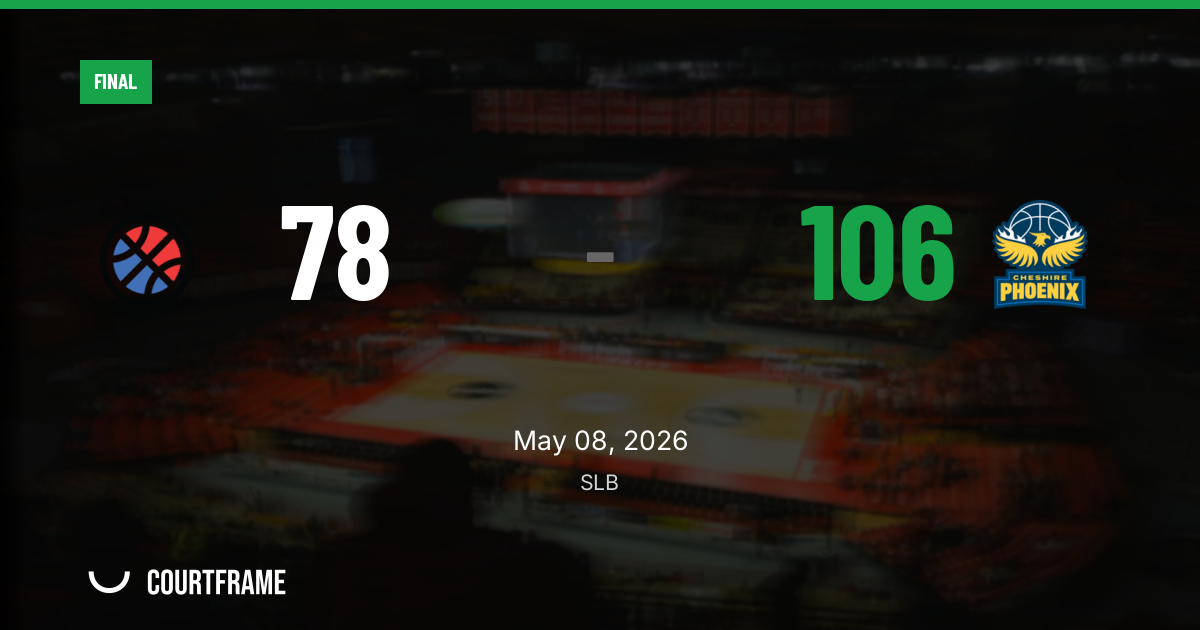
Cheshire Phoenix arrived in Manchester with the profile of the better team. On Friday night, they played like it.
The Phoenix beat Manchester Basketball 106-78 in Game 2 of the SLB semi-finals at the National Basketball Performance Centre, taking a 2-0 lead in the best-of-seven series. After trailing by two after the first quarter, Cheshire won the final three periods by a combined 30 points and turned the game with a 30-14 third quarter.
The result followed the pre-game indicators closely. Cheshire entered with a 20-12 record, the league’s top CPI mark at 100.00, a positive CPI trend of 7.4 and a strong recent profile built around efficient offense and defensive disruption. Manchester, ranked third by CPI at 56.07, came in with a negative CPI trend of minus-15.1 and had shown warning signs in its last 10-game sample, particularly with a 20.6 turnover rate and a minus-5.1 net rating.
Cheshire’s pressure breaks the game open
Manchester started well enough, taking the first quarter 23-21, but Cheshire’s defense changed the tone from there. The Phoenix forced 19 Manchester turnovers, finished with 16 steals and blocked eight shots. That pressure cut into Manchester’s rhythm and prevented the home side from building the type of half-court flow it needed to keep pace.
Cheshire’s defensive activity was consistent with its recent form. Over the previous 10 games analyzed, the Phoenix averaged 8.7 steals and 4.5 blocks while carrying a 97.7 defensive rating. In Game 2, that disruption showed up everywhere: passing lanes, rim protection and the tempo of Manchester’s possessions.
Manchester finished with 16 assists against 19 turnovers, a ratio that reflected how often Cheshire made the home team operate under stress. The Phoenix, by contrast, moved the ball more cleanly, recording 23 assists despite 16 turnovers.
The third quarter decides it
The game’s defining stretch came immediately after halftime. Cheshire led 47-40 at the break, then delivered a 30-14 third quarter that effectively ended the contest. That period turned a manageable deficit for Manchester into a 23-point hole entering the fourth.
It was the clearest expression of the matchup gap. Cheshire entered with the stronger offensive profile: 119.2 offensive rating, 73.0 true shooting percentage and 71.7 effective field-goal percentage across the last 10 games analyzed. Manchester’s comparable marks — 105.1 offensive rating, 66.2 true shooting percentage and 62.5 effective field-goal percentage — were solid but not at the same level.
Once Cheshire’s defense started producing extra possessions and its offense settled in, Manchester had no counterpunch strong enough to shift the game back.
Rebounding and depth tilt toward Phoenix
Cheshire also controlled the glass, outrebounding Manchester 46-35. That matched the broader trend coming in: the Phoenix had a 54.5 rebound percentage over the last 10 games analyzed, compared with Manchester’s 51.2. Cheshire also averaged 43.2 rebounds in that span, while Manchester averaged 36.4.
That edge mattered because Manchester needed to limit the margins. The home side entered with a 19-13 record and no significant injuries reported, so availability was not the issue. The issue was execution against a team with more two-way consistency. Cheshire had also been stronger in its recent split profile, going 7-2 with 96.4 average points in the provided sample, while Manchester was 4-6 with 84.5 average points.
The Phoenix’s balance made the matchup difficult to solve. P. Robinson came in as Cheshire’s leading scorer at 20.4 points per game, supported by White Skyler, Rideau Laquincy, F. A. Policelli and T. Cameron. Manchester had its own scoring structure with M. Jones, J. Johnson, P. Smith and M. Donovan, but the Phoenix’s collective defensive pressure prevented the game from becoming a clean shot-making contest.
What it means for the series
Cheshire now owns a 2-0 series lead in the semi-finals, and the manner of the win is as important as the margin. This was not a late-game escape or a shooting-only result. It was a comprehensive performance built on the same advantages that showed up before tip: better recent net rating, stronger defensive efficiency, higher rebound profile and a major CPI edge.
Manchester has no reported injury excuse and had the same five days of rest as Cheshire, though the Phoenix had played two games in the previous seven days compared with Manchester’s one. Fatigue did not show. If anything, Cheshire looked sharper as the night progressed.
For Manchester, the adjustment points are direct: protect the ball, survive Cheshire’s pressure and keep the rebounding battle closer. Without that, the series could continue to reflect the gap that Game 2 made impossible to ignore.