

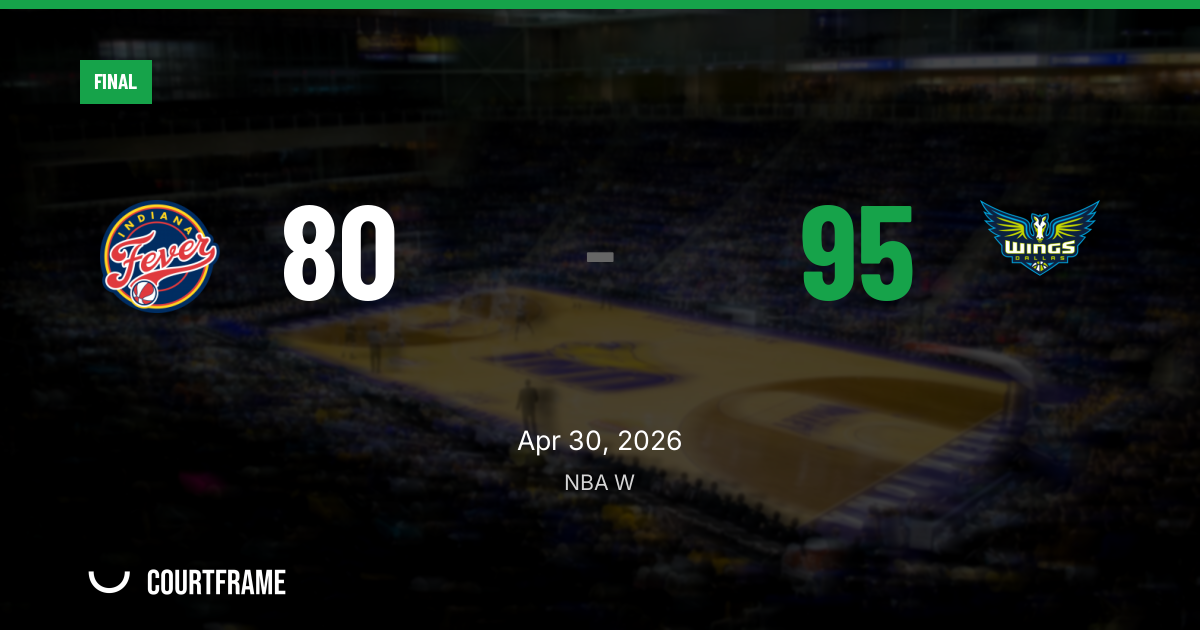
Dallas did not need a perfect game to make an opening-night statement. The Wings absorbed Indiana’s 29-point first quarter, detonated for 36 in the second and beat the Fever 95-80 on April 30 at Gainbridge Fieldhouse.
The swing was immediate and decisive. Indiana led 29-25 after one quarter, but Dallas won the second 36-17, turning a competitive start into a game controlled by the visitors. The Wings then kept Indiana at arm’s length after halftime, matching enough offense with a 17-point third quarter and closing with another 17 in the fourth.
The result cut against the market lean. Indiana entered with a 66.5 percent implied win probability across 10 bookmakers and was priced as the favorite in several spread ranges, but Dallas’ underlying profile offered warning signs: a stronger CPI at 90.63 compared with Indiana’s 77.79, a higher rank in that matchup index and a sharply positive trend.
Second Quarter Decides the Night
Indiana’s first quarter looked like the version suggested by its early advanced profile: efficient enough, connected enough and dangerous at home. The Fever had entered with a 113.1 offensive rating over two analyzed games, a 71.2 true shooting percentage and an 87.5 assist rate.
But Dallas’ second quarter changed the game’s terms. The Wings scored 36 points in the period, their best stretch of the night, and turned a four-point deficit into a commanding halftime position. Indiana never fully recovered its rhythm, scoring 20 in the third and just 14 in the fourth.
That downturn mattered because the Fever’s pre-game weakness showed up in the box score. Indiana carried a 20.6 turnover rate into the matchup and finished with 17 turnovers. Dallas had its own issue there — 22 turnovers after entering with a 28.8 turnover rate — but the Wings compensated by dominating the glass and shooting more efficiently from the field.
Dallas Wins the Possession Battle on the Glass
The cleanest separator was rebounding. Dallas finished with 45 rebounds to Indiana’s 26, reinforcing the pre-game contrast between the Wings’ 63.4 rebound percentage and the Fever’s 37.1 mark.
That edge gave Dallas the physical foundation it needed, especially on a night when it did not fully protect the ball. The Wings’ profile already pointed toward a team capable of generating volume through rebounding and pace; they entered with a 76.5 pace mark and an average of 45 rebounds. Both indicators translated into a road performance that put pressure on Indiana’s half-court defense.
Indiana’s inability to close possessions limited the value of its defensive activity. The Fever produced 10 steals and three blocks, but Dallas still controlled the broader flow because the rebounding gap was too wide to overcome.
Shot-Making and Free Throws Tell the Efficiency Story
Dallas shot 28-for-47 from the field and 8-for-23 from 3-point range, while Indiana went 20-for-37 overall and 4-for-23 from deep. The Wings also converted 15 of 17 free throws, giving them a steadier scoring base late in possessions.
Indiana generated a large free-throw total, going 28-for-42 at the line, but the missed chances added up in a 15-point game. The Fever entered with a high free-throw rate of 78.3 and again found their way to the stripe, but the conversion rate was not enough to offset Dallas’ rebounding advantage and 3-point edge.
The contrast from deep was especially important. Both teams attempted 23 3-pointers, but Dallas made twice as many. That aligned with the Wings’ early 34.8 percent 3-point shooting mark and punished an Indiana team that came in at 30.6 percent from beyond the arc.
Wings’ Balance Outweighs Fever’s Playmaking Dip
Dallas entered with an 89.3 assist rate and averaged 25 assists in its available sample. The Wings hit that number again with 25 assists, a sign their offense remained connected even through turnover trouble.
Indiana, by contrast, finished with 15 assists after entering with an average of 21. The Fever’s early identity had been built around ball movement, but Dallas disrupted that rhythm after the opening quarter and forced more possessions into lower-value outcomes.
That difference sharpened the impact of Dallas’ key contributors. P. Bueckers entered averaging 20 points, M. Siegrist 18 points and 11 rebounds, and A. James 17 points and seven rebounds. Indiana’s leading early scorers — K. Mitchell and C. Clark at 14 points per game apiece — came into the game as central pieces of a balanced Fever attack, but the team-wide offensive structure did not hold for four quarters.
No Injury Excuses, Just a Road Team Executing Its Profile
Both teams entered without significant injuries reported, so the outcome was less about availability and more about which pre-game indicators traveled. Dallas’ rebounding strength, positive CPI trend and assist-heavy offense all surfaced. Indiana’s efficient shooting profile showed flashes, especially early, but its turnover concerns and rebounding weakness became defining issues.
The Fever had five days of rest and home court. Dallas had no recent game load listed and no games in the previous seven days. Neither side carried a clear injury burden. Once the ball went up, Dallas simply imposed the more sustainable formula.
The Wings leave Indianapolis with a 95-80 win that was more convincing than the pre-game market expected. For Indiana, the opener exposed a familiar equation: shot-making and free throws can keep the Fever competitive, but without cleaner ball security and a stronger rebounding floor, efficient stretches can disappear quickly.