
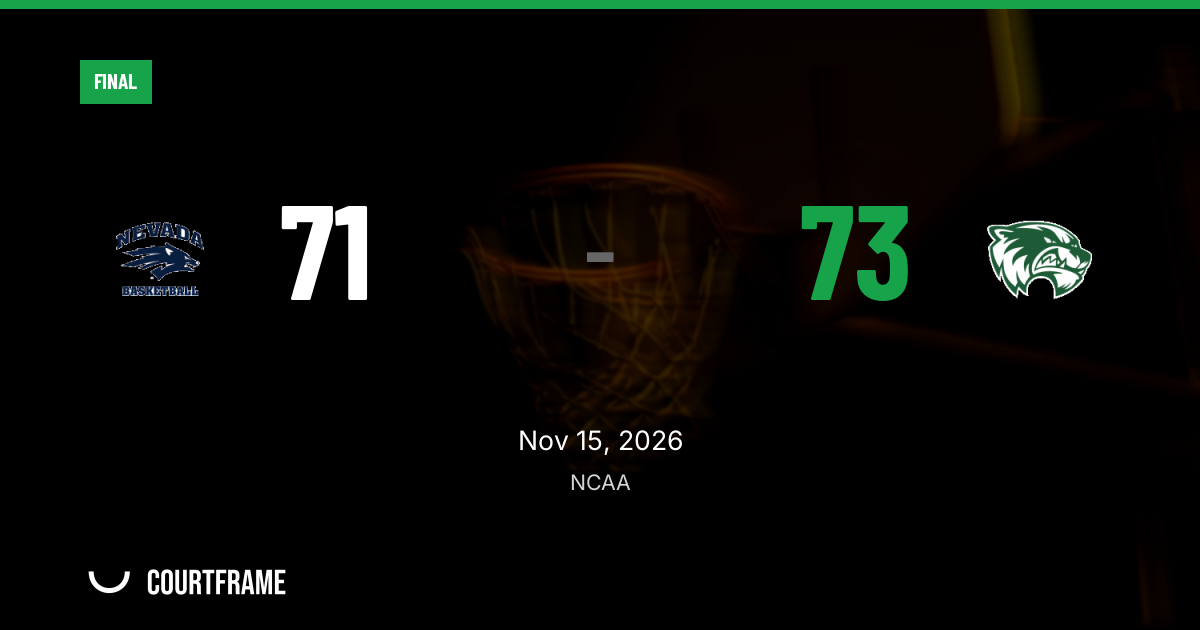
Utah Valley State beat Nevada 73-71 on November 15, 2026, handing Nevada its second loss and moving to 3-0. Nevada fell to 2-2 after a game that stayed within one possession at the finish.
The matchup carried conflicting signals before tipoff. Nevada entered with a 2-1 record, an 81.7 points-per-game scoring average and a 2-1 home split with 84.3 average points. Utah Valley State arrived 2-0, averaging 92.5 points per game overall and 87 points in its away split.
The final score landed well below both teams’ early scoring averages, which made the last possessions more about shot quality, defensive execution and late-game composure than pace or volume. Utah Valley State won despite scoring 19.5 points fewer than its season scoring average entering the game, while Nevada finished 10.7 points below its pregame scoring average.
Utah Valley State’s profile translated in a tight finish
Utah Valley State entered with a CourtFrame Power Index of 66.67, ranked No. 80, compared with Nevada’s 60.66 and No. 137 ranking. That six-point CPI differential pointed toward Utah Valley State having the stronger overall profile, even with Nevada carrying the home designation.
The Wolverines also entered with the sharper trend line. Utah Valley State’s CPI trend was 19.6, while Nevada’s was 3.6. In a two-point game, that pregame separation mattered because Utah Valley State did not need its usual scoring output to validate the matchup edge.
Nevada’s market position was stronger than its CPI position, with an implied home probability of 80.2%. The final result cut against that expectation, but it aligned more closely with the CourtFrame Power Index gap and Utah Valley State’s unbeaten start.
Rest advantage showed up in the margins
Utah Valley State came in with seven days of rest and no games in the previous seven days. Nevada had three days of rest and had played two games in the previous seven days.
That scheduling contrast did not create a blowout, but it framed the late-game edge. Utah Valley State had the longer runway to prepare and the fresher schedule profile, while Nevada was playing its third game in a seven-day window.
Both teams entered without significant injuries reported, so the result was not shaped by major availability losses. With both rotations intact, the two-point margin reflected execution and preparation more than roster attrition.
Nevada’s offense came in high-scoring but finished short
Nevada entered averaging 81.7 points per game and had averaged 84.3 points in its home split. The Wolf Pack finished with 71, their lowest figure relative to the pregame benchmarks in this matchup.
That offensive shortfall was decisive because Nevada’s home profile suggested it had enough scoring to pressure Utah Valley State for 40 minutes. Instead, Utah Valley State held the game in a lower scoring band and forced Nevada to win with efficiency rather than volume.
Utah Valley State also finished below its own scoring standard. The Wolverines entered at 92.5 points per game and scored 73, but they still generated enough to survive on the road. That is the key distinction: both offenses were pulled below their early-season averages, but Utah Valley State handled that environment better.
What the result means
Utah Valley State improved to 3-0 and added a narrow road win over a Nevada team that had opened 2-1. With no recent head-to-head history between the programs, the game offered a fresh measuring point for both teams’ early-season profiles.
For Utah Valley State, the win reinforced a strong start built on scoring production, rest advantage and a superior CourtFrame Power Index entering the matchup. For Nevada, the loss exposed the cost of an offensive dip in a game where the margin allowed little room for empty possessions.
The final score, 73-71, did not match the higher-scoring outline suggested by both teams’ early averages, but it clarified the matchup’s most important pregame indicator: Utah Valley State carried the stronger overall profile and converted it into a two-point win.