
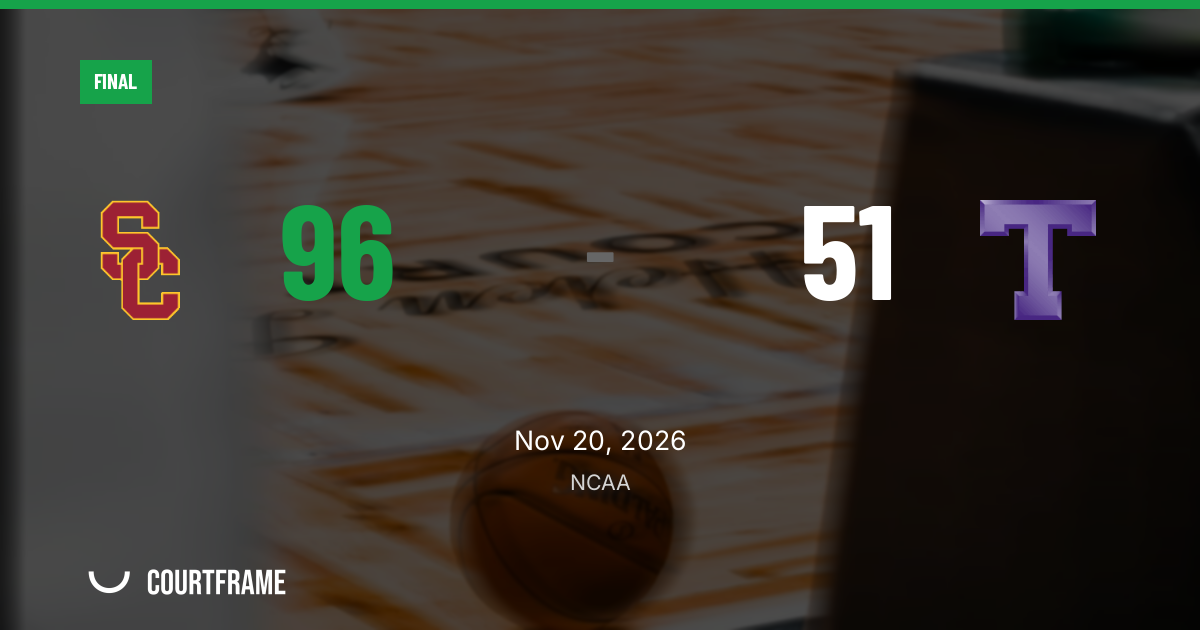
USC remained unbeaten on November 20, defeating Tarleton 96-51 in a game that matched the Trojans’ early-season profile as one of the sharper offensive teams in the NCAA.
The Trojans entered at 4-0 and averaging 96.8 points per game, then finished with 96 points against a Tarleton team that came in 4-1 but had been less effective away from home. USC’s 45-point margin also aligned with the pregame indicators: the Trojans carried a 96.2 percent market implied probability and an 11.2-point CourtFrame Power Index differential, with USC ranked No. 22 at 80.90 and Tarleton ranked No. 72 at 69.71.
USC’s scoring baseline held firm
USC did not need to exceed its season scoring average to create separation. The Trojans’ 96 points landed just below their 96.8 points-per-game mark, but the defensive side of the result turned the game into a one-sided outcome.
USC had already been dominant at home, entering with a 3-0 home record and an average of 104.3 points in those games. The Trojans did not reach that home scoring average, but they controlled the game comfortably enough that the offensive total was more than sufficient.
Tarleton entered averaging 81.6 points per game and finished with 51. That gap defined the night. USC’s defense held Tarleton well below both its overall scoring average and its road scoring profile, where Tarleton had averaged 74.7 points while going 1-2 away from home.
Pregame matchup signals carried into the result
The CourtFrame Power Index pointed toward a USC advantage before tipoff. USC’s 80.90 CPI and No. 22 ranking gave the Trojans a clear edge over Tarleton’s 69.71 CPI and No. 72 ranking. Both teams entered with negative short-term CPI trends, with USC at minus-1.6 and Tarleton at minus-1.3, but the baseline gap between the teams remained substantial.
The market also reflected a heavy expectation for USC. The Trojans’ 96.2 percent implied probability framed the game as a matchup USC was expected to control, and the final score validated that assessment more forcefully than the scoring environment alone suggested.
The total closed across a range that stretched from 157 to 162. USC and Tarleton combined for 147 points, with the decisive factor being Tarleton’s inability to sustain its usual offensive output rather than any major dip in USC’s production.
Rest and availability gave neither side an obvious excuse
Neither team entered with significant injuries reported, which kept the matchup focused on execution and team quality rather than availability. USC had four days of rest and had played once in the previous seven days. Tarleton had three days of rest and had played twice in the previous seven days.
That schedule context slightly favored USC, but the final margin was more directly tied to the Trojans’ ability to impose their scoring standard while suppressing Tarleton far below its season norm. With no recent head-to-head history between the programs, the game functioned as a clean test of current form, and USC’s deeper indicators translated directly into the final score.
What it means
USC improved to 4-0 and added another high-margin result to a start already defined by efficient scoring volume. The Trojans entered averaging 96.8 points and left with another 96-point performance, reinforcing the consistency of their offensive floor through four games.
Tarleton dropped to 4-1 and absorbed its most difficult result of the season. The larger concern was not simply the loss, but the 51-point output from a team that entered averaging 81.6 points. Against a USC team with a top-25 CourtFrame Power Index profile, Tarleton’s road limitations were exposed in a game that never matched its usual scoring level.