
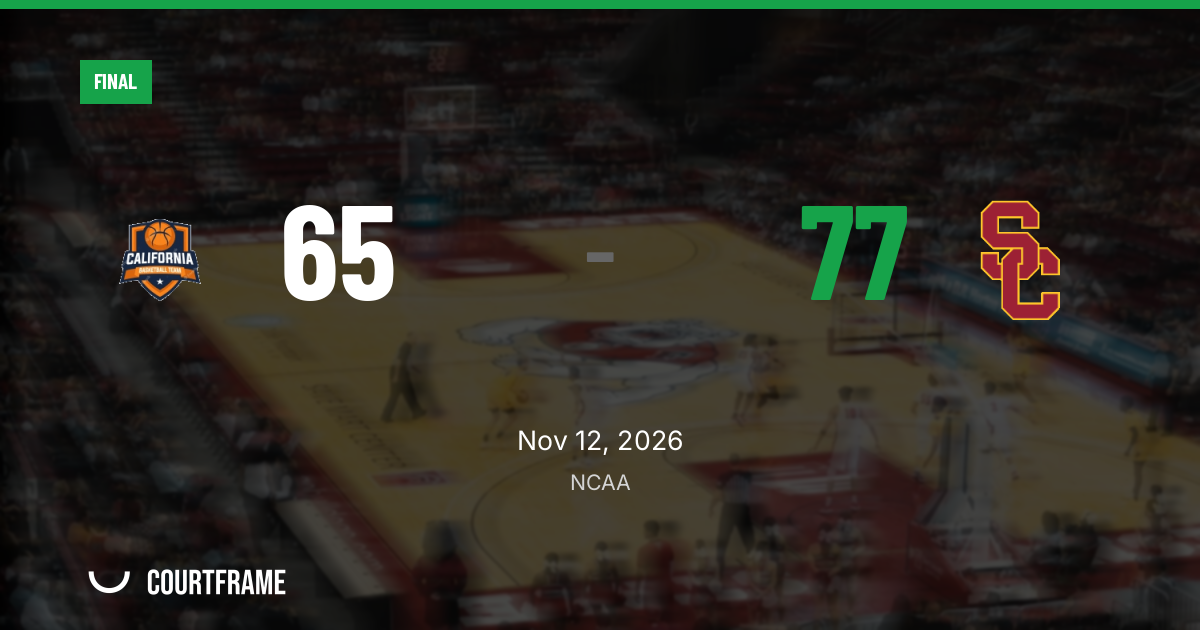
USC entered November 12 with the stronger profile and left with the result to match it, beating California 77-65 in a game that tightened the early-season separation between the programs. The Trojans improved to 3-0, while California fell to 2-2.
The matchup did not produce the high-end scoring environment suggested by both teams’ early offensive averages. California came in averaging 89 points per game, and USC entered at 94, but the Trojans’ 77-65 win landed well below those combined scoring levels. USC still controlled the scoreboard by holding California 24 points under its season scoring average.
USC’s edge showed in the final margin
USC carried a CourtFrame Power Index of 81.25, ranked 44th, into the matchup. California entered at 75.00, ranked 54th, leaving the Trojans with the stronger pre-game profile by 6.3 points. The final score reflected that gap more than California’s home-side scoring indicators.
The market also leaned heavily toward USC, giving the Trojans a 75.1 percent implied probability across seven bookmakers. That expectation proved accurate, though the pathway was more defensive than explosive. USC scored 77 points, 17 below its pre-game average, but its defensive work mattered more because California never reached the offensive rhythm suggested by its 89-point average.
California’s offense fell short of its early standard
California entered with a 2-1 record and a home split showing 3 wins, 1 loss and 87.5 average points. Against USC, the Bears finished with 65 points, their lowest figure relative to the offensive context they brought into the game.
That shortfall defined the night. California did not have a significant injury listed, and the Bears were playing on three days of rest with one game in the previous seven days. USC had the same rest profile and also reported no significant injuries, removing availability and schedule fatigue as major explanations for the gap.
With both teams operating from comparable rest and clean injury reports, the result came down to execution. USC’s ability to keep California well below its scoring baseline was the clearest separator.
USC stays unbeaten without needing a scoring surge
USC entered 2-0 with an away split of 2 wins, 0 losses and 85 average points. The Trojans did not need to match their 94-point season average to win comfortably. Their 77 points were enough because California’s offense produced only 65.
The Trojans’ CourtFrame Power Index trend was 9, while California’s was 13.9, showing both teams had positive early movement. USC’s higher overall index still carried more weight in this matchup, and the Trojans translated that advantage into a double-digit road result.
What the result means
USC’s 77-65 win reinforced its early-season standing at 3-0 and validated the pre-game indicators that favored the Trojans. The performance was not built on matching their top-end scoring average; it was built on suppressing a California team that had been scoring at a much higher clip.
For California, the concern is the offensive drop-off. The Bears had no major injury issue and no rest disadvantage, yet finished far below their scoring average. Against a USC team with the stronger CourtFrame Power Index and a clean 2-0 start, that offensive dip turned a competitive profile into a 12-point loss.