

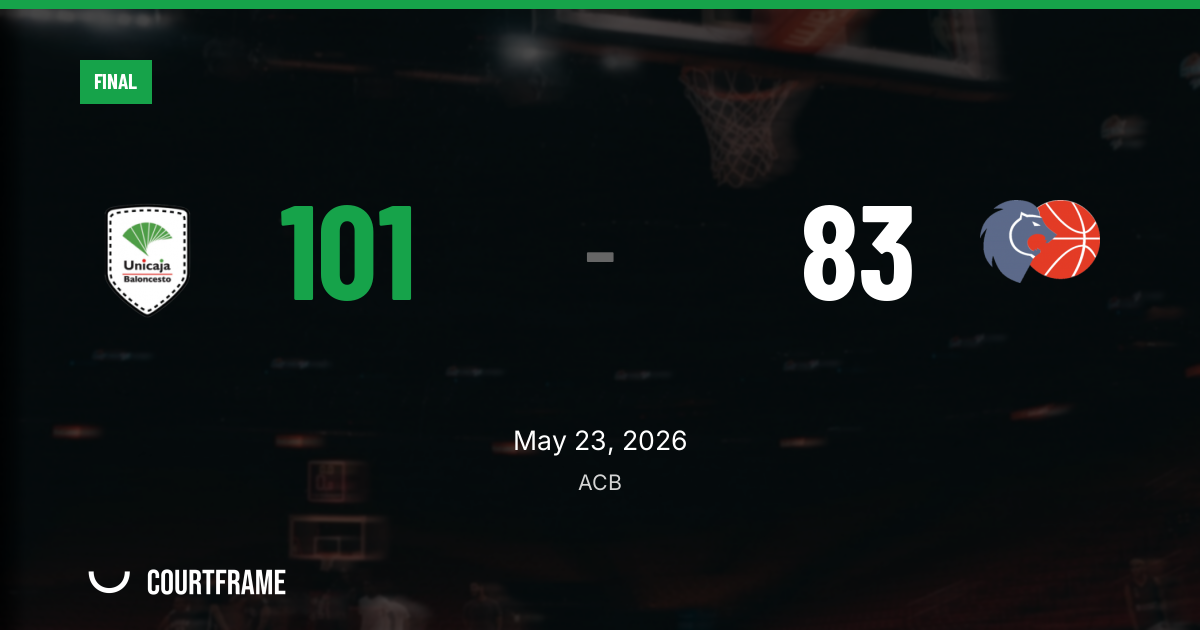
Unicaja did not ease into Game 2. It hit Breogan immediately, built a 29-15 lead after the first quarter and rode that opening separation to a 101-83 win on May 23 at Palacio de Deportes José María Martín Carpena.
The victory pushed Unicaja ahead 2-0 in the best-of-seven series, reinforcing the market’s pregame lean toward the home side. Unicaja entered with a 74.2 percent implied win probability across 13 bookmakers and played like the more complete team from the start.
Breogan arrived with the stronger CPI profile — ranked eighth with a 58.97 CPI compared with Unicaja’s 41.35 and 11th-place ranking — but that gap did not translate once the game settled into half-court execution and physical control. Unicaja won the glass 41-18, finished with 24 assists and kept its offense flowing despite 18 turnovers.
First quarter sets the tone
The game was effectively shaped in the first 10 minutes. Unicaja’s 29-15 opening quarter gave it enough cushion to absorb Breogan’s more competitive middle stretch. Breogan scored 23 points in both the second and third quarters, but Unicaja answered with 22 in the second and 26 in the third, preventing the visitors from turning runs into real pressure.
By the fourth quarter, the structure of the game had not changed. Unicaja led through shot-making, rebounding volume and passing rhythm, then closed with a 24-22 final period to finish off an 18-point margin.
Unicaja’s ball movement travels through the matchup
Unicaja’s offensive profile coming in pointed toward a team that could create efficient looks when it avoided empty possessions. Over its previous 10 analyzed games, it carried a 111.6 offensive rating, a 70.7 true shooting percentage and a 98.4 assist rate. Those traits showed up clearly in Game 2.
The home side recorded 24 assists, well above its recent average of 17.9, and generated enough quality offense to reach 101 points. That mattered against a Breogan team that entered with its own strong efficiency indicators, including a 114.6 offensive rating, 73.6 true shooting percentage and 42.2 percent 3-point shooting over the same 10-game sample.
Breogan did make its mark from the perimeter, finishing 15-for-24 from 3-point range. But the rest of the offensive profile could not keep pace. Breogan was held to 12-for-38 on field goals listed inside the team statistics and finished with only 13 assists.
The rebounding gap becomes the game’s clearest divide
The most lopsided number on the sheet was not the final score. It was the rebounding margin.
Unicaja finished with 41 rebounds to Breogan’s 18, turning a matchup that looked relatively even on paper into a game controlled by second possessions, defensive stops and physical presence. Both teams entered with nearly identical recent rebounding rates — Unicaja at 48.2 percent, Breogan at 48.3 percent — but the Game 2 result broke sharply from that trend.
That edge helped Unicaja withstand Breogan’s defensive activity. Breogan had 10 steals and forced 18 turnovers, but those plays did not create enough sustained momentum because Unicaja controlled so many missed-shot possessions and kept finding answers in the half court.
Breogan’s strengths flash, but not long enough
Breogan came in with reasons to believe it could trouble Unicaja. It had a better recent net rating than Unicaja, a higher recent offensive rating, a higher effective field goal percentage and a stronger 3-point percentage. It also entered averaging 90.9 points per game on the season, slightly ahead of Unicaja’s 88.
But Game 2 exposed the difference between shooting efficiency and full-game control. Breogan’s 3-point performance kept the scoreboard moving, yet the team’s 18 rebounds and 13 assists reflected a narrower offensive base. Unicaja’s defense did not need to erase every perimeter look; it needed to win enough possessions around the margins. It did that decisively.
No injury excuse, no fatigue imbalance
There was no obvious availability caveat attached to the result. Neither team reported significant injuries before the game. The schedule also offered little imbalance: Unicaja had six days of rest and one game in the previous seven days, while Breogan had seven days of rest and one game in the previous seven.
That made the performance read cleaner. Unicaja was not simply fresher or healthier. It was sharper early, more physical on the glass and more connected offensively.
Series outlook
Unicaja now leads the series 2-0, a major position in a best-of-seven format. The home side entered Game 2 with a 17-15 record, a 55.6 percent home win rate in the provided splits and an average of 93.1 points at home. It exceeded that home scoring profile and protected the Carpena floor with authority.
Breogan, now facing a deeper series deficit, will have to solve the possession battle first. The shooting can travel. The 41-18 rebounding gap cannot. If that does not change, Unicaja’s control of the series will only harden.