

CourtFrame
NCAA BasketballrecapNCAA

UCF blitzes TCU early, holds late push in 82-71 win

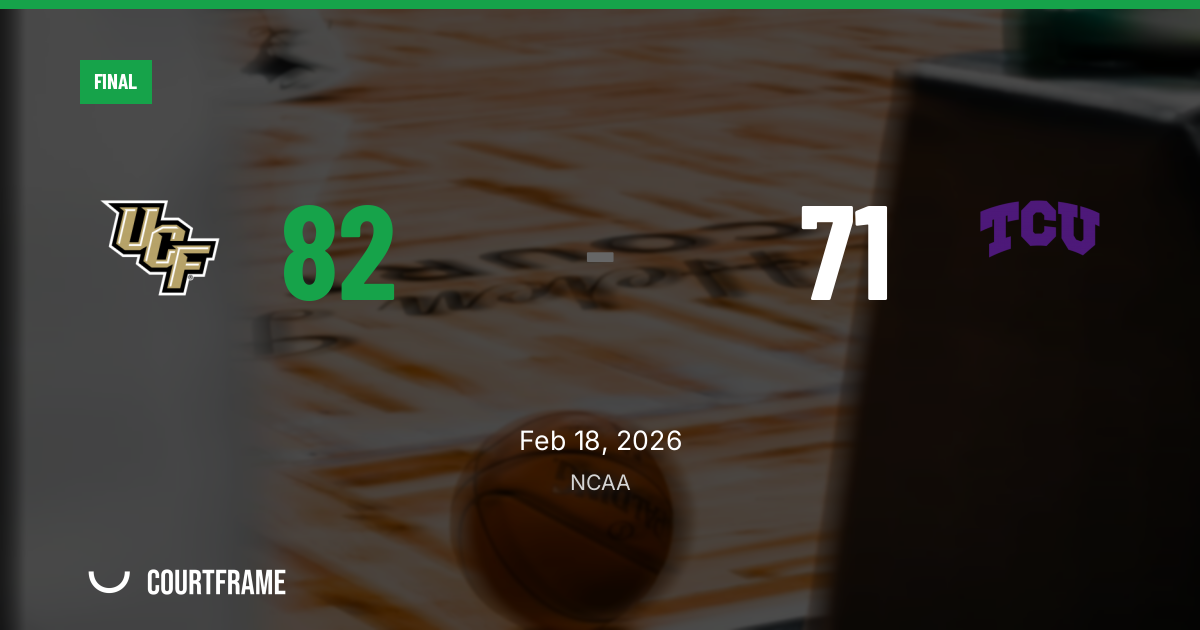
UCF put TCU in a first-half hole and never fully let the Horned Frogs back out, closing out an 82-71 win Tuesday. The Knights’ 42-28 edge before halftime set the tone, and their 40-point second half was enough to absorb TCU’s 43-point finish.

James O'Brien
James O'Brien
2 min read

Key Takeaways

  • 1UCF Knights beat TCU 82–71, an 11-point margin.
  • 2The second quarter decided it: UCF Knights won it 42–28, a 14-point swing.
  • 3UCF Knights led 42–28 at the break and never gave the lead back.
  • 4The two teams combined for 153 points.
  • 5The CourtFrame model picked UCF Knights at 56% confidence — the pick was correct.

UCF didn’t wait around for a close one. The Knights built the game’s defining margin before the break, then managed the rest of the night to secure an 82-71 win over TCU on Feb. 18, 2026.

The math of the night was simple: UCF’s 42-28 halftime advantage forced TCU into chase mode, and even a 43-point second half from the Horned Frogs couldn’t erase the early deficit. UCF matched that late scoring punch with 40 after halftime and kept control to the final horn.

Game flow: the first half decided the script

TCU’s best stretch came late, but the game’s shape was carved out in the first 20 minutes. UCF won the first half 42-28, a 14-point cushion that changed the possession-by-possession calculus for both sides.

From there, TCU needed a sustained run to flip the pressure back onto the Knights. Instead, UCF maintained enough offensive pace in the second half to keep the Horned Frogs from stacking stops and turning the game into a true one-possession finish.

Second half: TCU’s push, UCF’s answers

TCU did what teams down big at halftime have to do: score quickly and often. The Horned Frogs put up 43 in the second half, outscoring UCF 43-40 over the final 20 minutes.

But UCF’s ability to keep producing — 40 points after the break — prevented the game from tilting into desperation possessions for the Knights. Every time TCU tried to speed the game up, UCF had just enough response to keep the margin from collapsing.

What it means going forward

For UCF (now 19-7), this was the kind of stabilizing result that matters in February: a win that looked decisive early, then professional late when the opponent made its move. Coming in with a WLLLW form line, the Knights got back to the business of stacking results.

TCU fell to 16-11 and couldn’t turn a LWWWL stretch into momentum on the road. The Horned Frogs showed they can generate points in a hurry, but the 14-point halftime gap underscored how thin the margin becomes when you’re playing from behind for an entire night.

Final score

UCF 82, TCU 71

Halftime

UCF 42, TCU 28

Second half

TCU 43, UCF 40

Game Data

Quarter-by-quarter score, TCU at UCF Knights
TeamQ1Q2Q3Q4Final
TCU02804371
UCF Knights04204082
Date
February 18, 2026
Competition
NCAA
Status
Game Finished

CourtFrame model, before tip-off

Picked UCF Knights at 56% confidencepick hit

Published before the game and scored against the result afterwards, hit or miss. How the model works

What the pick was built on

  • Home record advantage for UCF (17-7) compared with TCU's away record (16-9)
  • Recent form is inconsistent for both teams, suggesting volatility and a tight margin
  • No significant injuries reported on either side, so baseline team strength should be intact

Frequently Asked Questions

What was the final score of TCU vs UCF Knights?

UCF Knights won 82–71, played on February 18, 2026.

Who won TCU vs UCF Knights?

UCF Knights, by 11 points in the NCAA.

Which quarter decided TCU vs UCF Knights?

The second quarter. UCF Knights won it 42–28, the largest swing of the game at 14 points.

What does CourtFrame's model predict for TCU vs UCF Knights?

The model favoured UCF Knights with 56% confidence, and that pick was correct. Picks are published before tip-off and scored against the result.

Data Official basketball data feed (ref. 488555)

How this was written Drafted by CourtFrame's generative model from the official statistical feed for this game, then published under editorial review. Editorial policy