

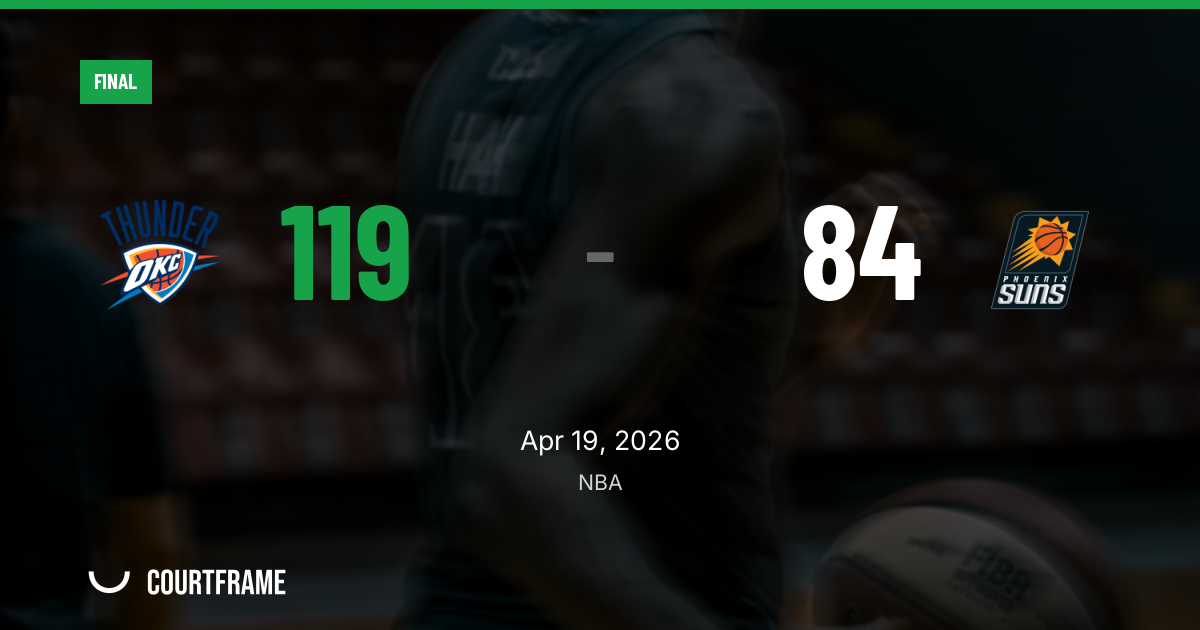
OKLAHOMA CITY — The Thunder didn’t just beat the Suns on Sunday night. They removed the margin for randomness.
Oklahoma City (64-18) blitzed Phoenix (45-37) from the opening tip, stacking a 35-20 first quarter and rolling to a 119-84 final at Paycom Center. The game followed the pregame indicators almost point-for-point: the league’s No. 2 CPI team (100.00) played like it, the No. 36 CPI team (46.17) couldn’t handle the pressure, and the fatigue gap — six days rest for OKC vs. a back-to-back with three games in seven days for Phoenix — showed up in every possession battle.
Game flow: a first-quarter knockout, then steady separation
Oklahoma City won every quarter (35-20, 30-24, 32-22, 22-18). That’s the cleanest signal of the night: no Phoenix counterpunch, no rotation stretch where the Suns found traction, no late-game variance. The Thunder’s lead expanded in waves, with the third quarter (32-22) removing any remaining doubt.
The possession math: OKC’s turnover pressure decided it
The clearest separator was ball security and what Oklahoma City did to Phoenix’s.
Oklahoma City finished with just 8 turnovers while forcing 19, a massive possession swing that fit the Thunder’s recent profile (17.2 turnover rate over their last 10) against a Suns team that has been loose with it (21.3 turnover rate over its last 10). The Thunder also piled up 13 steals and 7 blocks, turning defense into instant offense and preventing Phoenix from ever settling into half-court rhythm.
Phoenix, meanwhile, managed only 16 assists and just 3 steals. Against a Thunder team that entered with a sky-high 96.1 assist rate in its last 10, that lack of disruption was fatal: OKC played comfortably, got to its spots, and kept the floor tilted.
Shot profile and efficiency: Thunder’s spacing, Suns’ empty possessions
Oklahoma City’s recent offensive identity — elite efficiency and heavy three-point volume — translated to the box score. The Thunder went 14-for-46 from three and 21-for-23 at the line, pairing perimeter gravity with consistent free-throw finishing. With 28 assists, OKC consistently created shots via advantage basketball rather than isolation survival.
Phoenix’s night was the opposite: 19 turnovers bled possessions, and the Suns couldn’t compensate with playmaking (16 assists) or defensive events (3 steals, 2 blocks). Even with 13 made threes (13-for-39), the Suns’ offense never generated enough high-quality volume to keep pace — especially once Oklahoma City’s lead forced them into a chase game.
Physical edge: OKC wins the glass and the contact game
The Thunder controlled the rebounding margin, 54-45, another area where the pregame split leaned OKC (51.3 rebound percentage last 10 vs. Phoenix’s 48.2). When a team also wins turnovers by 11, even a modest rebounding edge becomes a multiplier.
OKC also lived at the line efficiently (21-for-23), reinforcing the same theme: the Thunder didn’t rely on tough shot-making to build separation; they won with repeatable advantages — extra possessions, clean looks, and free points.
Context that mattered: rest, form, and the injury cloud
This game had mismatch signals before tip. Oklahoma City came in 64-18 with a 78.9% home win rate (15-4) and 115.8 average points at Paycom Center. Phoenix arrived 7-9 on the road (43.8%) and on the second night of a back-to-back.
On the injury front, Oklahoma City was without Thomas Sorber (right ACL). Phoenix listed Grayson Allen (left hamstring) and Mark Williams (left foot) as questionable — and whether or not those issues affected availability, the Suns didn’t have the margin for diminished creation or interior stability against a Thunder team that has been demolishing opponents in its last-10 profile (124.7 offensive rating, 103.6 defensive rating, +21.1 net rating).
What it means: a result that matched the market
The betting market treated this as a Thunder-heavy spot (87.8% implied win probability), and the game played out like one: Oklahoma City controlled tempo, dictated shot quality, and turned Phoenix’s mistakes into points. The final margin — 35 points — reflected a contest that was effectively decided by the end of the first quarter and methodically widened from there.
For the Thunder, it was a high-clarity win: elite defense creating offense, plus enough spacing and free-throw efficiency to keep the floor from ever tilting back. For the Suns, it was a reminder that against top-tier opponents, turnover-prone possessions and limited disruption don’t just lose games — they end them early.