

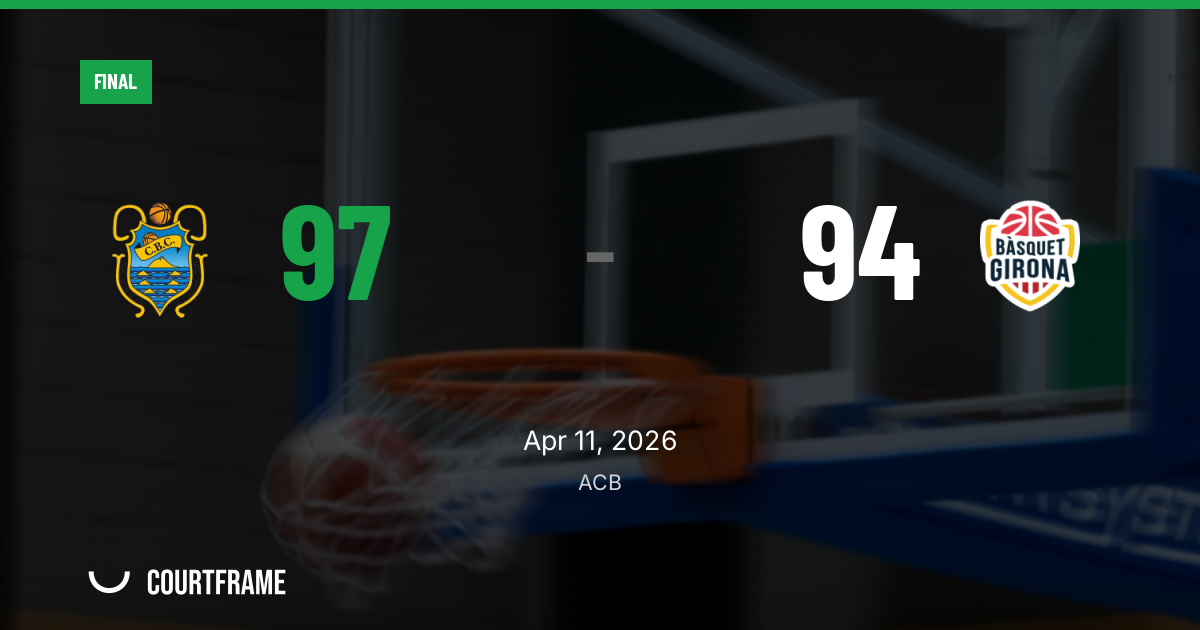
Tenerife didn’t need overtime — but it did need every bit of its first-three-quarters work.
Behind a 26-21 first quarter and steady scoring across the middle periods, Tenerife led 72-63 entering the fourth and ultimately held on for a 97-94 win over Bàsquet Girona on April 11, 2026 at Pabellón Insular Santiago Martín. Girona’s 31-point final frame made it a one-possession game late, but Tenerife’s earlier control of tempo and possessions proved decisive.
Game flow: Tenerife’s three-quarter edge, Girona’s late push
The quarter-by-quarter math explains the night. Tenerife won each of the first three periods (26-21, 24-22, 22-20) to build separation, then survived a fourth-quarter swing (25-31) that nearly erased it. Girona’s late offense flipped the pressure onto the home side, but Tenerife’s ability to bank points early meant it could withstand the closing run without needing a perfect finish.
Efficiency vs. volume: where the margins landed
This matchup played out like a clash of identities suggested by the pregame indicators. Tenerife entered with a strong net profile in the sample provided (net rating 16.1 over 9 games analyzed) and elite shot-making efficiency (82.6 true shooting percentage; 79.7 effective field goal percentage). Girona, meanwhile, carried a negative net rating (-1.2 over 8 games analyzed) and a much higher turnover rate (24.4%), a red flag against a Tenerife team that had been cleaner with the ball (18.7% turnover rate).
In the box score, that possession battle showed up in raw mistakes: Tenerife finished with 9 turnovers to Girona’s 15. That gap mattered in a three-point game, particularly with both teams otherwise finding ways to score.
Girona’s three-point volume kept it alive
Girona leaned hard into the arc: 14-for-36 from three. Tenerife countered at 10-for-23. Girona’s ability to generate that many makes from deep is consistent with its pregame three-point rate (92.6), and it’s the primary reason a game that tilted Tenerife’s way for three quarters still came down to the final possessions.
Tenerife’s free throws and ball security stabilized the finish
Tenerife went 27-for-35 at the line, compared to Girona’s 14-for-16. In a tight game, that’s not just points — it’s a stabilizer when the opponent is scoring quickly. Combine that with Tenerife’s lower turnover total, and the home side created just enough separation to survive Girona’s fourth-quarter spike.
Rebounding and physicality: Girona won the glass, but not the game
Girona controlled rebounds 35-25, aligning with its stronger rebounding profile in the provided sample (32.6 average rebounds; 51.0 rebound percentage) and giving it extra chances to fuel the comeback. Tenerife, however, offset that disadvantage by taking better care of the ball and getting to the stripe at a higher volume.
Pre-game context that held up
The broader context pointed toward Tenerife having the higher baseline. Tenerife came in 16-10 with a WLWWW form line and a perfect 5-0 home split (92.8 average points in those home games). Girona arrived 12-14 with a 2-3 away split. The CPI matchup also leaned heavily toward the home side: Tenerife’s CPI (87.04, rank 3) versus Girona’s (35.44, rank 11), with a 51.6 differential and opposing trends (Tenerife +6.8; Girona -8.9).
There were no significant injuries reported for either team, and both clubs had rest — Tenerife with 6 days (1 game in the last 7 days), Girona with 7 days (0 games in the last 7 days). With fatigue minimized, this was more about execution than availability, and Tenerife executed cleaner across the possession battle.
What it means
Tenerife defended its home floor again, improving on a season profile that has been especially strong in Santa Cruz de Tenerife. Girona proved it can generate high-end offense quickly — particularly from three — but the turnover burden and inability to fully flip the possession equation left too much ground to make up late.