

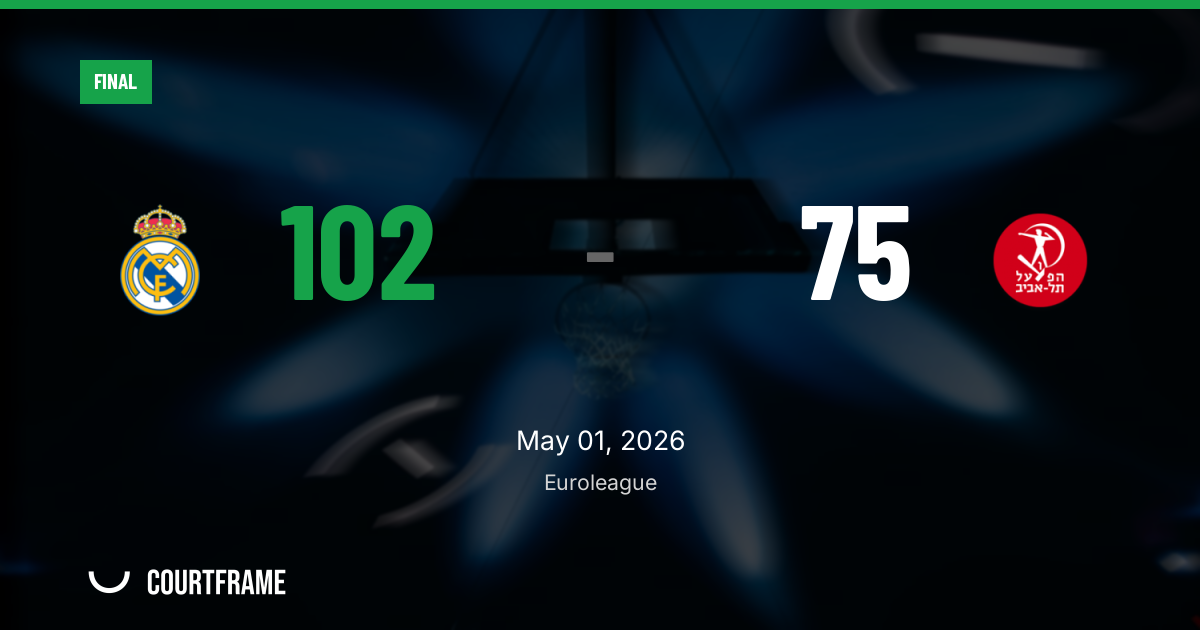
Real Madrid did not just protect home court. It seized control of the Euroleague Final.
Madrid beat Hapoel Tel-Aviv 102-75 on May 1 at Movistar Arena, using a 33-point third quarter and a 29-point fourth to turn Game 3 from a competitive fight into a statement. The result gives Real a 3-0 lead in the best-of-seven series and pushes Hapoel to the edge, even though this was not an elimination game.
The final margin reflected the larger profile of the matchup. Real entered with a 24-14 record, an 8-0 home split and an average of 93.3 points in those home games. Hapoel arrived at 23-15 but with a 2-7 away split and an 85.6-point road average. The market leaned sharply toward Madrid, with a 71.7 percent implied win probability across 11 bookmakers. By the end, that confidence looked conservative.
Second-half surge decides Game 3
Hapoel stayed within range early. Madrid led 24-21 after the first quarter, but Hapoel answered in the second, winning the period 21-16 to take a 42-40 lead into halftime.
Then the game flipped. Madrid scored 33 in the third quarter, holding Hapoel to 20, and followed with a 29-13 fourth. Across the final two quarters, Real outscored Hapoel 62-33. That was the game: Madrid’s shot quality, spacing and defensive pressure all rose at the same time, while Hapoel’s offense lost structure late.
The fourth quarter was especially telling. Hapoel had generated 21 points in each of the first two quarters and 20 in the third, but managed only 13 in the final period. Madrid’s defense, which came in with a 100.6 defensive rating over the previous 10-game sample, closed the game with the kind of control that has defined its playoff advantage.
Madrid’s ball security and rebounding travel to the box score
The cleanest separator was possession quality. Madrid finished with 22 assists against just 7 turnovers. Hapoel had 13 assists and 12 turnovers. That gap shaped the rhythm of the second half: Real kept creating organized looks, while Hapoel’s possessions became harder and more isolated.
Madrid also won the glass 39-31, consistent with the pre-game matchup. Real entered with a 52.9 rebound percentage over its last 10 analyzed games, while Hapoel was at 45.7. Edy Tavares’ season profile — 9.6 points and 6.6 rebounds per game over 15 games — was always central to that edge, and the team-wide rebounding result gave Madrid more stability throughout the night.
The assist numbers were just as aligned with the scouting report. Madrid’s 96.7 assist rate in the 10-game sample pointed to an offense built on passing connectivity. Facundo Campazzo, averaging 13.1 points and 4.8 assists, remained the natural pressure point for that system, while Mario Hezonja’s 13.9 points per game gave Madrid its top scoring profile entering the night.
Hapoel’s offensive efficiency never became control
Hapoel came in with strong shooting indicators: 72.5 true shooting percentage, 72.5 effective field goal percentage and a 113.3 offensive rating across the last 10 analyzed games. But the warning signs were there, too. Hapoel’s turnover rate was 21.9, and its defensive rating sat at 110.1 during that same stretch.
Game 3 exposed that split. Hapoel had enough shot-making to stay close in the first half, but not enough control to withstand Madrid’s pressure after halftime. Elijah Bryant entered as Hapoel’s leading listed scorer at 16.1 points per game, with Daniel Oturu at 15.2 and Antonio Blakeney at 14.6. Vasilije Micic’s 10.8 points and 4.5 assists gave Hapoel another creator, but the team finished with only 13 assists overall.
Against Madrid, that was not enough. Real’s structure forced Hapoel into a narrower game, and the visitors could not match Madrid’s late-game shot generation.
CPI gap shows up in the result
The CourtFrame Performance Index pointed to a major Madrid edge before tipoff. Real entered with an 84.08 CPI, ranked third, with a positive trend of 16.6. Hapoel’s CPI was 49.91, ranked eighth, with a negative trend of 10.4. The differential was 34.2.
That gap did not guarantee a blowout, but it framed the game accurately. Madrid had the stronger baseline, the better current trajectory and the cleaner home profile. Hapoel’s form was competitive — LWLWW over the previous five — but Madrid’s home dominance and playoff experience advantage were harder to ignore.
Fatigue was not a separator. Both teams entered on two days of rest with one game in the previous seven days. Neither injury report listed significant absences. This was not about availability. It was about execution.
What it means
Madrid now leads the Finals 3-0 and has turned a series between two high-scoring teams into a one-sided test of Hapoel’s resilience. The pre-game scoring profiles were nearly identical — Real at 87.9 points per game, Hapoel at 87.6 — but Game 3 showed the difference between scoring capacity and playoff control.
Real controlled the ball, controlled the glass and controlled the second half. Hapoel had no answer once Madrid’s pace and passing sharpened after halftime.
The series is not officially over. But after a 102-75 result in Madrid, it has moved firmly into Real’s hands.