

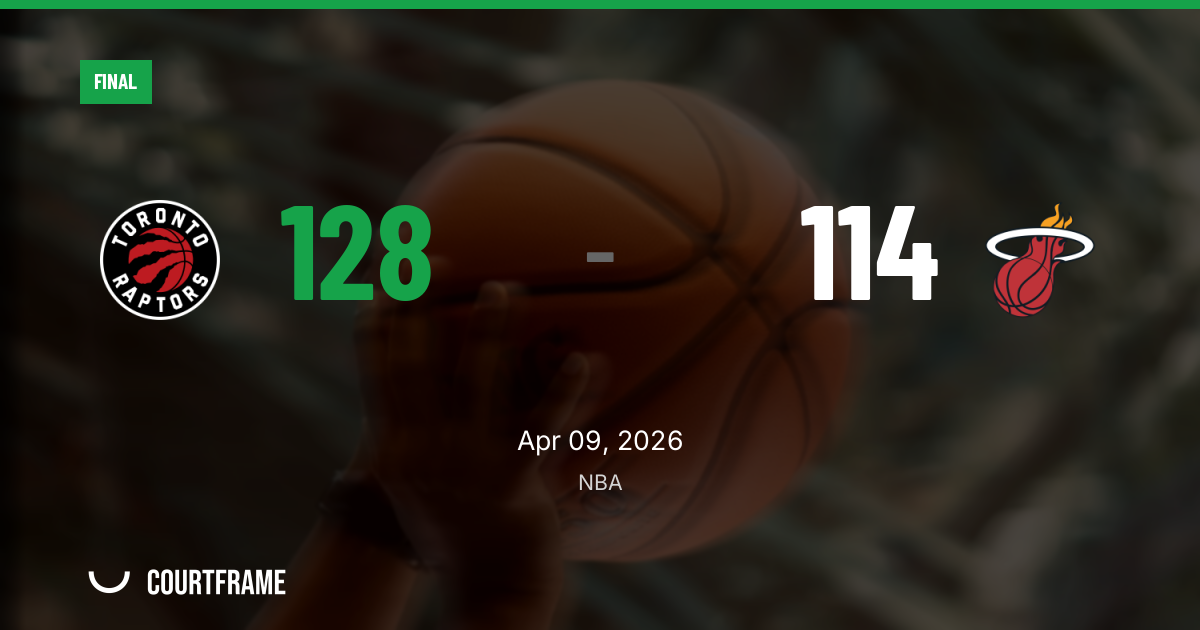
TORONTO — The Raptors didn’t wait around for the game to find them. They built it themselves.
Behind a 69-point first half and a wire-to-wire edge that withstood Miami’s best punch, Toronto (44-35) beat the Heat (41-38) 128-114 on April 9, 2026 at Scotiabank Arena. The win came with urgency attached: both teams entered the night hovering in the crowded late-season mix, with Toronto arriving on a WLWLL run and Miami on LWLWL.
The decisive stretch: a first-half avalanche
Toronto’s separation started immediately. The Raptors dropped 32 in the first quarter, then escalated the pace with 37 in the second to take a 69-50 halftime lead. That 19-point cushion mattered because it gave Toronto margin for error when Miami’s offense finally caught fire after the break.
Miami’s ball movement was a theme all night — the Heat finished with 35 assists — but in the first half the results lagged behind the process. Toronto, meanwhile, used clean early offense to keep Miami in chase mode from the opening minutes.
Miami’s third-quarter punch, Toronto’s answer
The Heat made their move in the third, hanging 40 points and briefly changing the temperature of the game. It was the kind of quarter that can flip a night — fast decisions, quick reads, and constant pressure on the defense.
But Toronto didn’t blink. The Raptors scored 33 of their own in the third, a critical counter that prevented Miami’s surge from turning into a true swing. Instead of a collapse, it became a hold: after three, Toronto still led 102-90.
Closing time: no drama in the fourth
With the game still within striking distance, the fourth quarter was about execution and discipline. Toronto won the final frame 26-24, keeping Miami from stringing together the consecutive stops and quick scores required to threaten the outcome.
That closing stretch also underscored the contrast in offensive style. Miami’s 35 assists reflected a pass-first approach that created volume opportunities across the roster. Toronto finished with 24 assists — less orchestration, more direct scoring — and, on this night, it was enough because the Raptors’ scoring base was established early.
What it means going forward
For Toronto, the formula was clear: jump on opponents early, then manage the game with steady offense when the inevitable run arrives. A 128-point output paired with a 19-point halftime lead is the kind of profile that travels into late-season basketball — especially when the opponent can post a 40-point quarter and still never fully seize control.
For Miami, the third quarter showed the ceiling when the ball is popping and the pace is right. But the Heat’s margin shrank when they had to dig out of a first-half hole. Against teams capable of putting up 69 before halftime, the early-game defense has to be sharper — because even a 40-point quarter may only buy back so much.