

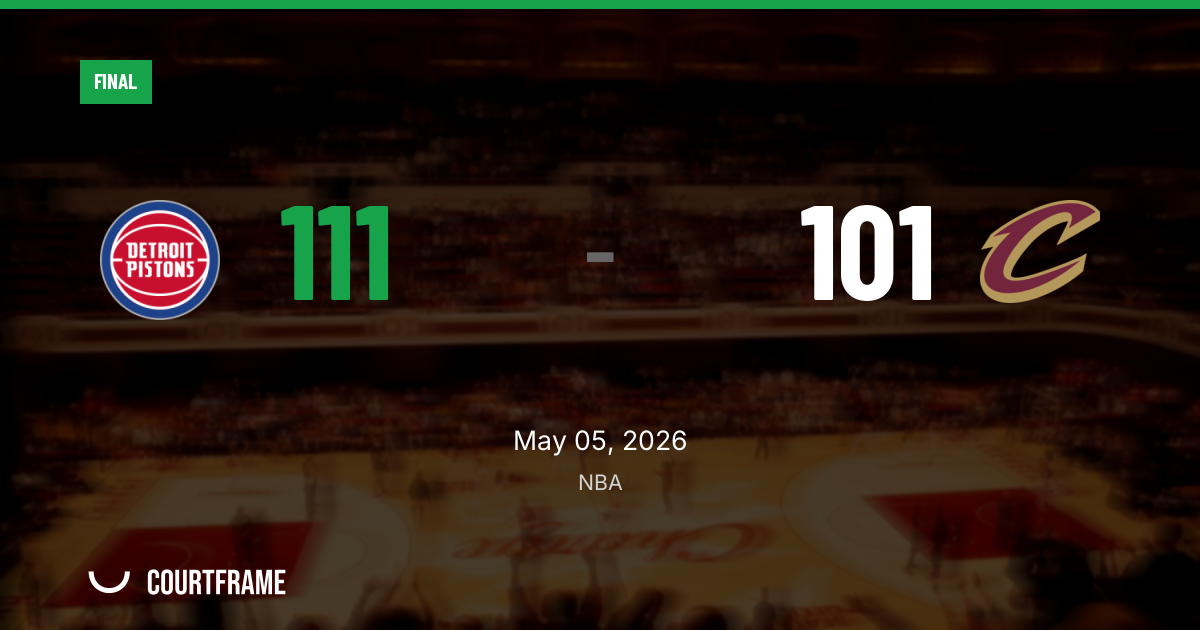
DETROIT — The Pistons did not ease into Game 2. They hit Cleveland with a 37-point first quarter, protected the lead through the middle stretches and closed out a 111-101 win Monday at Little Caesars Arena to take a 2-0 lead in their NBA Quarter-Finals series.
The result matched the setup. Detroit entered with the stronger overall record at 60-22, a 78.3 percent home win rate and two days of rest. Cleveland, 52-30, was playing on one day of rest in a back-to-back spot. In a matchup the market priced toward Detroit with a 57.4 percent implied win probability, the Pistons played like the sharper and fresher team.
The game turned on possession control. Detroit committed 12 turnovers while forcing Cleveland into 20, pairing that edge with 12 steals. The Cavaliers had enough shot-making to stay in range, but the volume of empty possessions made a road comeback difficult after the early deficit.
Detroit’s first-quarter surge set the terms
The Pistons won the opening quarter 37-21, the most important stretch of the night. Cleveland spent the rest of the game trying to reduce a margin Detroit never fully surrendered.
The Cavaliers responded with a 25-22 second quarter and won the third 30-24, but Detroit’s opening burst gave the home team enough cushion to absorb those pushes. The Pistons then closed the fourth quarter 28-25, preventing the game from becoming a one-possession finish.
Detroit’s profile coming in suggested a team built to execute in half-court playoff possessions: a 66.3 true shooting percentage, 61.6 effective field goal percentage and an 84.3 assist rate across the recent sample provided. In Game 2, the Pistons’ offensive flow was not just about shooting. It was about getting to the line and extending possessions with control.
Turnovers tilted the matchup
Cleveland’s pregame concern was clear: a 23.7 turnover rate in the recent sample. That weakness carried directly into Game 2. The Cavaliers finished with 20 turnovers, and Detroit’s 12 steals repeatedly turned defensive pressure into momentum.
The Pistons entered with an average of 9 steals and 8.3 blocks over the recent sample, indicators of a disruptive defense. Against Cleveland, the steals mattered more than rim protection. Detroit recorded 12 steals and only 3 blocks, but the perimeter pressure was enough to interrupt the Cavaliers’ rhythm and keep them chasing the game.
Detroit also protected the glass, finishing with 45 rebounds to Cleveland’s 41. That margin was consistent with the Pistons’ recent rebound profile, where they held a 53.8 rebound percentage compared with Cleveland’s 52.6.
Cleveland’s shooting profile could not overcome the giveaways
The Cavaliers came in with elite efficiency markers in the recent sample: 74.5 true shooting percentage, 71.8 effective field goal percentage and a 113.6 offensive rating. They also carried a heavy perimeter profile, with an 81.9 three-point rate.
That shape showed up again. Cleveland made 14 3-pointers on 38 attempts and went 15-for-16 at the free-throw line. But the Cavaliers’ 22-for-42 mark on field goals, paired with the 20 turnovers, left too little margin against a Detroit team that was generating extra possessions and living at the stripe.
The Pistons finished 27-for-58 from the field, 10-for-26 from 3 and 27-for-35 at the line. The free-throw gap was one of the defining separators: Detroit attempted 35 free throws to Cleveland’s 16. In a 10-point game, that pressure changed the math.
No injury caveat, just execution
Both teams entered without significant injuries reported, so Game 2 was decided less by availability and more by execution. Detroit’s core context mattered: Cade Cunningham came in averaging 24.1 points and 9.6 assists, Jalen Duren entered at 19.1 points and 10.1 rebounds, and the Pistons had enough balance around them to sustain offense even when Cleveland made its third-quarter run.
Cleveland’s lead options were also intact. Donovan Mitchell entered averaging 25.6 points, James Harden 20.7 points and 7.3 assists, with Evan Mobley and Jarrett Allen anchoring the frontcourt production. But the Cavaliers’ offensive talent was undercut by the same issue that appeared in their advanced profile: ball security.
Series shifts with Detroit in command
The Pistons now lead the best-of-seven series 2-0. It is not an elimination spot yet, but the pressure has moved sharply to Cleveland after dropping two games in Detroit.
Detroit’s CPI edge entering the matchup — 74.49 to Cleveland’s 67.54 — reflected the broader team-strength gap, and the Pistons validated it with a performance that leaned on depth, defensive activity and home-court force. Cleveland’s path back starts with cleaning up the possession game. If the Cavaliers keep giving Detroit extra chances, the series will continue to tilt toward the Pistons.