

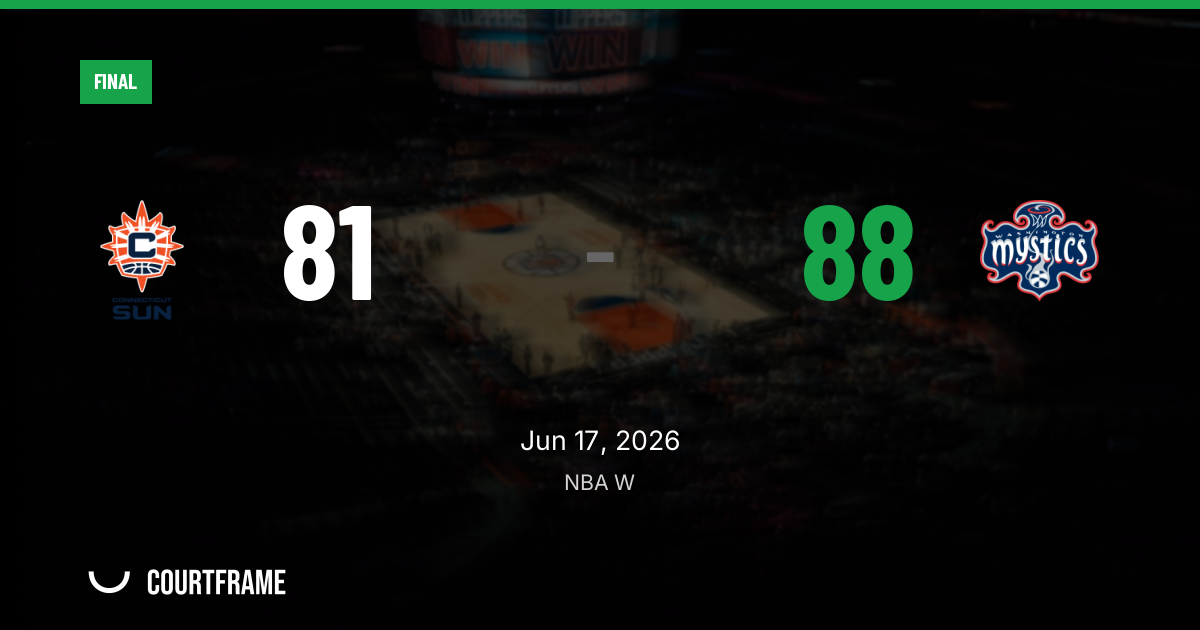
Washington Mystics W arrived at Mohegan Sun Arena with the stronger profile and left with the result to match it.
The Mystics beat Connecticut Sun W 88-81 on June 17, taking control with a 27-point third quarter and closing behind a decisive free-throw edge. Washington went 29-for-30 at the line, a clean late-game separator in a matchup that tightened after halftime.
Connecticut, now 2-14, had a pathway: protect the ball, create defensive activity and keep the game in the half court. The Sun committed only five turnovers, generated eight steals and blocked three shots. But the margins elsewhere were too steep. Washington won the glass 33-26, made seven 3-pointers to Connecticut’s four and turned repeated trips to the stripe into the defining scoring advantage.
Washington’s Third Quarter Changed the Game
The Mystics led 36-29 at halftime after holding Connecticut to 14 points in the first quarter and 15 in the second. The Sun found offense after the break, scoring 29 in the third and 23 in the fourth, but Washington’s own surge kept the game tilted.
The third quarter was the swing point. Washington scored 27 in the period, its best offensive quarter of the night, and carried enough cushion into the fourth to withstand Connecticut’s push. The Mystics followed with 25 more in the final quarter, preventing the Sun from turning defensive pressure into a full comeback.
That mattered because Connecticut did several things typically associated with an upset. The Sun’s turnover discipline was excellent, especially against a Washington team that entered with a 22.4 turnover rate over its last 10 games analyzed. But the Mystics finished with 13 turnovers and avoided the kind of collapse that would have allowed Connecticut’s defense to dictate the game.
The Free-Throw Line Decided the Math
The clearest statistical divide came at the foul line. Washington shot 29-for-30 on free throws. Connecticut went 15-for-23.
That gap shaped the entire game. Connecticut actually kept the turnover battle firmly in its favor and had more steals and blocks, but Washington’s efficiency at the line erased those defensive wins. The Mystics did not leave points available. The Sun did.
The 3-point line also favored Washington. The Mystics made 7 of 18 from deep, while Connecticut finished 4 of 20. That aligned with the pregame shooting profile: Washington entered with a 30.5 percent 3-point mark over the last 10 games analyzed, compared with Connecticut’s 24.5 percent. In a seven-point game, those perimeter and free-throw differences were enough.
Pregame Indicators Pointed Toward Washington
The market leaned slightly toward the Mystics, giving Washington a 54.5 percent implied probability across 12 bookmakers. The CPI matchup was even more direct: Washington entered with a 35.27 CPI, ranked 10th, while Connecticut carried an 8.94 CPI, ranked 15th. The differential sat at minus-26.3 from Connecticut’s perspective.
The result followed that gap. Washington was not dominant wire to wire, but it played with the cleaner scoring profile. The Mystics entered averaging 81.9 points per game on the season, ahead of Connecticut’s 78.1, and cleared both numbers with 88 points. Connecticut reached 81, but its inability to match Washington’s foul-line production and rebounding kept the comeback incomplete.
The venue trend also held. Connecticut came in 1-7 at home with a 12.5 percent home win rate, despite averaging 79 points in those games. The Sun reached that offensive neighborhood again, but the defensive issues that have defined their season remained. Over the last 10 games analyzed, Connecticut had a 106.6 defensive rating and a minus-12.9 net rating. Washington’s 88-point night fit that broader pattern.
No Injury Excuses, Just Execution
Neither team entered with significant injuries reported, and the rest setup was comparable. Connecticut had four days of rest and two games in the previous seven days. Washington had three days of rest and two games in the previous seven days.
That made the outcome less about availability and more about execution. Washington’s core profile traveled: better rebounding percentage over the recent sample, stronger 3-point shooting, higher free-throw percentage and a better defensive rating than Connecticut. The Mystics did not need a major outlier in volume categories. They needed to win the efficiency pockets, and they did.
For Connecticut, the loss was another example of competitive stretches not becoming a complete result. The Sun’s assist rate over the last 10 games analyzed sat at 77.9, and they finished with 16 assists against only five turnovers. That is a functional offensive structure. But with a 26-rebound night, 4-for-20 shooting from 3 and eight missed free throws, the possession quality did not turn into enough points.
What It Means
Washington improved to 6-7 and strengthened its road profile after entering 5-4 away from home. The Mystics’ 88 points came in above their 79.6 road scoring average, and the win reinforced the idea that their offensive ceiling is tied to balance: enough perimeter shooting, enough frontcourt work on the glass and elite conversion at the line.
Connecticut dropped to 2-14, with another home loss that followed the same difficult script. The Sun defended actively and protected the ball, but they were beaten in the possession margins that decide close games: rebounds, 3-point makes and free throws.
Washington did not just survive the road spot. It validated the pregame read, absorbed Connecticut’s best second-half push and closed with the kind of free-throw precision that turns a competitive game into a controlled win.