

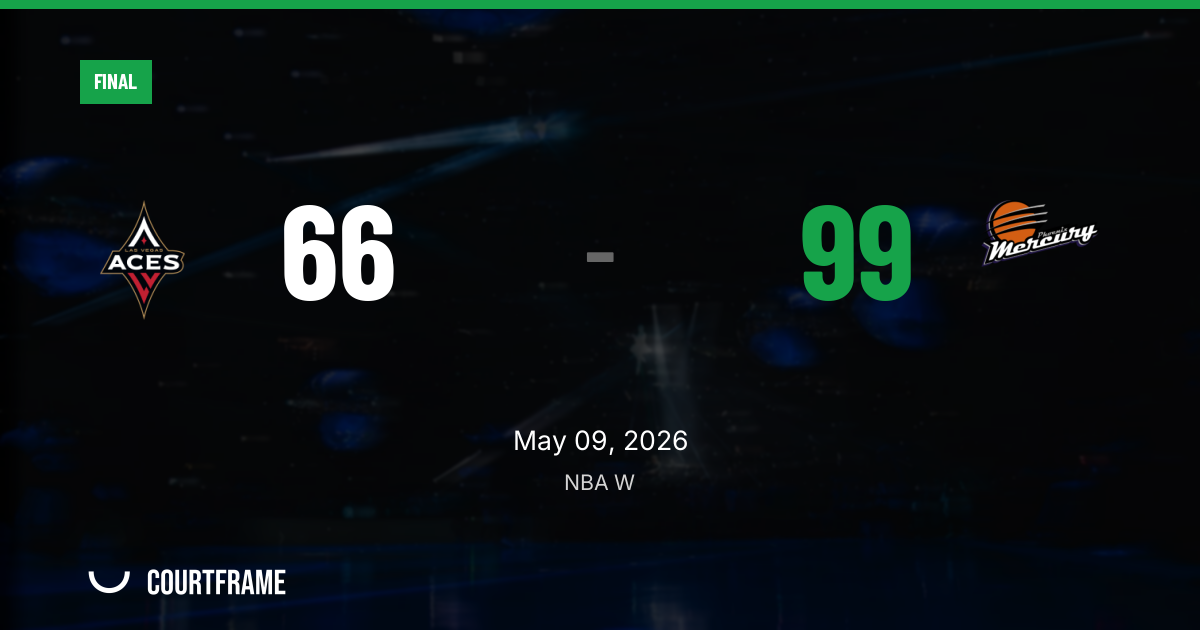
Phoenix arrived in Las Vegas with the league’s top CPI profile and left with a result that looked every bit as emphatic as the data suggested.
The Mercury beat the Aces 99-66 on May 9 at Michelob Ultra Arena, moving to 1-0 while dropping Las Vegas to 0-1. Phoenix controlled the game early, scoring 27 points in the first quarter, adding 29 in the second and putting the matchup out of reach with another 27-point burst in the third.
Las Vegas had no injury excuse. Neither team listed significant injuries pregame. This was a clean read on form, execution and shot quality — and Phoenix owned all three.
Phoenix’s profile translated immediately
The Mercury entered with a 100.00 CPI, ranked No. 1, while the Aces came in at 0.00 and ranked No. 16. That gap showed up in the most decisive areas: spacing, decision-making and defensive pressure.
Phoenix’s early-season advanced profile already pointed to an elite attack: a 119.9 offensive rating, 73.6 true shooting percentage, 68.3 effective field goal percentage and 44.8 percent shooting from 3. The Mercury also carried a 20.3 net rating, compared with Las Vegas’ minus-19.1.
That pregame imbalance became the story of the night. Phoenix stretched the floor, played with pace under control and forced Las Vegas into the exact kind of possession game the Aces could not afford.
The turnover battle broke the game open
Las Vegas entered with a 22.6 turnover rate and 16.5 average turnovers. Phoenix entered with 9.5 steals per game and a cleaner 18.6 turnover rate. The matchup leaned toward Mercury disruption, and that played out sharply.
In the available team statistics, Phoenix committed just eight turnovers while Las Vegas had 17. The Mercury also generated 11 steals to the Aces’ five. That gap gave Phoenix more control of the game’s rhythm and prevented Las Vegas from building any sustained half-court pressure.
The Aces did record eight blocks, doubling Phoenix’s four, but rim protection was not enough to offset the damage created by live-ball mistakes and perimeter shooting.
Mercury spacing stretches Las Vegas thin
Phoenix’s shot profile was a major pregame indicator. The Mercury entered with a 70.7 three-point rate and were shooting 44.8 percent from beyond the arc. Las Vegas, meanwhile, came in shooting 23.7 percent from 3 despite a 40.9 three-point rate.
The team statistics reflected that divide: Phoenix hit 11 of 24 from 3, while Las Vegas made 4 of 19. The Aces were not far behind in total rebounding in the available box score, trailing 37-35, and they had 19 assists to Phoenix’s 23. But the shot-value gap was too large.
Phoenix also made 12 of 15 at the foul line, while Las Vegas went 4 of 8. The Mercury’s efficiency advantages showed up in every high-leverage scoring channel.
Quarter-by-quarter control
Phoenix never let the game settle into Las Vegas’ preferred terms. The Mercury led 27-21 after the first quarter, then created separation with a 29-14 second quarter. The third quarter was even more damaging for the Aces, who scored just 10 while Phoenix added 27.
Las Vegas did win the fourth quarter 21-16, but by then the competitive portion had already been decided. Phoenix’s 83 points through three quarters matched the profile of a team that entered with superior offensive efficiency and cleaner possession management.
Market leaned Las Vegas; data favored Phoenix
The betting market implied a 76 percent probability for Las Vegas, with Phoenix at 24 percent, across 12 bookmakers. That read conflicted with several pregame indicators: Phoenix’s superior offensive rating, net rating, true shooting, assist rate, rebounding rate and CPI rank.
The Mercury also came in rested, with 13 days off and no games in the previous seven days. Las Vegas had five days of rest and one game in the last week. Fatigue did not appear to define the matchup, but Phoenix’s sharper execution suggested the extended runway was put to use.
What it means
For Phoenix, this was more than a road win. It was confirmation that the early efficiency markers are not hollow. K. Copper entered averaging 19 points, K. Williams 16, K. Dunn 13, Q. Carter 10 and A. Prechtel 9, giving the Mercury a balanced scoring base that fit their high-assist, high-spacing profile.
For Las Vegas, the concerns are equally clear. A. Wilson entered as the Aces’ top listed producer at 19 points per game, with N. Smith adding 11 and six rebounds. But Las Vegas’ broader offensive structure remains under pressure: high turnovers, poor 3-point accuracy and limited scoring margin for error.
The final score matched the underlying indicators more than the market expectation. Phoenix played like the sharper, more efficient team. Las Vegas played like a group still searching for offensive stability.