

Phoenix Mercury W entered opening night with the stronger market profile, the cleaner injury report and a major CPI advantage. Then the Mercury backed it up.
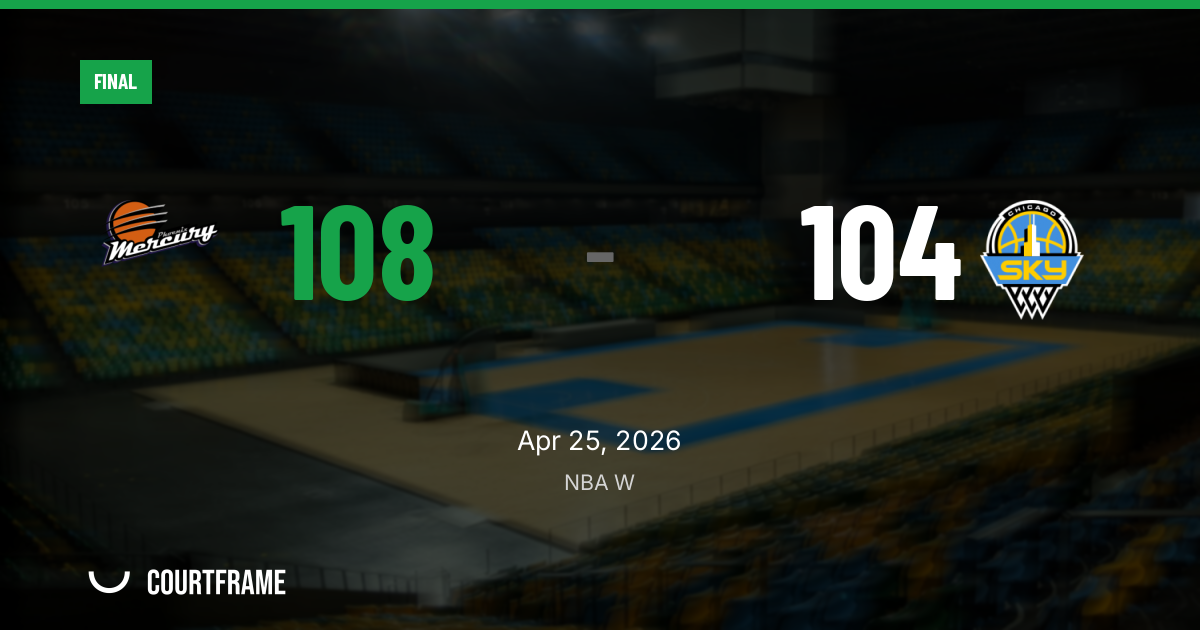
Phoenix beat Chicago Sky W 108-104 on April 25 at Mortgage Matchup Center, closing out a tight, offense-driven regular-season opener after leading 29-22 through the first quarter. The Sky kept coming — scoring 27, 28 and 27 points over the final three periods — but never fully erased the early separation.
The result aligned with the pregame indicators. Phoenix carried a 63.6 percent implied win probability across nine bookmakers and a CPI of 77.14, ranked fourth, compared with Chicago’s 22.86, ranked 27th. The four-point margin reflected a competitive game, but the underlying profile tilted toward the Mercury from the start.
Phoenix’s first-quarter edge mattered
The game’s defining cushion came early. Phoenix outscored Chicago 29-22 in the opening quarter, creating enough room to absorb three productive Sky quarters after that. Chicago won the second half narrowly in rhythm, but Phoenix matched the Sky’s fourth-quarter output 27-27 to prevent a late swing.
That closing stability mattered in a game with little defensive separation. Both teams generated efficient offense and lived at the free-throw line, but Phoenix’s ability to maintain scoreboard pressure kept Chicago in chase mode for most of the night.
The Mercury’s shooting profile traveled from the data to the floor
Phoenix’s advanced profile pointed to a team built around shot-making efficiency. The Mercury entered with an 85.3 true shooting percentage, 81 effective field goal percentage and 44.1 percent shooting from 3-point range across the available sample. Against Chicago, that identity again drove the outcome.
The Mercury finished with 15 made 3-pointers on 34 attempts and converted 31 of 38 free throws. That combination gave Phoenix enough scoring volume to offset Chicago’s pressure inside the arc and at the line.
Chicago, meanwhile, shot 24-for-43 from the field and 38-for-48 at the stripe, but hit only 6 of 16 from 3. In a four-point game, that perimeter gap was decisive. Phoenix generated nine more made 3s, a margin Chicago could not fully counter even with its free-throw volume.
Rebounding and ball movement gave Phoenix the margins
The Mercury also controlled two key possession categories. Phoenix outrebounded Chicago 33-25, consistent with its pregame rebound percentage edge of 56.9 to 43.1. In a game played within two possessions late, that advantage helped stabilize the Mercury’s offense and limit Chicago’s ability to flip the game through extra chances.
Phoenix also finished with 24 assists, compared with 18 for Chicago. That tracked with the broader playmaking profile entering the matchup: the Mercury averaged 24 assists in the available data, while the Sky averaged 18. Phoenix’s assist rate advantage suggested a more connected half-court attack, and the ball movement showed up in the final result.
The one concern for Phoenix was ball security. The Mercury committed 16 turnovers, two more than Chicago. But the Sky did not create enough separation off that area to offset Phoenix’s shooting, rebounding and passing advantages.
No injury imbalance, no fatigue excuse
Neither team entered with significant injuries reported, and neither had played in the previous seven days. That made the matchup a clean opening-night evaluation rather than a game shaped by availability or schedule fatigue.
For Phoenix, the win reinforced the strength of its roster profile. K. Copper entered as the Mercury’s leading scorer in the available player data at 19 points per game, followed by K. Williams at 16 and K. Dunn at 13. Phoenix’s broader scoring balance and perimeter volume made it difficult for Chicago to load up on one action or one option.
Chicago’s key player profile was more compact entering the game, with K. Cardoso at 10 points per game and S. Diggins-Smith contributing 7 points and 4 assists in the available sample. The Sky found enough offense to reach 104, but their defensive rating profile entering the game — 126.4 — remained a concern in a matchup where Phoenix’s spacing and free-throw creation were constant problems.
What it means
Phoenix starts 1-0 with a result that matched the pregame model and the market. The Mercury were not flawless — the turnover rate remains the obvious pressure point — but they won the categories that usually travel: shooting efficiency, rebounding and assist creation.
Chicago starts 0-1 despite a strong scoring night. The Sky’s offense kept the game alive, but the defensive and rebounding gaps were too costly. Against a Phoenix team with a top-four CPI ranking and a clear pregame edge, Chicago needed to win the margins. Instead, the Mercury did.