

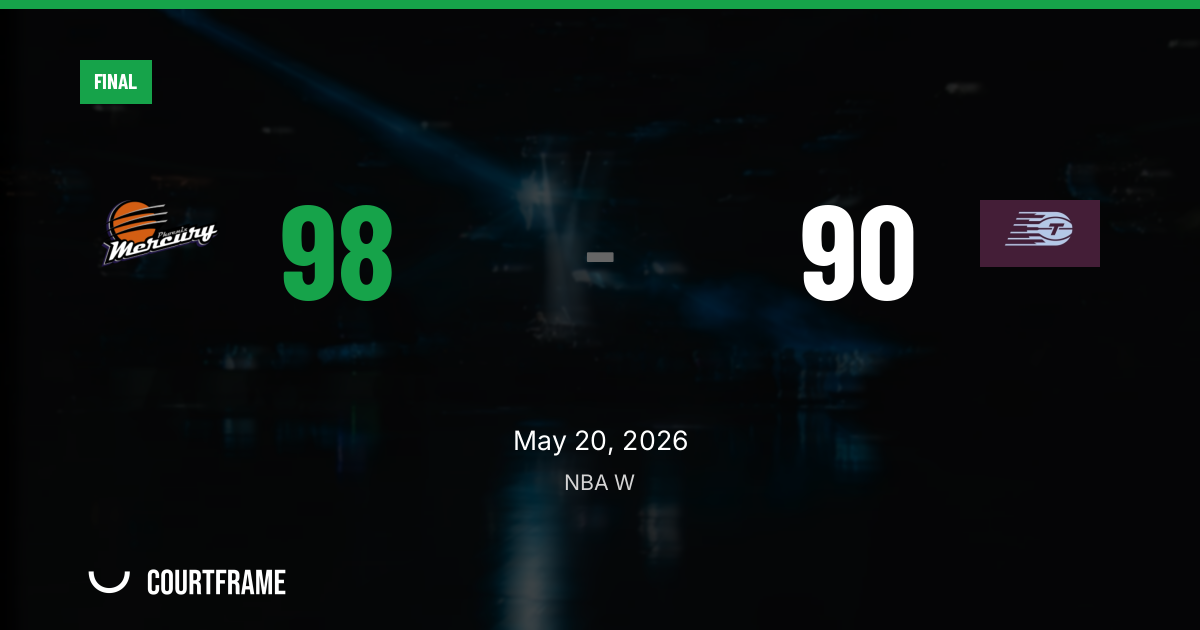
Phoenix had the better pregame profile, the fresher legs and the stronger home split. By the end of Wednesday’s 98-90 win over Toronto at Mortgage Matchup Center, all three had shown up in the result.
The Mercury moved to 2-2 by closing the game with their best stretch of control, winning the fourth quarter 25-16 after Toronto had surged for 30 points in the third. The Tempo, also now 2-2, had enough shot-making to stay attached, but not enough late-game efficiency to finish the road upset.
The market leaned heavily toward Phoenix before tip, giving the Mercury a 73.5 percent implied win probability across 11 bookmakers. The game played tighter than that number for long stretches, but the final margin still reflected the matchup indicators: Phoenix entered with a higher CPI, a stronger home record and more rest.
Fourth-quarter separation decides it
The first half gave little away. The teams were tied 23-23 after one quarter, and Phoenix edged the second 22-21 to take a 45-44 lead into halftime. Toronto then delivered its best offensive burst of the night, scoring 30 in the third quarter, but Phoenix still answered with 28 to keep the game within reach entering the fourth.
That is where the Mercury took over. Phoenix’s 25-16 closing quarter flipped a game that had been driven by runs into one decided by execution. Toronto’s offense, which had been able to create enough pressure through the middle stages, stalled when the game tightened.
The final score aligned with Phoenix’s season-long home trend. The Mercury entered with a 3-1 home split and 95.3 average points in those games. They cleared that level again, reaching 98 in a game that demanded sustained scoring.
Ball security gives Phoenix the edge
The cleanest separator was possession control. Phoenix committed 9 turnovers, while Toronto had 12. That gap mattered in a game where both teams had stretches of efficient offense and where the Tempo held a rebounding edge.
Phoenix also generated 20 assists, matching the profile of a team that came in with a 96.3 assist rate and 19.8 average assists. The Mercury’s offense has been at its best when the ball moves quickly enough to offset turnover risk, and Wednesday’s version leaned into that formula.
Toronto entered with a higher turnover rate than Phoenix, and that pregame concern carried into the night. The Tempo’s 12 turnovers were not an avalanche, but they were costly against a Mercury team that did not give possessions back at the same rate.
Tempo’s shooting profile kept it close
Toronto’s path was clear before the game: space the floor, lean into volume from deep and trust its guards to carry the offense. The Tempo entered with a 75.9 three-point rate and again built much of their attack from beyond the arc, going 15-for-36 from 3-point range.
That shooting was enough to keep pressure on Phoenix, especially during the 30-point third quarter. But Toronto’s overall offensive balance never fully matched its perimeter production. The Tempo finished with 15 assists and 12 turnovers, a ratio that left too many possessions dependent on shot-making rather than sustained creation.
Phoenix, meanwhile, finished 22-for-28 at the free-throw line. That mattered in a game where the Mercury made only 4 of 22 from 3. Even without a strong perimeter night, Phoenix found enough points at the line and enough late stops to win.
Rest and home context mattered
Neither team entered with significant injuries, so availability did not define the matchup. Schedule context did. Phoenix came in with four days of rest and two games in the previous seven days. Toronto had two days of rest and three games in that same span.
That difference showed most clearly late. Toronto had the sharper third-quarter burst, but Phoenix had the stronger close. The Mercury’s fourth-quarter response was the kind of finish expected from the team with the better rest profile and stronger home indicators.
The CPI matchup also pointed toward Phoenix. The Mercury entered with an 84.27 CPI, ranked eighth, compared with Toronto’s 51.14, ranked 11th. The 33.1-point differential suggested a broader team-quality gap than the identical records implied.
What it means
For Phoenix, this was a validation win more than a surprise. The Mercury were favored, healthier on the schedule and stronger at home. They still had to solve a dangerous Toronto perimeter attack, and they did it by limiting mistakes and owning the final quarter.
For Toronto, the loss will sting because the game was there after a 30-point third quarter. The Tempo showed enough shooting to threaten, but the late fade highlighted the same underlying concern that showed up in the pregame data: turnovers and road reliability.
Phoenix did not need a clean 3-point night to get to 98. That is the most encouraging part. The Mercury won with control, free throws and fourth-quarter poise — the kind of formula that travels deeper into the regular season.