

The Knicks came to Atlanta with the stronger indicators. In Game 4, they finally turned them into the series reset they needed.
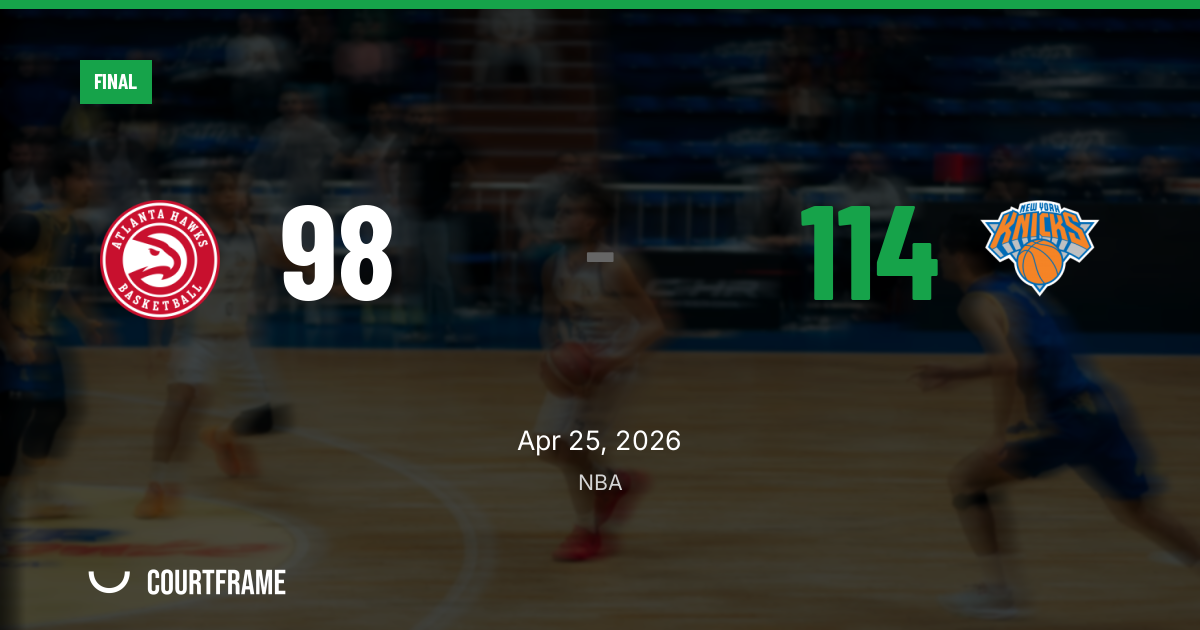
New York beat the Hawks 114-98 on April 25 at State Farm Arena, evening the first-round matchup at 2-2 and reclaiming momentum in a series that Atlanta had led entering the night. The Knicks were sharper from the opening quarter, built a 27-20 lead after one and never let the Hawks fully stabilize until the fourth quarter, when the game had already moved decisively in New York’s direction.
The result tracked with the pregame data. New York entered with the better record, the stronger recent form, a higher CPI, the better net rating over the last 10 games and a cleaner turnover profile. Those margins translated directly: the Knicks won the glass 43-38, had 23 assists to Atlanta’s 20, committed 14 turnovers to the Hawks’ 18 and created enough separation with perimeter shot-making to absorb Atlanta’s late push.
Knicks’ offensive profile carries over
New York’s recent offensive indicators pointed to a team operating at a high level: a 120.3 offensive rating, 72.9 true shooting percentage and 69.5 effective field-goal percentage over the last 10 games analyzed. In Game 4, the Knicks’ balance was the difference.
They posted quarter totals of 27, 31, 28 and 28, a model of playoff steadiness. There was no single dead stretch for Atlanta to attack. The second quarter was especially damaging, with New York putting up 31 points to take control of the game before halftime.
The Knicks also won the shot-quality math from deep. New York went 14-for-31 from 3-point range, while Atlanta finished 10-for-41. That gap shaped the game. The Hawks leaned heavily into volume from the arc, consistent with their recent three-point rate, but the efficiency never caught up. New York generated fewer attempts from 3 but extracted far more value from them.
Atlanta’s turnover problem becomes a playoff problem
Atlanta’s recent profile came with a clear warning sign: a turnover rate of 18.9 over the last 10 games analyzed. Against a Knicks team that entered with a better defensive rating and a lower turnover rate, that weakness was exposed.
The Hawks turned it over 18 times. New York had 9 steals, repeatedly disrupting Atlanta’s rhythm and preventing the Hawks from building the kind of flow that has defined their best offensive stretches this season. Atlanta entered with a strong assist rate and averaged 25.3 assists over the recent sample, but managed only 20 assists in Game 4.
That mattered because Atlanta needed execution to offset New York’s efficiency edge. Instead, possessions stalled, the 3-point volume became less threatening and the Hawks spent much of the night chasing a game the Knicks controlled structurally.
Rebounding edge reinforces Knicks’ control
The Knicks entered the matchup with a slight rebounding advantage in recent play, posting a 53.3 rebound percentage compared with Atlanta’s 50.2. Game 4 followed the same pattern.
New York finished with 43 rebounds to Atlanta’s 38. That edge was not overwhelming, but it fit the broader theme: the Knicks were better in the possession game. They gave themselves more stability, limited the damage from mistakes and kept Atlanta from turning the game into the higher-variance environment the Hawks needed.
Karl-Anthony Towns’ season profile gave New York a major interior reference point, while Josh Hart’s rebounding production from the perimeter remained part of the Knicks’ broader identity. Atlanta, playing without Jock Landale because of a right high ankle injury, had one fewer frontcourt option available in a matchup where physical balance mattered.
Market lean proves right as New York resets the series
The market leaned slightly toward New York before tip, with the Knicks carrying a 54.2 percent implied probability across 11 bookmakers. That view aligned with the broader matchup data: New York entered 53-29, had won four of its last five, held a 71.77 CPI and ranked 13th in CPI, compared with Atlanta’s 54.75 mark and No. 29 ranking.
Atlanta still had legitimate reasons for confidence. The Hawks were 16-5 at home with a 76.2 home win percentage and had averaged 117.8 points in that split. But Game 4 did not play to that home profile. The Hawks scored 20, 24 and 21 points in the first three quarters before a 33-point fourth, and by then New York’s earlier work had created too much cushion.
The series is now tied 2-2, and Game 4 shifted the tone. Atlanta still has the scoring talent to stretch New York’s defense, led by Jalen Johnson, Nickeil Alexander-Walker and C.J. McCollum. But the Knicks’ core advantages — efficiency, rebounding and cleaner possessions — showed up in the most important game-state moments.
New York did not just win a road playoff game. It restored the matchup to the terms that favored it before the series tightened.