

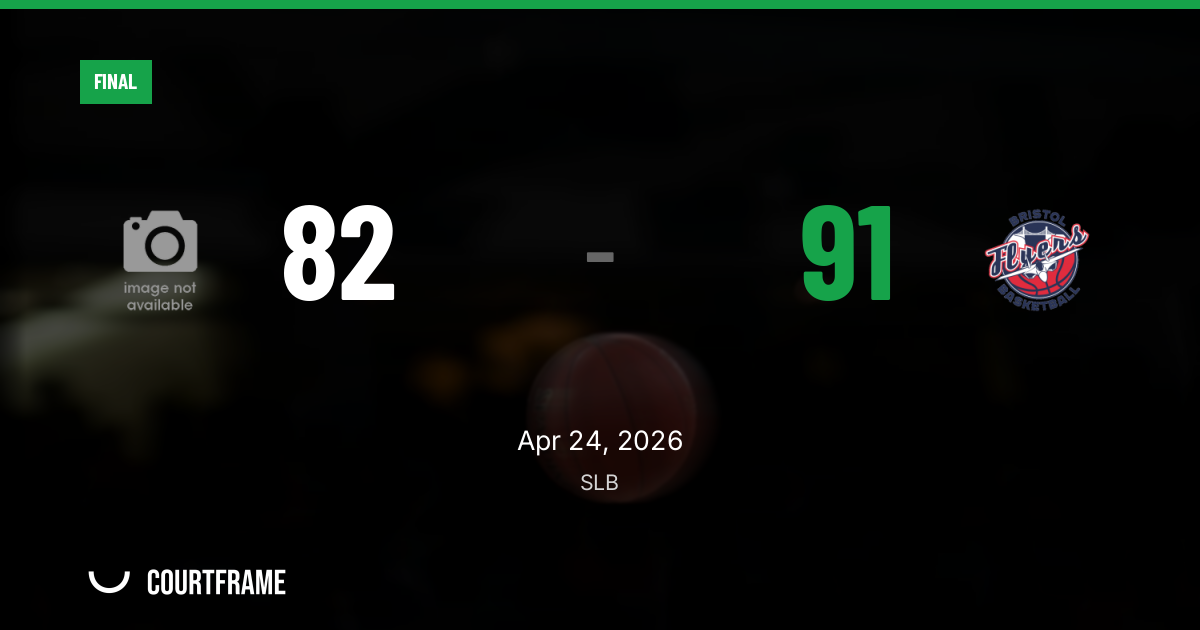
Bristol didn’t win this game in the opening 10 minutes. It won it in the next 20.
After spotting Caledonia a 24-16 first-quarter lead, the Flyers settled into their identity — pace-controlled, pass-heavy offense and a shot diet tilted toward the three — and rode it to a 91-82 win Thursday, April 24, 2026, at Playsport Arena.
Game flow: Caledonia’s early punch, Bristol’s sustained response
The Gladiators came out sharp, taking the first quarter 24-16. But Bristol immediately changed the texture of the game in the second, winning the period 27-18 to pull even at halftime. The decisive separation arrived in the third: Bristol’s 26-20 edge pushed the Flyers into control, and they protected it with a 22-20 fourth to close.
From the start of the second quarter onward, Bristol outscored Caledonia 75-58 — the kind of sustained, multi-possession control that showed up both in the shot profile and in the way the Flyers generated looks.
The numbers that decided it
1) Bristol’s passing advantage translated into cleaner offense
The Flyers finished with 27 assists, a notable edge over Caledonia’s 20. That gap reflected Bristol’s ability to consistently create advantage situations and turn them into catch-and-shoot opportunities, particularly from deep.
It also aligned with the broader pregame profile: both teams entered with extremely high assist rates over their last 10 games (Caledonia 93.1; Bristol 92.1), but Bristol’s execution — and the way it sustained that execution after the first quarter — was the separator.
2) Three-point volume and makes swung the math
Bristol hit 12 threes on 32 attempts, while Caledonia went 9-for-23. The Flyers’ willingness to live behind the arc matched the pregame indicators: both teams had heavy three-point rates in the last-10 sample (Caledonia 67.3; Bristol 66.5). In this one, Bristol simply got more of them up — and made enough to tilt the scoring margin.
3) Defensive activity: Flyers won the steals battle 10-5
Bristol’s pressure showed up in the steal count (10-5) and helped blunt Caledonia’s early rhythm. While the turnover totals were relatively close (Bristol 12, Caledonia 14), the Flyers’ ability to create live-ball disruptions helped fuel their second- and third-quarter momentum.
4) Rebounding and rim protection were neutral — so shot-making mattered more
The teams finished even on the glass, 29-29, and matched each other with three blocks apiece. With no clear edge in extra possessions or rim deterrence, the game leaned more heavily on execution: Bristol’s ball movement and perimeter shot creation won out over 40 minutes.
Pregame context: A road win that tracked the market — and the profile
On paper, Bristol entered with the better record (14-17 vs. Caledonia’s 7-25) and was a narrow market favorite (implied probability: Bristol 54.9%). The Flyers also carried the stronger CPI mark in the matchup (34.26 to 22.79), with a differential of -11.5 from Caledonia’s perspective.
And while both teams had five days of rest, Bristol had played just one game in the previous week (Caledonia had played two). Over a game that turned on sustained execution after the opening quarter, that steadier recent workload fit the way the Flyers looked once they found their offensive cadence.
Home/away splits: Bristol’s comfort traveling showed again
Caledonia’s home split entering the night (1-6, 14.3% win rate) left little margin for error once the Flyers stabilized. Bristol, meanwhile, had been solid away from home (4-3, 57.1% win rate). When the game tightened after the first quarter, Bristol played like the team more accustomed to winning on the road — controlling the middle quarters and avoiding the kind of extended scoring droughts that typically swing close games.
What it means
Bristol’s 91-82 win was a clean example of how it wants to win: share the ball, generate threes, and apply enough defensive pressure to keep the opponent from living comfortably in the half court. Caledonia’s fast start bought hope, but Bristol’s 53-38 combined edge in the second and third quarters decided the night.