

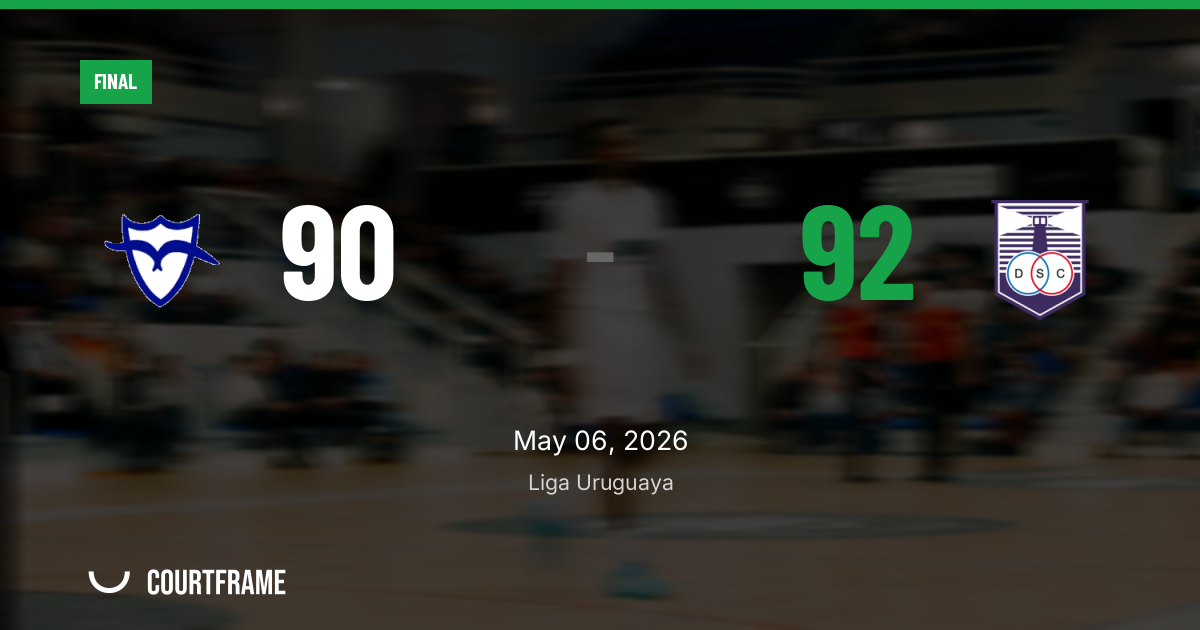
Defensor walked into Malvin with the market calling it close and left with control of the series.
In Game 2 of the Liga Uruguaya quarter-finals, Defensor edged Malvin 92-90 on May 6, pushing its best-of-seven lead to 2-0. The result matched the pre-game warning signs: Defensor entered with the stronger CourtFrame Performance Index profile, the better recent form and a more efficient statistical foundation. Malvin had the home court and a slight market edge, but Defensor had the cleaner process.
The game swung on that difference. Malvin won the opening quarter 30-22 and made another charge with 26 points in the fourth. Defensor did not dominate wire to wire. It absorbed runs, controlled the damage and won the middle of the game decisively enough to survive the finish.
Defensor’s middle-game response changed the night
Malvin’s first quarter looked like the version of this matchup that favored the home side: high energy, clean offense and enough pace to put Defensor under pressure. But the second quarter flipped the game. Defensor held Malvin to 11 points in the period while scoring 17, cutting into the early deficit and resetting the terms of the game.
That stretch mattered because it forced Malvin out of its early rhythm. After scoring 30 in the first quarter, Malvin managed only 25 total points across the second and third quarters. Defensor’s 17-11 second quarter and 21-14 third quarter gave the visitors the cushion they needed before a tense final period.
Malvin did win the fourth 26-21, but Defensor had already done enough. In a playoff game decided by one possession, the visitors’ ability to steady the game after a poor opening quarter was the defining separator.
Turnovers outweighed Malvin’s playmaking edge
Malvin finished with 21 assists to Defensor’s 16 and held a 33-28 rebounding edge, indicators that usually point toward a home win. But the turnover column told the more important story.
Defensor committed only 8 turnovers. Malvin had 14. That six-turnover gap was critical in a two-point game, especially against a Defensor team that entered with a lower turnover profile over the recent 10-game sample. The pre-game data showed Defensor at an average of 11.7 turnovers compared with Malvin’s 12.4, and that advantage became sharper under playoff pressure.
Malvin’s assist rate profile suggested the ball would move — and it did. But Defensor’s cleaner possessions gave it more stability in the moments when the game tightened. The visitors also generated 9 steals, another sign that Malvin’s creation came with risk.
Shot profile aligned with Defensor’s identity
Defensor came in as the more perimeter-heavy team, carrying an 82.3 three-point rate over the recent sample compared with Malvin’s 67.8. That identity showed up again in Game 2.
Defensor went 12-for-33 from three-point range, leaning into volume from deep. Malvin made 8-of-21. The four-made-three gap was one of the clearest statistical reasons Defensor survived despite Malvin’s advantages on the glass and in assists.
Malvin was efficient inside the arc, listed at 25-for-39 on field goals, and got to the line for 25 free-throw attempts. But Defensor’s perimeter output and lower turnover count helped offset Malvin’s broader production profile.
Pre-game indicators pointed to a Defensor threat
The market implied a narrow Malvin edge at home, with a 53 percent probability for the home side and 47 percent for Defensor across 9 bookmakers. The spread market reflected the same uncertainty, with tight numbers around one to three points.
But the underlying indicators were more favorable to Defensor. Defensor entered with a 56.08 CPI, ranked fifth, while Malvin carried a 38.44 CPI, ranked 10th. The differential was 17.6 points toward Defensor. Defensor also arrived in stronger form at WWWLW, compared with Malvin’s WLLWL.
The advanced profile reinforced that gap. Defensor’s recent 10-game offensive rating was 109.8, ahead of Malvin’s 103.2. Defensor also had the better net rating, at minus-2.7 compared with Malvin’s minus-13.2. Neither team entered with a dominant recent defensive profile, but Defensor’s offense had the stronger baseline.
No injury caveat, no fatigue excuse
Both teams entered without significant injuries reported. The rest profile was also even: each side had 3 days of rest and one game in the previous 7 days. This was not a game tilted by availability or schedule stress.
That makes the result more direct. Defensor’s strengths — shooting volume, offensive efficiency and ball security — traveled. Malvin’s strengths — home scoring, playmaking and rebounding — were present, but not enough to overcome the possessions it gave away.
Series pressure shifts hard to Malvin
Defensor now leads the quarter-final series 2-0. It is not an elimination spot yet for Malvin, but the shape of the series has changed. Defensor has won twice, including a road game in a matchup the market priced as nearly even.
For Malvin, the problem is not effort or shot creation. The Game 2 box showed enough offense to win: 90 points, 21 assists and a strong opening and closing quarter. The issue is sustaining control between those bursts. Against a Defensor team comfortable playing through the three-point line and limiting mistakes, empty possessions are becoming too expensive.
Game 2 did not look like a mismatch. It looked like a playoff game decided by details. Defensor handled more of them correctly — and now owns the series because of it.