

Chicago didn’t wait for the game to find a rhythm. It imposed one.
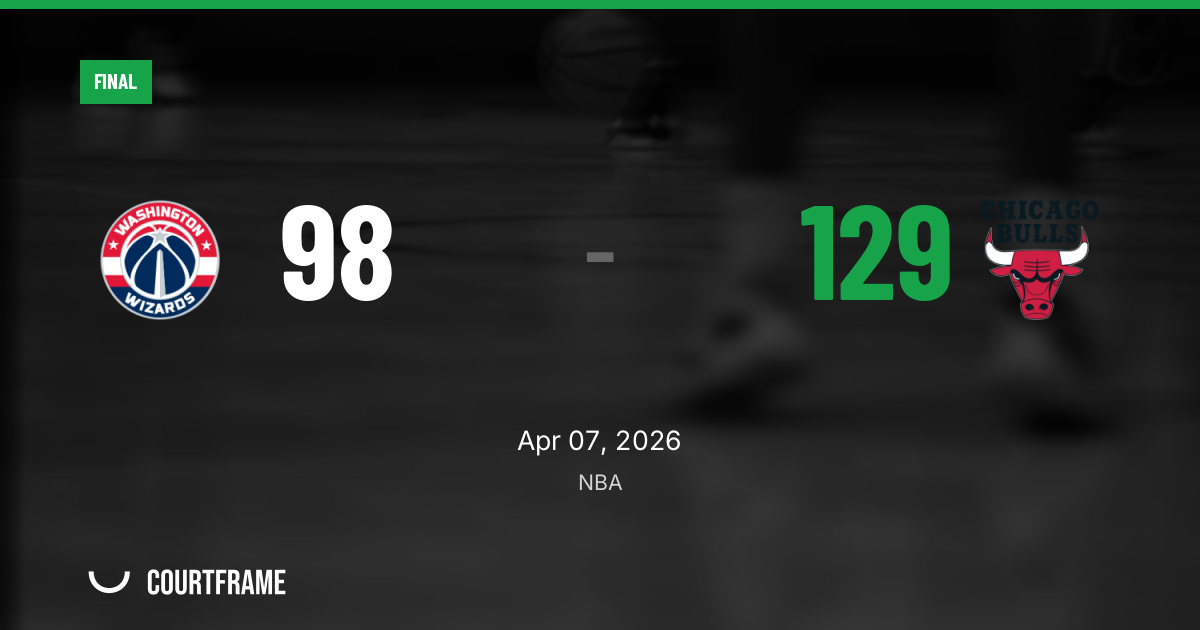
Behind a 38-point opening quarter and a steady avalanche of offense the rest of the way, the Bulls routed the Wizards 129-98 on April 7, 2026, at Capital One Arena. Both teams entered on five-game losing streaks — Chicago at 29-49, Washington at 17-61 — but only one of them played with structure. Chicago’s 35 assists told the story of a night where the ball consistently beat the defense.
How the game flipped early
The separation was immediate: Chicago 38, Washington 18 after one. The Wizards were forced to chase from the opening tip, and the Bulls kept stacking advantages with scoring bursts in every quarter: 28 points in the second, 34 in the third, 29 in the fourth.
Washington did stabilize late — a 35-point fourth quarter was its best stretch — but it came with the outcome long decided. Chicago’s lead was built on the front end, when the Bulls repeatedly generated clean looks and turned possessions into points without slowing down.
Ball movement wins the night
The cleanest differentiator on the stat sheet: assists. Chicago finished with 35 assists to Washington’s 22, a gap that mirrored the difference in offensive organization. The Bulls consistently created advantages through passing and pace, while the Wizards struggled to manufacture efficient offense early and often.
Quarter-by-quarter control
First quarter: the knockout setup
Chicago’s 38-point first quarter set the tone and forced Washington into a game script it couldn’t control. The Wizards’ 18 points left no margin for error for the remaining three quarters.
Second and third: no let-up
Even with the early cushion, Chicago kept pressing. A 28-point second quarter pushed the game further out of reach, then a 34-point third quarter erased any chance of a mid-game swing.
Fourth: Washington’s late push, Chicago’s finish
Washington finally found some offensive traction in the fourth (35 points), but Chicago matched with 29 of its own to close the door without drama.
What it means going forward
For Chicago, this was the template for how to win cleanly: play fast, share the ball, and keep the scoring pressure constant. For Washington, the early deficit underscored the season-long problem of starting games on the back foot — and how quickly the margin disappears when the opponent is generating offense through passing rather than isolation.